Understanding the intricate lifecycle of a star requires far more than static textbook images or simplified diagrams. A dynamic 3D Sun Simulator provides an interactive, highly accurate environment to study stellar evolution, orbital mechanics, and thermal radiation physics. This computational tool serves engineering professionals, educators, and space technology enthusiasts by visualizing the complex mathematical models governing our solar system. By translating raw astrophysical data into a functional three-dimensional space, the simulator allows users to observe how changes in solar mass, luminosity, and temperature directly impact the surrounding celestial bodies over billions of years.
Contents
The Core Physics of the Solar Engine
The Sun operates as a massive, self-regulating fusion reactor maintained by a state of hydrostatic equilibrium. This delicate balance prevents the star from collapsing under its own immense gravity. The core pressure is extraordinarily high, allowing hydrogen nuclei to overcome their natural electromagnetic repulsion and fuse into helium. This continuous process of nuclear fusion releases highly energetic photons, which then begin a slow, tortuous journey toward the surface. The energy generated in the core is the primary driver for all subsequent astrophysical phenomena observed in the simulator.

Surrounding the core is the radiative zone, where energy transport occurs exclusively via radiation. Photons travel through this extremely dense plasma, constantly colliding with particles, absorbing, and re-emitting energy. This random walk process means a single photon can take hundreds of thousands of years to traverse this layer. Above the radiative zone lies the convective zone. Here, the plasma is cooler and less dense, allowing thermal columns to carry hot material outward to the surface while cooler material sinks back down. This turbulent boiling motion creates the granular texture visible on the solar surface and drives the complex magnetic fields that spawn solar flares.
Mathematical Models of Stellar Energy
To accurately simulate stellar behavior, developers and astrophysicists rely on foundational thermodynamic and gravitational equations. The fundamental equation of state for an ideal gas within the stellar interior is vital for modeling pressure distribution. The pressure P is determined by the equation
P = ρ * k * T / μ * mH
In this formula, ρ represents the plasma density, k is the Boltzmann constant, T denotes the absolute temperature in Kelvin, μ stands for the mean molecular weight, and mH is the mass of a hydrogen atom. This relationship ensures that the simulated star maintains structural integrity across different stages of its life.
Luminosity is another critical parameter that dictates how much energy the star radiates into space. The Stefan-Boltzmann law calculates the total energy radiated per unit surface area of a black body. The total solar luminosity L is expressed as
L = 4 * π * R2 * σ * T4
Here, R is the stellar radius, σ represents the Stefan-Boltzmann constant, and T is the effective surface temperature. As the simulated star ages and expands, its radius increases significantly, altering its overall luminosity and the amount of heat delivered to the orbiting planets.
| Solar Layer | Average Temperature | Primary Function |
|---|---|---|
| Core | 15,000,000 K | Nuclear fusion and primary energy generation |
| Radiative Zone | 2,000,000 K to 7,000,000 K | Energy transport via photon radiation |
| Convective Zone | 5,800 K to 2,000,000 K | Energy transport via thermal convection currents |
| Photosphere | 5,800 K | Visible surface emitting visible light spectrum |
| Corona | 1,000,000 K to 3,000,000 K | Outer atmosphere heated by magnetic wave dynamics |
Orbital Mechanics and Planetary Kinematics
When engineering a functional solar system model, precision in orbital mechanics is absolutely paramount. The simulator utilizes rigorous mathematical frameworks originally established by Johannes Kepler and later refined by Isaac Newton. Planets do not travel in perfect circles but rather in elliptical orbits defined by precise orbital elements. The semi-major axis defines the size of the orbit, while eccentricity determines how elongated the ellipse is. To calculate the exact position of a celestial body at any given moment, the simulation engine continuously solves the Kepler equation.
The orbital period T of a planet — the time it takes to complete one full revolution around the star — is intrinsically linked to its distance from the star and the mass of the star itself. Kepler’s Third Law states that the square of the orbital period is proportional to the cube of the semi-major axis a. In a computational model, this is expressed using the standard gravitational parameter. The formula is
T2 = 4 * π2 * a3 / G * M
In this equation, G is the universal gravitational constant and M is the mass of the central star. If the user alters the mass of the simulated sun, the engine must dynamically recalculate the orbital velocities and trajectories of all planetary bodies to maintain physical accuracy.
Surface Temperature Calculations
☀ A primary feature of an advanced stellar simulator is the ability to track planetary climates in response to solar changes. The equilibrium temperature of a planet depends heavily on its distance from the heat source and its planetary albedo, which is the measure of reflectivity of the planetary surface. A high albedo means the planet reflects most of the incoming solar radiation, while a low albedo indicates high absorption.
The core formula used in the simulation to determine planetary surface temperature Teq without greenhouse gas effects is
Teq = Tsun * [ Rsun / 2D ]0.5 * [ 1 – A ]0.25
In this robust calculation, Tsun represents the surface temperature of the star, Rsun is the stellar radius, D represents the precise distance from the star to the planet, and A is the planetary albedo. By continuously processing this formula during the animation loop, the simulator accurately visually updates the planet’s status, freezing oceans if the orbit moves too far away or scorching the crust if the star expands into a red giant.
| Celestial Body | Mean Albedo Value | Estimated Base Temperature |
|---|---|---|
| Mercury | 0.119 | 167 degrees Celsius |
| Venus | 0.750 | 464 degrees Celsius |
| Earth | 0.306 | 15 degrees Celsius |
| Mars | 0.250 | -65 degrees Celsius |
| Jupiter | 0.538 | -110 degrees Celsius |
The Stellar Evolution Timeline
The life cycle of a main-sequence star like our Sun is a dramatic narrative written over billions of years. Currently, our star is in a stable phase, quietly fusing hydrogen into helium. However, this fuel supply is finite. The simulator allows users to fast-forward through deep time to observe the inevitable evolutionary shifts. As the core exhausts its hydrogen reserve, the nuclear reactions slow down, causing the outward radiation pressure to drop. Gravity briefly wins this cosmic tug-of-war, compressing the core and driving its temperature to extremes.
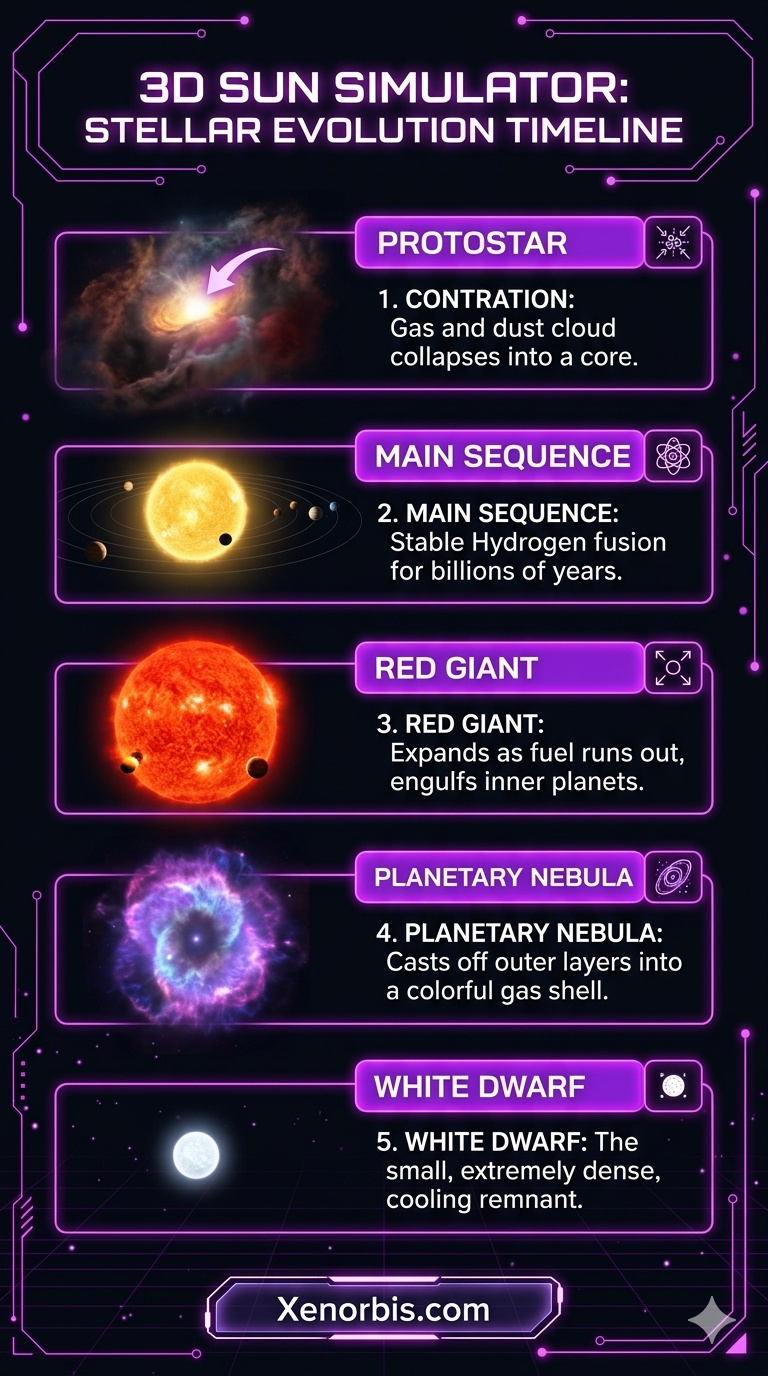
This intense core heating triggers hydrogen fusion in the shell surrounding the core, generating a massive surge in outward pressure. The star begins to expand violently, entering the Red Giant phase. During this catastrophic expansion, the stellar radius will increase by a factor of over two hundred, engulfing the inner planets including Mercury and Venus. The simulation visually demonstrates how the surface temperature of the star paradoxically cools down as it expands, shifting its emission spectrum from yellow-white to a deep, ominous red. The habitable zone is pushed completely out of the inner solar system, transforming previously frozen outer moons into potential temporary havens for liquid water.
Shifting Habitable Zones
The concept of the circumstellar habitable zone — often referred to as the Goldilocks zone — is central to astrobiology and planetary science. It defines the specific region around a star where atmospheric conditions might allow liquid water to pool on a planetary surface. The simulator dynamically calculates the inner and outer boundaries of this zone based on stellar luminosity. The inner boundary radius Rinner is calculated as
Rinner = [ L / Sinner ]0.5
Here, L is the current solar luminosity and Sinner is the critical solar flux that would trigger a runaway greenhouse effect.
🌟 As the star transitions into a Red Giant, the value of L increases exponentially. Consequently, the boundaries of the habitable zone sweep outward at a rapid geological pace. The 3D model accurately tracks this migration, allowing users to visually measure the exact epoch when Earth’s oceans will boil away. Following the Red Giant phase, the star will suffer severe thermal pulses, eventually ejecting its outer envelope into deep space to form a spectacular planetary nebula. The exposed core, no longer capable of fusion, collapses into a super-dense White Dwarf, glowing faintly entirely from residual thermal energy.
| Evolutionary Phase | Approximate Duration | Stellar Radius Scale |
|---|---|---|
| Protostar | 50 million years | Variable contraction |
| Main Sequence | 10 billion years | 1.0 Solar Radii |
| Red Giant Branch | 1 billion years | Up to 256 Solar Radii |
| Planetary Nebula | 10,000 years | Expanding gas shell |
| White Dwarf | Trillions of years | 0.01 Solar Radii |
Solar Wind and Space Weather Dynamics
☄ Beyond gravity and light, a star interacts with its planetary system through the continuous emission of charged particles known as the solar wind. This stream of electrons and protons flows outward at speeds exceeding four hundred kilometers per second. A truly comprehensive 3D simulator incorporates these particle dynamics, visualizing how the solar magnetic field twists into a complex Archimedean spiral due to the stellar rotation.
Planetary magnetospheres act as invisible shields against this harsh radiation. The strength of the interaction between the solar wind and a planet determines the rate of atmospheric stripping over deep time. During periods of high solar activity, magnetic reconnection events on the star surface lead to violent solar flares and massive expulsions of plasma. Modeling these phenomena requires tracking the magnetic flux density B across the simulated stellar surface and triggering emission vectors when local energy thresholds are exceeded. Understanding space weather is highly relevant for aerospace engineering, as these events directly impact satellite communications, power grid stability, and the safety of human spaceflight.
Recommended Literature
For professionals, engineers, and astronomy enthusiasts looking to deepen their understanding of stellar physics and the mathematical foundations powering simulation tools, the following technical textbooks are highly recommended. These volumes cover everything from basic orbital mechanics to advanced magnetohydrodynamics.
- Stellar Structure and Evolution by Rudolf Kippenhahn and Alfred Weigert — A fundamental text covering the thermodynamic principles and mathematical models of star formation and death.
- An Introduction to Modern Astrophysics by Bradley W. Carroll and Dale A. Ostlie — A comprehensive guide encompassing orbital mechanics, planetary science, and galactic dynamics.
- Physics of the Solar Corona by Markus J. Aschwanden — A highly specialized book focusing on the extreme thermal environment and magnetic complexities of the outer solar atmosphere.
- Fundamentals of Astrodynamics by Roger R. Bate, Donald D. Mueller, and Jerry E. White — The definitive engineering reference for calculating orbits, trajectories, and physical space maneuvers.
- Solar System Dynamics by Carl D. Murray and Stanley F. Dermott — An advanced textbook detailing the gravitational interactions and resonant frequencies that govern planetary movements.
- Radiative Processes in Astrophysics by George B. Rybicki and Alan P. Lightman — Essential reading for understanding how light interacts with matter, forming the basis for calculating stellar luminosity and planetary temperatures.

Julian D. Thorne — Celestial Mechanics Developer
Researcher and 3D engine developer focused on interactive stellar systems. Julian bridges the gap between theoretical physics and real-time browser-based cosmos exploration.
