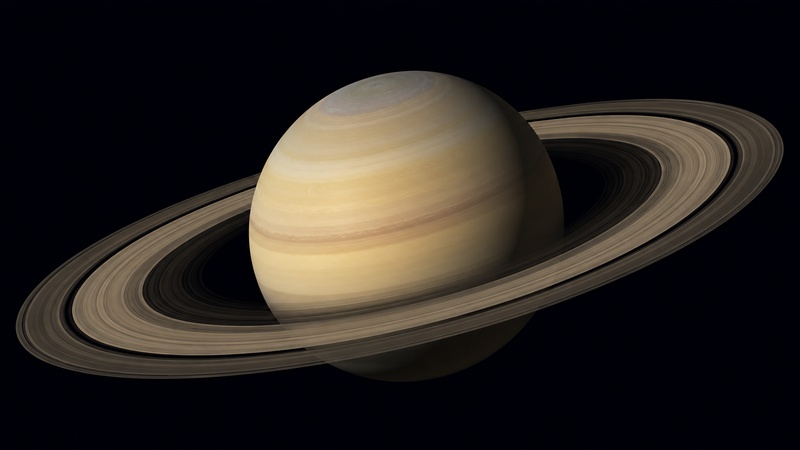
Saturn stands as the undeniable crown jewel of our solar system. The sheer visual spectacle of a massive gas giant encased in a sprawling disk of ice and rock has captivated astronomers for centuries. However static images and flat photographs can only convey a fraction of the actual astronomical majesty. An interactive 3D simulation brings the complex orbital mechanics and planetary physics directly to the user screen. By rendering the planet and its intricate ring system in real-time space visualization tools allow observers to manipulate the viewing angle and orbital speed to witness the dynamic celestial ballet exactly as it unfolds in the dark void of space.
Understanding the architecture of the sixth planet from the Sun requires moving beyond basic observation into the realm of astrodynamics and gravitational physics. The rings are not solid structures but rather a chaotic swarm of billions of individual particles ranging in size from microscopic dust grains to massive boulders the size of mountains. Each of these particles acts as an independent moon orbiting the central gas giant governed strictly by the laws of motion established by Johannes Kepler and Isaac Newton. A precise 3D rendering engine calculates these orbital paths using continuous mathematical updates to present a smooth and physically accurate representation of the solar system.
Contents
The Core Physics and Atmospheric Dynamics of the Gas Giant
Beneath the spectacular ring system lies a colossal sphere composed primarily of hydrogen and helium. Saturn is unique among the planets due to its extraordinarily low density. It is the only planet in our neighborhood with an average density lower than that of liquid water. If an inconceivably large ocean existed the entire planet would float upon its surface. This low density combined with an extremely rapid rotation period creates a pronounced oblate shape. The planet bulges significantly at the equator and flattens at the poles a physical characteristic clearly visible in high-quality 3D simulations.
🪐 The atmosphere is a turbulent chaotic environment driven by immense internal heat and powerful jet streams. Unlike Jupiter which displays highly contrasting bands of color Saturn features a more muted pale yellow hue due to ammonia crystals in its upper atmosphere. Below this hazy cloud top layer lie swirling storms and vortexes including the famous polar hexagon a persistent cloud pattern driven by complex fluid dynamics. Simulating these features requires applying specialized shader techniques to map high-resolution planetary textures onto spherical geometry ensuring the lighting and shadows react correctly to the position of the virtual sun.
Gravity acts as the ultimate architect of the entire system. The mass of the planet generates an immense gravitational well that holds the rings in place and dictates the movement of over one hundred recognized natural satellites. The interaction between the equatorial bulge and the orbiting debris introduces precession into the system causing the orbital nodes of the particles to drift slowly over time. This continuous shifting creates the dense intricate structures visible within the main ring divisions.
| Physical Parameter | Measurement Value | Astronomical Significance |
|---|---|---|
| Equatorial Radius | 60,268 kilometers | Determines the massive scale and the gravitational reach across the orbital plane. |
| Mass | 5.683 × 1026 kilograms | Roughly 95 times the mass of Earth dictating the escape velocity and orbital speeds. |
| Average Density | 0.687 grams per cubic centimeter | The lowest in the solar system resulting in a highly oblate planetary sphere. |
| Rotational Period | 10.6 hours | Drives extreme equatorial bulging and influences atmospheric jet stream velocity. |
| Surface Gravity | 10.44 meters per second squared | Surprisingly close to Earth gravity despite the massive size due to the low density. |
| Axial Tilt | 26.73 degrees | Causes extreme seasonal changes and varying ring visibility from the Earth perspective. |
| Escape Velocity | 35.5 kilometers per second | The sheer speed required for any spacecraft or debris to leave the gravitational well. |
Orbital Mechanics and Astrodynamic Mathematics
The foundation of any realistic space simulation rests upon rigorous mathematical calculations. To accurately position the planet and animate the surrounding debris programmers rely on classical mechanics. The velocity of any object within the ring system depends entirely on its distance from the center of mass. This relationship is defined by the standard orbital velocity equation. Particles closer to the atmosphere travel significantly faster than those residing in the outer edges creating a differential rotation that prevents the rings from acting as a single solid disk.
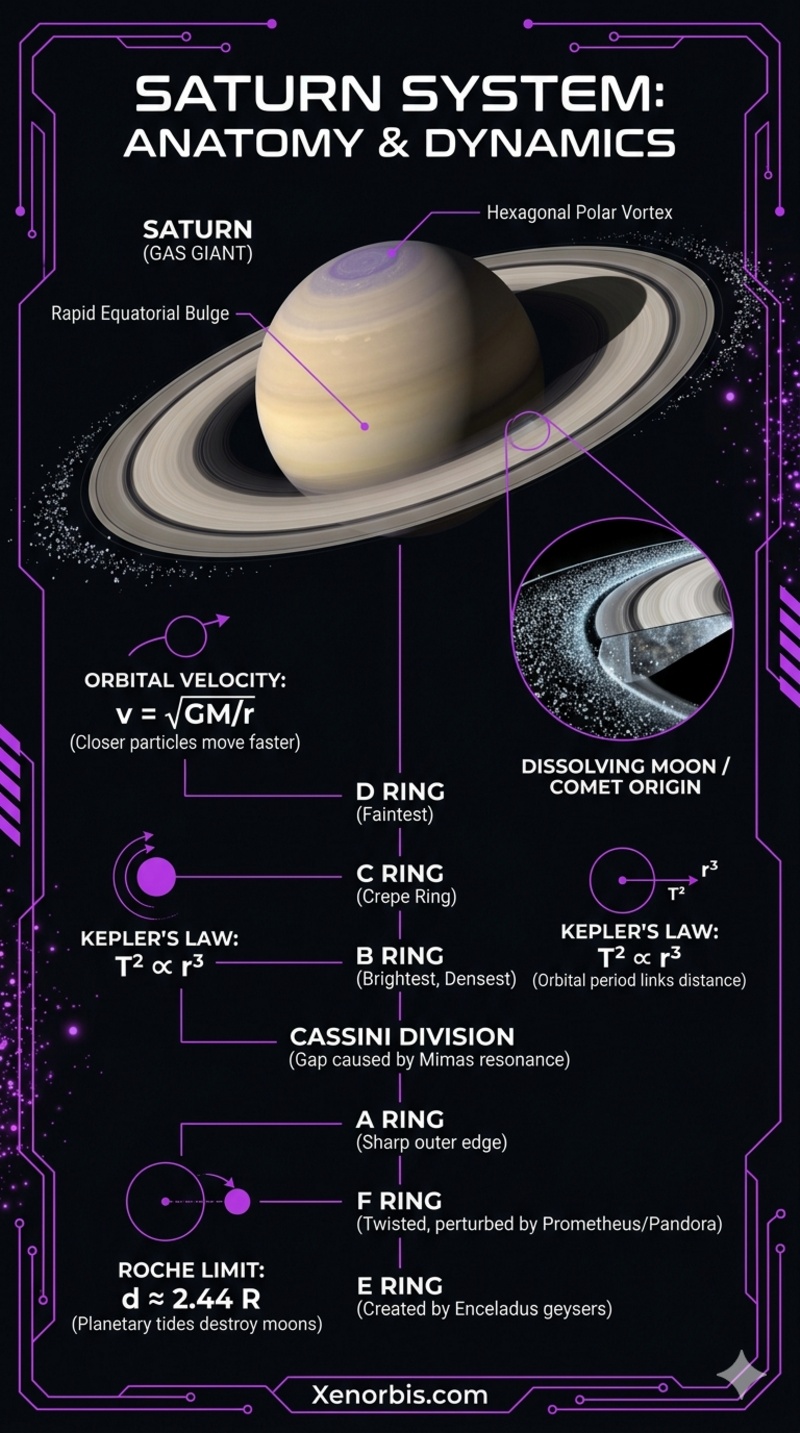
The fundamental equation for orbital velocity is expressed as:
v = √[ G × M / r ]
In this expression v represents the orbital velocity. The constant G is the universal gravitational constant. The variable M denotes the mass of the central body which in this case is Saturn. The parameter r is the radial distance from the center of the planet to the orbiting particle. As the radius increases the velocity decreases proportionally to the square root of the distance.
To determine how long it takes a single block of ice to complete one full orbit astronomers use the orbital period formula derived from Keplers Third Law of Planetary Motion. This calculation is vital for simulations that offer time-acceleration features allowing users to watch years of orbital movement in mere seconds.
The orbital period is calculated using:
T = 2 × π × √[ r3 / ( G × M ) ]
Here T is the total time required to complete one revolution. This mathematical relationship explains why the inner particles streak around the planet in just a few hours while the outermost material takes significantly longer. When millions of these calculations run simultaneously across a graphics processing unit the result is a mesmerizing fluid-like motion that accurately mimics the real physics of the solar system.
Gravitational force governs the attraction between the planet and its moons. Newton law of universal gravitation provides the exact force pulling two masses together. This force is essential when calculating orbital perturbations and the effects of shepherd moons on the ring boundaries.
Fg = G × m1 × m2 / d2
Fg defines the gravitational force vector. The masses of the two interacting bodies are m1 and m2. The distance between their centers is squared in the denominator showing that gravitational influence weakens rapidly over distance following an inverse-square law.
Decoding the Architecture of the Ring System
The rings are not a continuous sheet of material. They are divided into distinct sections separated by massive gaps and narrow slits. These structures are named alphabetically in the order of their discovery rather than their distance from the planet. The main visible rings from the inner edge to the outer edge are the C Ring the B Ring and the A Ring. The faint D Ring sits incredibly close to the atmosphere while the F G and E rings spread far out into the void.
The most prominent feature dividing this structure is the Cassini Division. This massive dark gap measures nearly 4,800 kilometers wide. For centuries astronomers believed it was completely empty space. Modern space probes revealed it actually contains sparse faint material. The primary cause of this massive clearing is a strong orbital resonance with the moon Mimas. Any particle attempting to orbit within the Cassini Division receives a periodic gravitational tug from Mimas pulling it out of that specific orbit and clearing the zone entirely.
Smaller gaps such as the Encke Gap are maintained by tiny shepherd moons. The moon Pan orbits directly inside the Encke Gap acting like a cosmic snowplow. Its gravity sweeps the area clean and creates intricate wave-like disturbances along the edges of the ring material. A high-quality interactive visualizer must account for these distinct boundaries and gaps to provide an authentic representation of the planetary environment.
| Ring Designation | Radial Distance from Center | Composition and Characteristics |
|---|---|---|
| D Ring | 66,900 to 74,510 km | Extremely faint innermost ring structured with subtle wave patterns. |
| C Ring | 74,658 to 92,000 km | Known as the Crepe Ring highly transparent and primarily composed of darker material. |
| B Ring | 92,000 to 117,580 km | The brightest most massive and densest section containing highly reflective water ice. |
| Cassini Division | 117,580 to 122,170 km | A massive dark gap cleared by a 2:1 orbital resonance with the moon Mimas. |
| A Ring | 122,170 to 136,775 km | Features a sharp outer edge maintained by the shepherd moons Prometheus and Pandora. |
| F Ring | 140,180 km | A narrow highly active and twisted structure constantly perturbed by passing satellites. |
| E Ring | 180,000 to 480,000 km | A diffuse massive outer disk created by icy geysers erupting from the moon Enceladus. |
The Roche Limit and Celestial Destruction
A frequent question regarding the ring system involves its ultimate origin. The prevailing scientific consensus points toward the destruction of a massive icy moon or a wandering comet. This destruction occurs due to a specific gravitational boundary known as the Roche limit. When a celestial body held together merely by its own gravity approaches too close to a massive planet tidal forces begin to tear it apart.
🌕 The gravitational pull on the near side of the approaching moon is significantly stronger than the pull on the far side. This differential force stretches the object. Once the moon crosses the Roche limit this tidal stretching exceeds the internal gravitational cohesion of the moon. The object shatters into millions of fragments which then spread out along the orbital path eventually flattening into the sprawling disk we observe today.
The mathematical definition of the rigid body Roche limit is:
d = 2.44 × R × [ ρplanet / ρmoon ]1/3
In this equation d represents the critical distance. R is the radius of the primary planet. The variables ρplanet and ρmoon represent the densities of the planet and the approaching satellite respectively. Because the primary material orbiting Saturn is water ice which has a lower density than rock the limit extends further out making the system highly effective at capturing and shredding icy bodies.
Rendering the Cosmos: 3D Visualization Techniques
Translating these immense astronomical concepts into a functional interactive tool requires advanced web technologies and complex rendering engines. A robust simulation utilizes WebGL to tap directly into the graphics processing unit of the user device. Instead of drawing individual static pixels the engine constructs a mathematically precise 3D space using vertex and fragment shaders.
| Simulation Variable | Engine Functionality | Visual and User Experience Effect |
|---|---|---|
| Camera Zoom Distance | Modifies the field of view and clipping planes. | Transitions smoothly from macro planetary views to micro particle analysis. |
| Time Step Multiplier | Scales the delta-time variable in the physics loop. | Allows observation of slow orbital precession by fast-forwarding time. |
| Directional Light Angle | Updates the primary shadow casting vector. | Simulates seasonal changes and shifts the massive planetary shadow across the debris. |
| Particle Density Threshold | Adjusts the number of rendered instanced meshes. | Optimizes performance for lower-end devices without losing structural integrity. |
| Texture Anisotropy | Improves filtering of textures viewed at steep angles. | Keeps the ring textures sharp and clear when looking perfectly flat across the orbital plane. |
Spacecraft Trajectory and Real-World Orbital Math
The identical math driving the interactive visualizer is utilized by aerospace engineers to navigate actual spacecraft. When the Cassini probe arrived at the system it relied on precise calculations to thread the needle through the outer ring divisions. A minor miscalculation in velocity or orbital period would have resulted in a catastrophic collision with debris. Engineers rely heavily on delta-v calculations to alter spacecraft trajectories. Delta-v represents the change in velocity required to perform a maneuver. Firing thrusters expels mass and alters the orbital parameters.
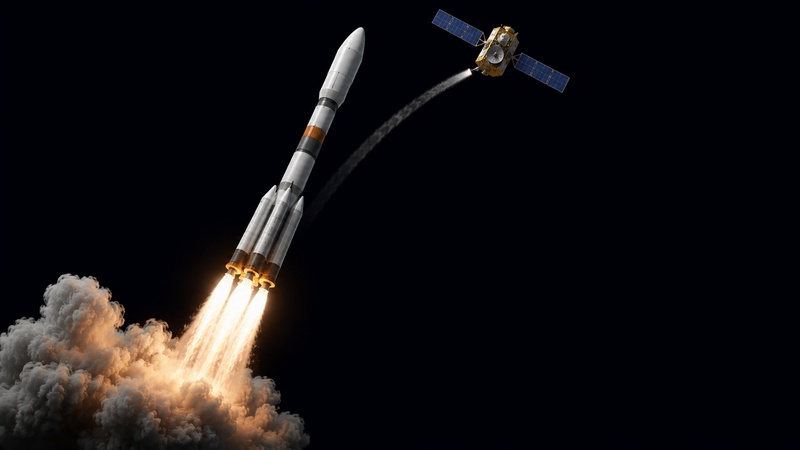
The Tsiolkovsky rocket equation governs these maneuvers:
Δv = ve × ln[ m0 / mf ]
In this critical formula Δv is the change in velocity. The effective exhaust velocity of the propellant is ve. The natural logarithm of the ratio between the initial total mass m0 and the final empty mass mf determines the maximum possible maneuverability of the probe. Surviving the chaotic environment of the gas giant required constant adjustments calculated using this exact relationship.
🚀 Gravitational assists or slingshot maneuvers allow probes to steal a tiny fraction of orbital momentum from celestial bodies. By flying incredibly close to large moons like Titan the spacecraft can accelerate without expending limited chemical fuel. The vector mathematics required for these maneuvers involve plotting hyperbolic trajectories that precisely intercept the moving target within a microscopic window of time.
Conclusion on Interactive Celestial Study
Transforming complex astronomical data into an accessible digital format revolutionizes how enthusiasts and students interact with the cosmos. A highly detailed 3D program does not just display a picture it provides a functional sandbox governed by the strict laws of physics. By manipulating the environment altering the lighting and studying the orbital paths users gain a deep intuitive understanding of how massive gravitational systems operate. The intricate balance of forces that maintains the beautiful but violent ring structures becomes starkly apparent when viewed through the lens of a real-time rendering engine.
Recommended Literature on Astronomy and Astrodynamics
- The Saturn System Through The Eyes Of Cassini — Produced by NASA. A comprehensive visual and technical breakdown of the most successful mission to the outer solar system detailing the exact structure of the rings.
- Orbital Mechanics for Engineering Students — Howard D. Curtis. An essential textbook for understanding the raw mathematics and physics behind orbital velocity trajectories and celestial navigation.
- Fundamentals of Astrodynamics — Roger R. Bate Donald D. Mueller and Jerry E. White. The definitive guide on spacecraft trajectory calculations and the application of Keplers laws in real-world scenarios.
- Physics of the Solar System — B. Bertotti P. Farinella and D. Vokrouhlicky. A deep dive into the gravitational mechanics tidal forces and planetary formations that shape gas giants.
- Saturn from Cassini-Huygens — Michele Dougherty Larry Esposito and Stamatios Krimigis. An exhaustive scientific volume detailing the atmospheric composition magnetosphere and ring dynamics compiled from decades of probe data.
- Planetary Sciences — Imke de Pater and Jack J. Lissauer. A highly detailed academic resource covering the internal structures atmospheric chemistry and evolutionary history of planetary bodies.

Julian D. Thorne — Celestial Mechanics Developer
Researcher and 3D engine developer focused on interactive stellar systems. Julian bridges the gap between theoretical physics and real-time browser-based cosmos exploration.

