
The universe presents a canvas of unimaginable scale painted with the light of countless celestial engines. When you look up at the night sky, you are not merely seeing static points of illumination. You are witnessing a dynamic, violent, and beautifully complex cosmic ecosystem. This environment operates as a vast sanctuary where luminous bodies of all shapes, temperatures, and lifespans exist in a delicate balance. Every single star represents an ongoing war between crushing gravitational forces and explosive thermal pressure. To truly understand the cosmos is to look beyond the surface and examine the complete life cycles of these massive nuclear furnaces. They are born in freezing clouds of interstellar dust, live for millions or even trillions of years while burning primordial fuel, and eventually die in spectacular cosmic events that seed the universe with the heavy elements necessary for planetary formation and biological life.
Our journey through this interactive encyclopedia will take you step by step through the mechanisms that govern these brilliant spheres. From the murky and chaotic origins within dark nebulae to the bizarre and mind-bending physics of their final remnants, the lifecycle of a star is a masterclass in extreme physics. The rules of nature are stretched to their absolute limits inside these objects. Whether we are discussing a tiny crimson dwarf slowly burning its reserves over eons or a gargantuan blue giant racing toward self-destruction, each classification offers unique insights into the mechanics of the universe.
Contents
The Primordial Cradle: Giant Molecular Clouds
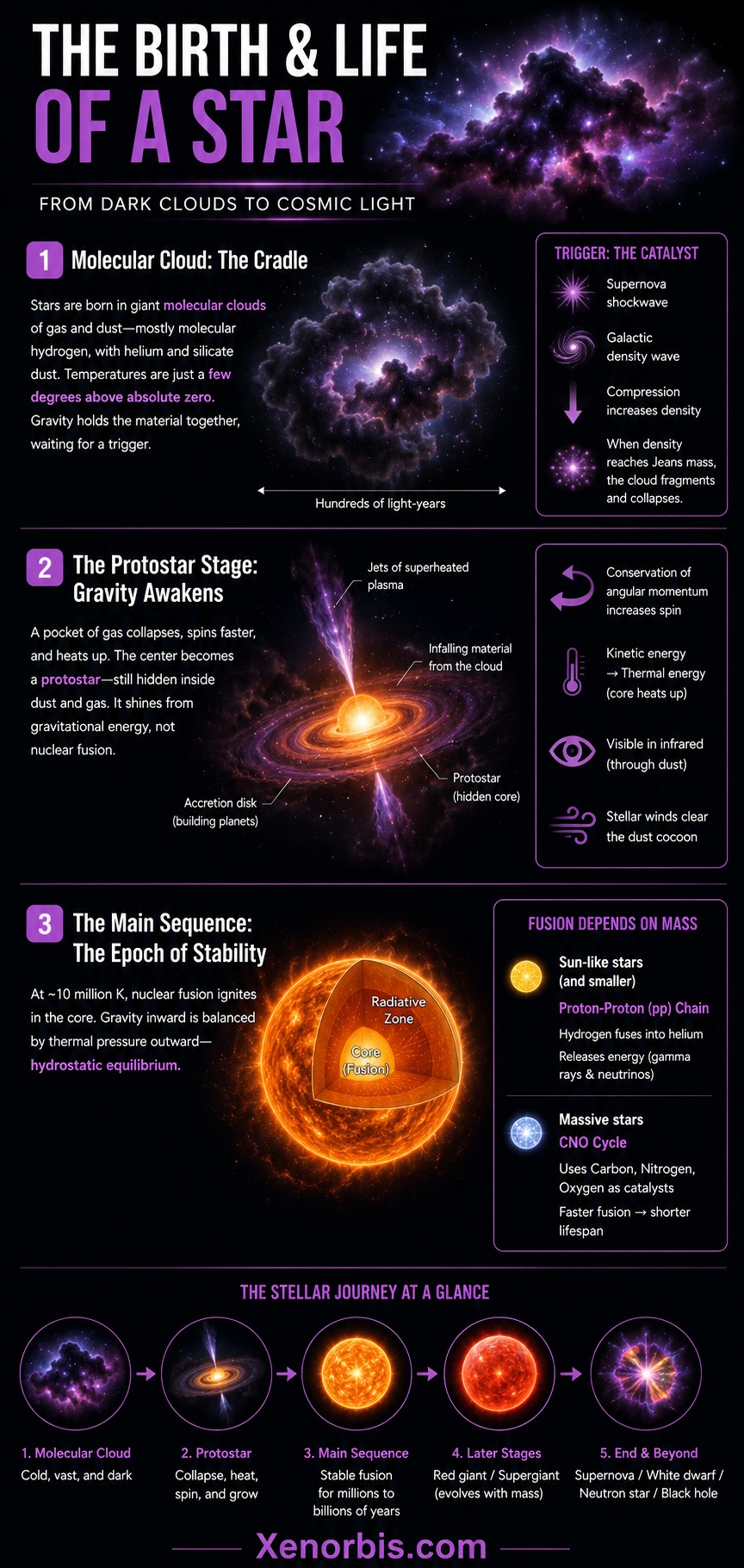
Every luminous body in the universe begins its journey within the freezing depths of a giant molecular cloud. These colossal structures of interstellar medium span hundreds of light-years across and contain the mass of millions of suns. The dominant ingredient in these sprawling nurseries is molecular hydrogen, accompanied by traces of helium and complex silicate dust grains. The temperatures inside these dark nebulae plunge to just a few degrees above absolute zero. This extreme cold is a critical requirement for stellar birth. Without thermal energy pushing outward, the gas becomes highly susceptible to the inward pull of its own gravity.
However, a molecular cloud can sit in a state of quiet equilibrium for millions of years. It usually requires an external catalyst to trigger the collapse. This catalyst often arrives in the form of a dramatic shockwave. The violent supernova explosion of a nearby dying star or the sweeping gravitational influence of a galactic density wave can compress the gas. Once the density in a specific pocket of the cloud reaches a critical threshold—known mathematically as the Jeans mass—the gravitational pull becomes entirely overwhelming. The cloud fragments into smaller cores, and the relentless process of gravitational collapse begins in earnest.
The Protostar Stage: Gravity Awakens
As the fragmented pocket of gas falls inward, it begins to spin faster due to the conservation of angular momentum. The immense kinetic energy of the collapsing material is rapidly converted into thermal energy, causing the core to heat up dramatically. This dense, glowing center is known as a protostar. At this stage, the object is completely hidden from visual observation, shrouded deep within a thick envelope of surrounding dust and gas. Astronomers must rely on infrared telescopes to pierce this dusty veil and witness the birth process.
The protostar does not yet produce energy through nuclear fusion. Instead, its intense luminosity is entirely the result of gravitational contraction. The core temperature steadily climbs toward the millions of degrees required to ignite atomic fuel. Meanwhile, the spinning material surrounding the young stellar object flattens into a wide accretion disk. This swirling disk of silicates and ice acts as the foundational building block for future planetary systems. Powerful magnetic fields generated by the rotating protostar often channel infalling material outward, blasting tremendous jets of superheated plasma into deep space. This turbulent phase, characterized by violent stellar winds, eventually blows away the remaining dust cocoon, revealing the newborn entity to the galaxy.
The Main Sequence: The Epoch of Stability
The defining moment in a stellar life cycle occurs when the core temperature reaches roughly ten million Kelvin. At this extreme heat, protons overcome their mutual electromagnetic repulsion and slam together. Nuclear fusion ignites. The star steps onto the main sequence, entering the longest and most stable epoch of its existence. During this phase, the inward crushing force of gravity is perfectly counterbalanced by the outward thermal pressure generated by nuclear reactions. This state of harmony is known as hydrostatic equilibrium.
The exact mechanism of fusion depends entirely on the initial mass of the star. For stars similar to our Sun or smaller, the dominant process is the proton-proton chain. In this reaction, hydrogen nuclei fuse directly to form helium, releasing vast amounts of energy in the form of gamma rays and neutrinos. For stars significantly heavier than the Sun, extreme core temperatures allow for a more complex reaction known as the CNO cycle. This process utilizes carbon, nitrogen, and oxygen atoms as catalysts to facilitate hydrogen fusion at a much faster rate. Because massive stars burn their fuel exponentially faster, their time on the main sequence is drastically shorter than that of their smaller counterparts.
Stellar Classifications on the Main Sequence
Astronomers categorize main sequence stars using a spectral classification system based on surface temperature and specific absorption lines in their emitted light. This system ranks stars from the hottest and most massive to the coolest and smallest.
| Spectral Class | Approximate Temperature Range | Primary Characteristics and Visual Color |
|---|---|---|
| O-Type | ≥ 30,000 K | Intensely hot blue giants. Extremely rare, highly luminous, with very short lifespans ending in supernovae. |
| B-Type | 10,000 K — 30,000 K | Deep blue-white stars. Very energetic and massive, burning through hydrogen reserves in mere millions of years. |
| A-Type | 7,500 K — 10,000 K | Brilliant white stars with strong hydrogen absorption lines. Frequently feature dusty debris disks. |
| F-Type | 6,000 K — 7,500 K | Yellow-white stars. Slightly more massive and hotter than our Sun, offering wide habitable zones for planets. |
| G-Type | 5,200 K — 6,000 K | Yellow dwarfs like our Sun. Highly stable with lifespans stretching approximately ten billion years. |
| K-Type | 3,700 K — 5,200 K | Orange dwarfs. Excellent candidates for hosting exoplanetary life due to their calm behavior and long lifespans. |
| M-Type | 2,400 K — 3,700 K | Red dwarfs. The most common type in the galaxy. Extremely cool, faint, and capable of burning for trillions of years. |
Leaving the Sequence: The Red Giant Phase
Nothing lasts forever in the cosmic theater. After billions of years of steadfast fusion, a star eventually exhausts the hydrogen fuel in its core. With the outward thermal pressure suddenly removed, hydrostatic equilibrium breaks down, and gravity swiftly reasserts its dominance. The core begins to collapse inward under its own immense weight. As the core shrinks, its temperature skyrockets. This intense heat ignites a fresh shell of hydrogen just outside the depleted core, pushing the outer layers of the star outward.
🌟 The star bloats to monstrous proportions, swelling to hundreds of times its original size. As the outer envelope expands, it cools down, shifting the stellar color to a deep, ominous crimson. The star has officially become a red giant. Deep within, the core continues to compress until it reaches an astonishing one hundred million Kelvin. At this precise moment, a violent event known as the helium flash occurs. Helium atoms begin fusing into carbon and oxygen via the triple-alpha process. The star gains a brief, turbulent lease on life, burning this heavier fuel for a few million years before ultimately exhausting its options.
White Dwarfs: The Fading Cores of Average Stars
For average stars like our Sun, the red giant phase marks the beginning of the end. Their cores never accumulate enough mass to generate the extreme temperatures required to fuse carbon or oxygen. The outer envelope of the dying giant becomes unstable, pulsating violently until it is entirely blown away into deep space. This ejected material forms a gorgeous, glowing shell of ionized gas known as a planetary nebula, leaving behind only the blazing hot, naked core.
☀ This exposed core is a white dwarf. It is an object of profound strangeness. A typical white dwarf contains the mass of an entire sun crushed into a sphere no larger than the planet Earth. The gravitational pull on its surface is hundreds of thousands of times stronger than Earth gravity. Conventional matter cannot exist under such conditions. Instead, the white dwarf is supported entirely by a quantum mechanical phenomenon called electron degeneracy pressure. Because two electrons cannot occupy the same quantum state simultaneously, their resistance to further compression halts the collapse. Devoid of any active nuclear fusion, a white dwarf will spend the next several trillion years slowly radiating its residual heat into the frozen void, eventually becoming a cold, invisible black dwarf.
Lifespans and Ultimate Destinies
The initial mass of a collapsing gas cloud dictates the entire evolutionary path of the resulting stellar body. Mass is destiny.
| Initial Stellar Mass Category | Main Sequence Duration | Ultimate Stellar Remnant |
|---|---|---|
| Low Mass — Red Dwarfs | Trillions of years | Directly contract into helium White Dwarfs without expanding into giants. |
| Intermediate Mass — Yellow Dwarfs | Billions of years | Carbon-Oxygen White Dwarfs surrounded by planetary nebulae. |
| High Mass — Blue Giants | Millions of years | Core-collapse Supernova resulting in a Neutron Star or Black Hole. |
Supernovae and the Birth of Heavy Elements
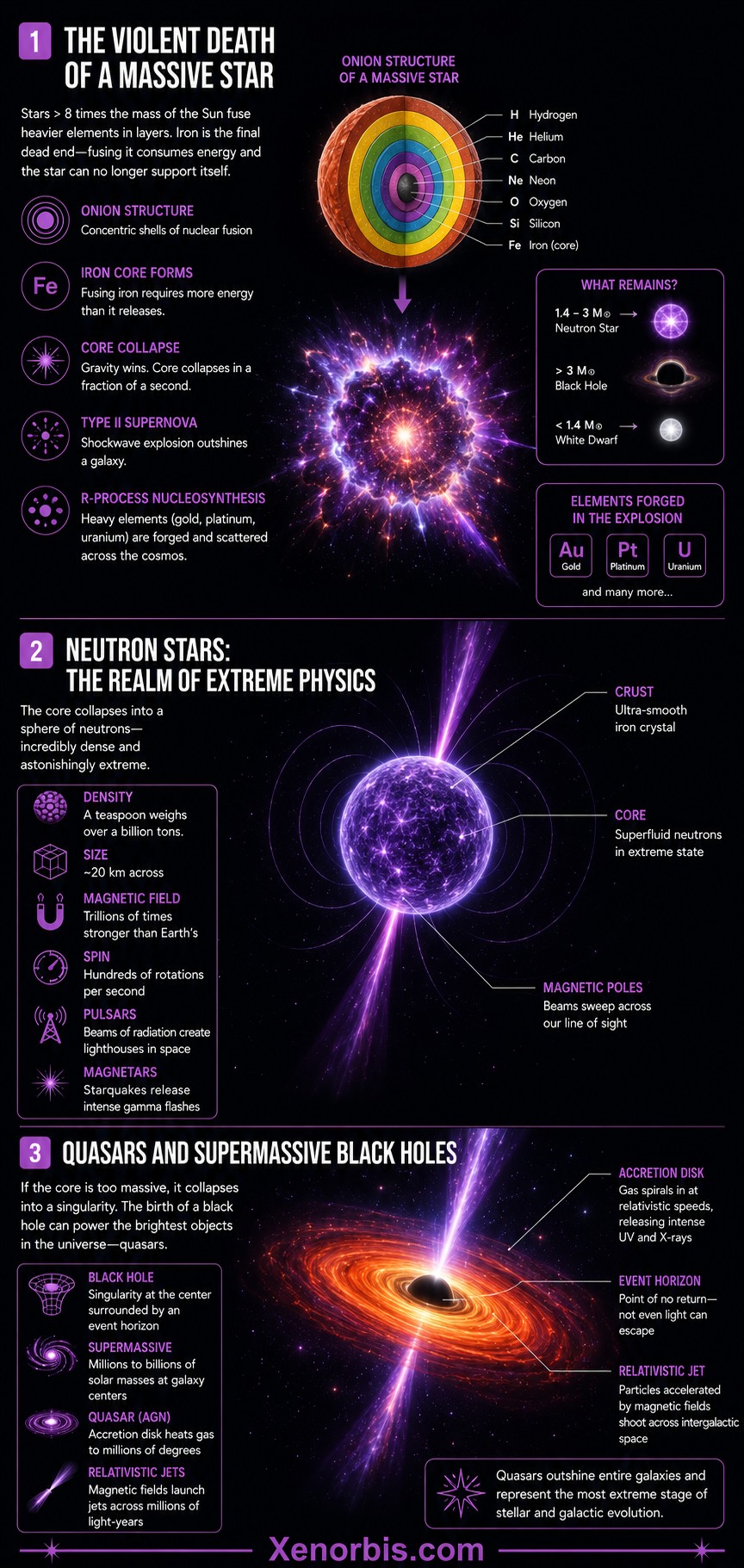
While average stars end their lives with a gentle exhalation, massive stars exit the universe with unparalleled violence. For stars boasting more than eight times the mass of the Sun, the core temperature grows hot enough to fuse progressively heavier elements. Carbon fuses into neon, neon into oxygen, oxygen into silicon, and finally, silicon into iron. The star begins to resemble an onion, characterized by distinct concentric shells of nuclear fusion. However, iron is the ultimate cosmic dead end. Fusing iron requires more energy than it releases, bringing the outward pressure to an immediate and catastrophic halt.
In a fraction of a second, gravity wins the ultimate victory. The core collapses inward at a substantial fraction of the speed of light. The compression is so profound that electrons are smashed directly into protons, transforming the entire core into a massive ball of neutrons. The infalling outer layers of the star hit this ultra-dense neutron core and rebound outward in an explosive shockwave of incomprehensible power. This is a Type II supernova. The explosion shines brighter than an entire galaxy, unleashing a flood of free neutrons that rapidly capture onto existing nuclei. This rapid sequence—the r-process—is responsible for forging the heaviest elements in the periodic table, including gold, platinum, and uranium, scattering them across the cosmos to seed future worlds.
Neutron Stars: The Realm of Extreme Physics
When the smoke of a supernova clears, what remains is an object that defies common intuition. If the collapsed core possesses a mass between 1.4 and 3 times that of our Sun, it forms a neutron star. This object packs the mass of an entire solar system into a sphere roughly twenty kilometers across. The density is so extreme that a single teaspoon of neutron star material would weigh over a billion tons on Earth. The crust consists of ultra-smooth iron crystal, while the deep interior is hypothesized to contain a frictionless superfluid of neutrons.
Neutron stars exhibit wild observational behaviors. Due to the conservation of angular momentum from the original massive star, they spin at dizzying speeds—sometimes hundreds of times per second. Their collapsed magnetic fields become trillions of times stronger than Earth magnetic field. These spinning magnetic dynamos channel beams of intense electromagnetic radiation out of their magnetic poles. If these beams sweep across our line of sight, we observe them as regular, rhythmic pulses of radio waves. We call these cosmic lighthouses pulsars. Certain neutron stars with extraordinarily powerful magnetic fields are classified as magnetars, capable of triggering crustal starquakes that release blinding flashes of gamma radiation.
Quasars and Supermassive Black Holes
If the collapsing core of a dying star exceeds the Tolman-Oppenheimer-Volkoff limit, not even the quantum resistance of neutrons can halt the crush of gravity. The core collapses into a singularity—a point of infinite density and zero volume. A black hole is born. The boundary surrounding this singularity, where the escape velocity exceeds the speed of light, is known as the event horizon. While stellar-mass black holes wander the galaxy quietly, their supermassive cousins sit at the centers of nearly every large galaxy, boasting masses billions of times greater than the Sun.
When a supermassive black hole actively feeds on surrounding gas and stars, it transforms into a quasar—an Active Galactic Nucleus. The infalling material forms a colossal accretion disk, spinning at relativistic speeds. Friction within this disk superheats the gas to millions of degrees, causing it to emit blinding amounts of ultraviolet and X-ray radiation. Quasars are the most luminous continuous objects in the known universe, often outshining their entire host galaxies. Powerful magnetic fields thread through the accretion disk, accelerating charged particles outward to form relativistic jets that shoot across intergalactic space for millions of light-years. Quasars represent the most extreme and violent stage of stellar and galactic evolution.
Remarkable Examples in the Night Sky
Humanity has cataloged billions of distinct objects, but a few stand out as perfect examples of the evolutionary stages discussed above.
| Celestial Object Name | Evolutionary Classification | Notable Feature or Significance |
|---|---|---|
| Betelgeuse | Red Supergiant | A massive star nearing the end of its life, destined for a supernova explosion soon in cosmic time. |
| Sirius B | White Dwarf | The tiny, intensely hot companion to the brightest star in our night sky, packing solar mass into an Earth-sized volume. |
| Crab Pulsar | Neutron Star | The rapidly spinning remnant of a supernova documented by Chinese astronomers in the year 1054. |
| Proxima Centauri | Red Dwarf | Our closest stellar neighbor, a dim M-type star that will likely outlive the current age of the universe. |
| TON 618 | Quasar | One of the most massive black holes ever discovered, powering a hyper-luminous accretion disk in the distant universe. |
The Mathematics of the Stars
🔭 Our understanding of these distant objects is not built on guesswork, but on the rigorous application of physics and mathematics. By analyzing the light captured by telescopes, astronomers can decipher the fundamental properties of any star. The relationship between a star size, temperature, and total energy output is governed by the Stefan-Boltzmann law. This principle is expressed as L = 4πR2σT4 where L represents the total luminosity, R is the radius of the star, T is the surface temperature, and σ stands for the Stefan-Boltzmann constant. This formula proves that a slight increase in temperature leads to a massive increase in energy output.
Furthermore, we determine the surface temperature of a star by examining the peak wavelength of its emitted light. Wien displacement law dictates that hotter objects emit most of their radiation at shorter, bluer wavelengths. The formula is written as λmax = b / T where λ represents the peak wavelength and b is Wien constant. This simple equation explains why a smoldering red dwarf appears crimson while an intensely hot O-type star burns with a piercing blue radiance. Finally, the extreme gravity of stellar remnants is defined by the Schwarzschild radius, calculated as Rs = 2GM / c2 which determines the precise boundary of a black hole event horizon based on its mass.
The Essential Role of Stellar Evolution
The universe is an immense recycling engine. The life cycle of stars is the primary driver of cosmic chemistry. The Big Bang produced only hydrogen, helium, and tiny amounts of lithium. Every other element—the carbon in our cellular DNA, the calcium solidifying our bones, the iron carrying oxygen in our blood, and the silicon forming the rocky crust beneath our feet—was forged in the nuclear furnaces of ancient stars. When these stars died, they expelled their enriched material back into the interstellar medium, providing the raw ingredients for the next generation of stars, planets, and ultimately, biological life. By studying the stellar zoo, we are quite literally studying our own deep history.
Recommended Reading
For those looking to expand their knowledge of astrophysics and the life cycles of celestial objects, the following books provide exceptional, accessible insights into the mechanics of the universe.
- Astrophysics for People in a Hurry by Neil deGrasse Tyson — A brilliant, concise overview of fundamental cosmic principles.
- Black Holes and Time Warps: Einstein Outrageous Legacy by Kip S. Thorne — An incredible deep dive into the extreme physics of stellar remnants.
- The Life and Death of Stars by Kenneth R. Lang — A highly detailed yet accessible examination of stellar nucleosynthesis and evolution.
- Cosmos by Carl Sagan — The definitive philosophical and scientific journey through our place in the universe.
- Death by Black Hole: And Other Cosmic Quandaries by Neil deGrasse Tyson — Engaging essays exploring the most violent and extreme phenomena in astrophysics.

Julian D. Thorne — Celestial Mechanics Developer
Researcher and 3D engine developer focused on interactive stellar systems. Julian bridges the gap between theoretical physics and real-time browser-based cosmos exploration.

