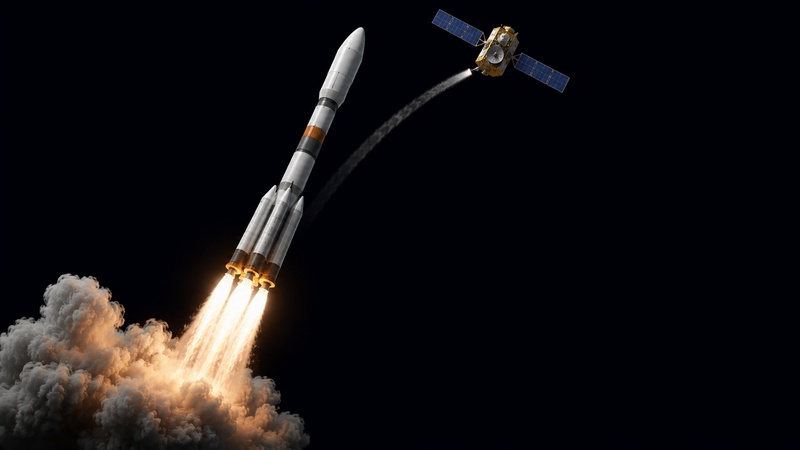
The late nineteen fifties marked a monumental shift in human technological capability. The ambitious drive to conquer the cosmos pushed engineering boundaries and captivated the global imagination. Sending a functioning payload into stable earth orbit was an incredibly complex challenge that demanded precise mathematical calculations, experimental rocketry, and flawless execution. Today, a highly detailed first satellite launch simulation USA environment allows enthusiasts, students, and space historians to witness this magnificent achievement directly on their screens. By interacting with a carefully constructed digital replica of an early American orbital mission, users can observe the raw telemetry, mechanical staging processes, and the dramatic escape from the atmosphere. This engaging format transforms abstract historical facts into a vivid and highly educational visual experience.
🚀 Understanding the sheer scale of this endeavor requires looking back at the specific vehicles that made these early triumphs possible. The first successful American orbital flight utilized a specialized multi-stage rocket design, heavily modified from existing military ballistic missile technology. To achieve the immense speed necessary to stay in space, engineers had to think creatively about weight distribution and thrust efficiency. A single massive rocket simply could not reach orbital velocity due to the burden of its own empty fuel tanks. The ingenious solution was a clustered stage architecture where depleted sections were intentionally discarded mid-flight. Witnessing this staging sequence within a digital simulator perfectly illustrates the harsh realities of the rocket equation, where every single gram of payload requires exponentially more propellant to lift off the launch pad.
Contents
Critical Phases of an Orbital Ascent
A critical aspect of any successful space mission is the carefully planned flight trajectory. Reaching space is not merely a matter of flying straight up. If a vehicle ascends vertically without altering its pitch, it will inevitably fall back to earth once the engines shut down. To establish a permanent orbit, the spacecraft must perform a maneuver known as a gravity turn. Shortly after clearing the thickest layers of the lower atmosphere, the rocket gently tilts toward the horizon. This specific angle allows the vehicle to build up tremendous lateral speed. By the time the final stage burns out, the payload is traveling fast enough sideways that its downward falling arc perfectly matches the curvature of the planet below. This delicate balancing act is beautifully rendered in a launch simulation, where observers can track the gradual change in pitch alongside the climbing velocity.
| Flight Phase | Approximate Altitude | Critical Mission Event |
|---|---|---|
| Pre-Flight Countdown | Sea Level | Final systems validation and propellant pressurization |
| Liftoff and Ascent | 0 to 15 kilometers | Vertical climb clearing the launch pad infrastructure |
| Maximum Dynamic Pressure | 15 to 20 kilometers | The peak level of aerodynamic stress on the airframe |
| Main Engine Cutoff | 80 to 90 kilometers | Termination of the primary liquid fueled booster stage |
| Orbital Insertion | Over 300 kilometers | Final upper stage ignition to achieve required horizontal velocity |
As the virtual rocket ascends, the visual environment undergoes a profound transformation. The dense, breathable air at sea level scatters sunlight, creating the familiar bright blue sky. However, as the vehicle pushes past the stratosphere and approaches the Karman line, the atmospheric pressure drops drastically. The sky darkens into a deep indigo and eventually fades into the absolute blackness of the cosmic void. This atmospheric thinning also affects the behavior of the rocket exhaust. At lower altitudes, high ambient air pressure tightly constricts the fiery plume. In the vacuum of space, without any surrounding pressure to contain it, the exhaust forcefully expands outward into a massive, bell-shaped visual spectacle. A high-quality simulation accurately models these atmospheric physics, providing a visually stunning representation of leaving our home planet.
Vehicle Architecture and Propellant Strategy
The specific hardware utilized during the earliest days of the United States space program relied on a fascinating mix of brute force and delicate instrumentation. The primary booster provided the overwhelming thrust required to tear the vehicle away from the launch pad, burning highly refined kerosene and liquid oxygen. Once this massive lower section exhausted its fuel supply, it detached and fell away. The upper sections of the rocket consisted of clusters of smaller, solid-propellant motors. These upper stages were spun up rapidly by electric motors prior to launch, acting like a massive gyroscope to maintain stability during the final, unguided push toward orbit.
| Launch Vehicle Element | Propellant Type | Operational Purpose |
|---|---|---|
| Main First Stage | Liquid Oxygen and Kerosene | Providing the overwhelming initial thrust to defeat gravity |
| Second Stage Cluster | Solid Propellant Motors | Rapid acceleration outside the densest atmospheric layers |
| Third Stage Cluster | Solid Propellant Motors | Continuing the aggressive push toward orbital velocity thresholds |
| Fourth Stage and Payload | Solid Propellant and Batteries | Final velocity injection and scientific data transmission |
The transition from an upright position on the launch pad to a horizontal trajectory high above the atmosphere is a masterful display of physics. The simulation captures the heavy, sluggish initial movements of the fully fueled booster. Every second that passes burns hundreds of kilograms of fuel, rapidly decreasing the overall mass of the vehicle. According to the laws of motion, as the mass decreases while the engine thrust remains constant, the rate of acceleration must increase. This phenomenon becomes incredibly obvious in the later stages of the flight. The final, lightweight solid rocket motors fire with a sudden, violent burst of speed that finally pushes the payload over the required orbital velocity threshold.
- Aerodynamic Drag Reduction: The necessity of launching vertically to minimize the time spent pushing through thick lower air.
- Mass Ratio Efficiency: The fundamental requirement to shed heavy, empty fuel tanks to allow further acceleration.
- Centrifugal Force Balance: Achieving a speed where the outward momentum perfectly cancels out the downward pull of gravity.
- Thermal Stress Management: Utilizing aerodynamic properties and specialized materials to protect the delicate scientific payload from extreme atmospheric heating.
Decoding the Digital Telemetry
The heart of the simulation lies in the continuous stream of flight telemetry. During a real mission, ground control relies entirely on these incoming numbers to assess vehicle health and trajectory. In the digital environment, users are presented with identical vital statistics. The mission clock begins ticking the moment the hold-down clamps release. The altitude metric tracks the vertical distance from the surface, dictating aerodynamic behavior and staging timing. Simultaneously, the velocity indicator tells the story of kinetic energy accumulation. To achieve a low earth orbit, the final stage must reach a staggering speed of roughly twenty-eight thousand kilometers per hour. Watching these numbers climb rapidly provides a deep, intuitive understanding of the massive forces at play.
The specific payload of this simulated first US mission is just as important as the rocket that carries it. Early satellites were not just metal cylinders; they were highly sensitive flying laboratories designed to answer fundamental questions about the space environment. The historical American orbital payloads carried cosmic ray detectors, internal temperature sensors, and micrometeorite impact microphones. The data transmitted back to earth by these early instruments led to groundbreaking discoveries, such as the identification of immense radiation belts trapped by the magnetic field of the earth. When the simulated payload successfully separates from the final rocket stage and begins broadcasting its distinctive radio signal, it represents the culmination of years of scientific dedication and mechanical engineering brilliance.
| Orbital Characteristic | Definition | Relevance to Early Missions |
|---|---|---|
| Perigee | The point in the orbit closest to the surface of the earth | Determines how long the satellite will avoid atmospheric drag |
| Apogee | The point in the orbit furthest from the surface of the earth | Demonstrates the maximum kinetic energy achieved by the launch vehicle |
| Orbital Period | The total time required to complete one full revolution | Usually around ninety to one hundred minutes for low earth observation satellites |
The Educational Impact of Aerospace Recreations
Engaging with a first satellite launch simulation USA offers a vastly superior educational experience compared to simply reading historical documents. Passive reading cannot adequately convey the dynamic, high-stakes nature of rocketry. By placing the user in control of the visual perspective and time scaling, the digital application fosters active learning. An observer can pause the ascent exactly at the moment of stage separation to study the mechanical design of the booster integration. An enthusiast can manipulate the virtual camera to watch the launch site rapidly shrink into the distance as the massive scale of the planet becomes fully apparent. This interactive, hands-on approach demystifies complex aerospace engineering concepts and makes the rigorous science of astronautics accessible to a remarkably broad audience.
- Real-Time Velocity Measurement: Tracking the immense speed required to transition from a ballistic arc to a stable orbit.
- Vertical Altitude Tracking: Monitoring the transition across distinct atmospheric boundaries into the harsh vacuum of space.
- Mission Elapsed Time: Understanding the incredibly short duration in which a launch vehicle consumes massive reserves of chemical energy.
- Pitch and Orientation Data: Observing the critical angular adjustments that steer the rocket parallel to the surface of the earth.
Ultimately, exploring a first satellite launch simulation USA is about reconnecting with a defining moment of human ambition. It serves as a digital monument to the brilliant minds who looked up at the night sky and decided that the boundaries of our planet were merely a starting point. Once the simulated payload finally achieves a stable orbit and the camera pans out to reveal the breathtaking expanse of the earth glowing against the dark void, observers are left with a profound sense of awe. The challenging journey upward through the punishing atmosphere is an incredible feat of engineering, and the resulting view from orbit remains one of the most inspiring perspectives ever achieved by humanity. Preserving and interacting with these historic moments through advanced web visualizations guarantees that the spirit of early spaceflight will never be forgotten.

Julian D. Thorne — Celestial Mechanics Developer
Researcher and 3D engine developer focused on interactive stellar systems. Julian bridges the gap between theoretical physics and real-time browser-based cosmos exploration.


