
Click or tap the screen to keep the ship airborne
Avoid collisions!
Ship Destroyed
Time: 00:00
The digital cosmos has always captivated players seeking pure adrenaline and unforgiving challenges. Browser-based gaming has evolved far beyond simple pastimes, delivering sophisticated experiences that test spatial awareness and reflex speeds. At the absolute forefront of this modern web arcade movement stands Jet Thrust 3D, an intense flight simulator hosted exclusively on Xenorbis.com. This game strips away complex simulator setups and replaces them with pure, unadulterated arcade physics, demanding split-second decisions as players pilot an advanced rocket through a hazardous cosmic highway. The minimalist aesthetic combined with relentless speed creates a hypnotic loop where every single tap can mean the difference between setting a glorious high score and crashing into oblivion.
🚀 What makes this cosmic odyssey so incredibly gripping is the immediate sense of weight and velocity. From the moment the stellar engines ignite, the craft is subjected to an artificial gravitational pull that constantly drags it toward the lower perimeter of the flight sector. Navigating this endless corridor requires a deep understanding of momentum rather than simple directional inputs. Players must find their own rhythm, balancing the constant descent against sharp, well-timed propulsion bursts. It is a digital dance of survival set against a deep space void where danger approaches from the right at an ever-accelerating pace. The game successfully recreates the golden era of arcade cabinets while utilizing modern rendering capabilities to ensure buttery smooth performance during high-speed maneuvers.
Contents
Core Flight Dynamics and Momentum Preservation
The fundamental pillar of survival in this space simulation is managing the propulsion vector. Unlike traditional flight simulators that utilize complex pitch, yaw, and roll controls, this experience utilizes a streamlined single-axis altitude management system. Activating the thrusters causes the ship to surge upward against the constant downward pull of cosmic gravity. Ceasing propulsion results in a rapid descent, meaning that maintaining a perfectly level trajectory requires a series of rapid, rhythmic inputs. The sheer speed of the game ensures that overcorrecting is just as deadly as failing to react, as smashing into the upper ceiling causes immediate structural instability just like hitting the floor.
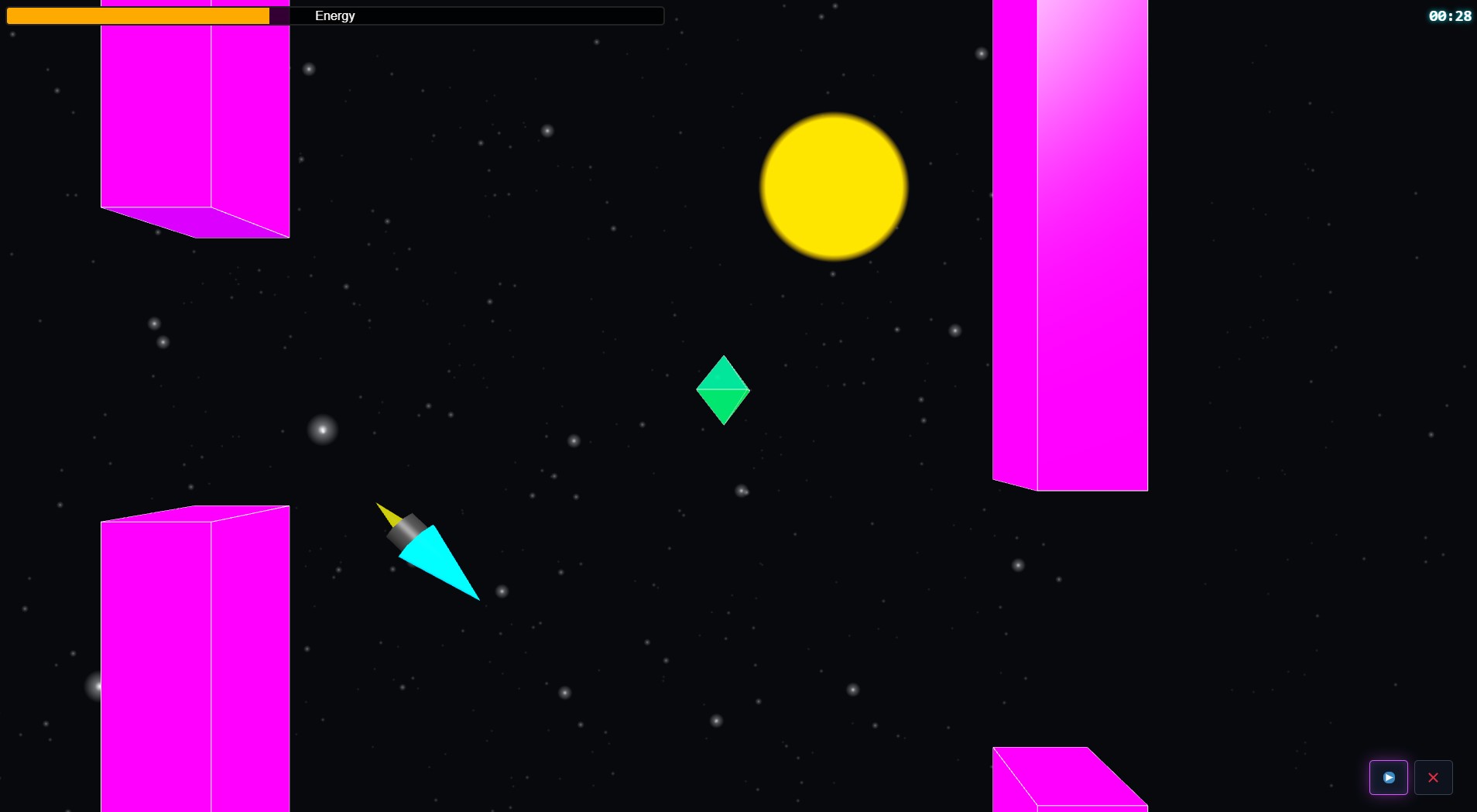
Experienced pilots on Xenorbis.com quickly learn that momentum carries a distinct weight. When the thrusters are engaged, the rocket does not instantly change direction; it smoothly curves upward based on kinetic energy. This structural delay means players must anticipate hazards well before they arrive on screen. If a wall or obstacle is spotted ahead, the input must occur a fraction of a second early to ensure the flight path clears the danger zone. This mechanical nuance elevates the game from a basic reactionary test to a deep exercise in spatial anticipation and trajectory planning.
Shifting Hazards and Tactical Phases
- The stellar corridor is never consistent, constantly cycling through distinct hazard profiles to prevent complacency. Every thirty seconds, the cosmic environment shifts dramatically, forcing the pilot to completely alter their defensive strategy. The first major phase introduces massive neon structures that block large portions of the flight path, while the alternate phase turns the game into a bullet-hell scenario filled with incoming high-velocity projectiles. This constant cycle creates an intense psychological rhythm where players must mentally prepare for a completely different set of survival requirements twice every minute.
- During the structural phase, the primary threats are colossal neon pillars that rise from the floor and drop from the ceiling. These barriers leave only a narrow gap for passage, positioned at completely random altitudes. Pilots must rapidly adjust their current trajectory to line up perfectly with these shifting windows. The difficulty amplifies over time as the game velocity increases, reducing the available clearance windows and forcing tighter maneuvers. The structural design emphasizes vertical agility and immaculate control over the rocket height.
- When the environment transitions into the projectile phase, the structural walls fade away, replaced by an oncoming barrage of tactical rockets. These projectiles travel significantly faster than standard obstacles, entering the screen from various vertical coordinates. Because these threats move at extreme velocities, standard vertical dodging paths must be tightened significantly. Surviving this phase requires minuscule adjustments and a calm composure, as sudden panic inputs will inevitably send the ship directly into the path of an oncoming warhead.
Cosmic Obstacle Database
To assist pilots in identifying and mitigating threats, the following reference table outlines the primary hazards encountered during the deep space voyage across Xenorbis.com. All dimensions and safety clearance recommendations are calculated using universal tracking standards, accommodating both international piloting systems.
| Hazard Type | Primary Risk Index | Recommended Clearance Metric / Imperial |
|---|---|---|
| Neon Ceiling Pillar | Extreme Structural Impact | 5.5 meters / 18.0 feet |
| Neon Floor Base | Zonal Deflection Hazard | 6.2 meters / 20.3 feet |
| Tactical Homing Rocket | High Velocity Kinetic Strike | 8.0 meters / 26.2 feet |
| Atmospheric Boundary Limit | Frictional Hull Degradation | 3.1 meters / 10.1 feet |
| Debris Fragment Cloud | Minor Shield Disruption | 4.5 meters / 14.7 feet |
Resource Gathering and Hull Preservation Mechanics
Survival cannot be achieved through passive evasion alone; pilots must actively hunt for localized energy sources to sustain their ship systems. The rocket hull is equipped with a reactive shield matrix that depletes rapidly upon colliding with any solid hazard. To counteract this damage, the sector contains floating crystalline matrix formations that provide immediate structural restoration or, conversely, cause catastrophic system failure. Learning to instantly identify these objects visually is just as critical as mastering the thruster mechanics.
Green crystals represent the primary lifeline during extended sorties. Safely intercepting a green crystal triggers an immediate restorative sequence, repairing approximately one-fifth of the maximum shield capacity. These items are often positioned in highly dangerous areas, such as directly inside the narrow gaps of neon pillars or precisely along the trajectory of oncoming rockets. The game constantly presents a high-stakes choice: risk a tight maneuver to restore lost shield energy or play it safe and risk running out of power later in the run.
Conversely, red crystals represent unstable antimatter clusters that must be avoided at all costs. Intercepting a red crystal causes an instant, irreversible breach of the main containment core, resulting in immediate destruction regardless of current shield levels. These hazardous objects look remarkably similar in structure to their beneficial counterparts, relying on color distinction to warn the pilot. Amidst the chaos of rapid projectile dodging, misidentifying a crystal is one of the most common ways a promising flight ends prematurely.
Stellar Energy and Matrix Analysis
The following reference layout details the behavior, visual signatures, and operational impacts of the various energetic materials scattered across the flight corridor.
| Material Variant | Visual Signature Hue | Hull Modification Effect |
|---|---|---|
| Restorative Crystalline Matrix | Vibrant Neon Green | Restores 20 Percent Shield Capacity |
| Unstable Antimatter Cluster | Deep Radiant Red | Instant Core Detonation Failure |
| Kinetic Shield Booster | Bright Cerulean Blue | Temporary Velocity Stabilization |
Velocity Scaling and Environmental Progression
Jet Thrust 3D employs a dynamic difficulty scaling system that ensures no two flight sessions feel identical. As time elapses, the overall velocity of the universe increases, causing obstacles, projectiles, and energy crystals to stream across the screen at a much faster rate. This velocity scaling changes the fundamental physics of the game over time, as the momentum calculations that worked perfectly during the first thirty seconds become entirely obsolete by the two-minute mark.
The acceleration affects not only the scrolling speed of the hazards but also the responsiveness requirements of the ship. At higher speeds, the window of opportunity to react to an oncoming pillar shrinks to mere milliseconds. The paraxial background elements, including the distant stars and lunar objects, shift speed proportionally, enhancing the sensory feeling of entering hyper-velocity flight. This progression forces the pilot into a state of hyper-focus where conscious thought gives way to pure muscle memory.
Operational Velocity Tiers
The following structural reference guide demonstrates how the timeline of a single flight correlates with universal system velocity changes and overall survival difficulty ratings.
| Flight Duration | System Velocity Metric / Imperial | Operational Difficulty Tier |
|---|---|---|
| 00:00 to 00:30 | 15.0 km/s / 9.3 mi/s | Standard Training Level |
| 00:30 to 01:30 | 18.0 km/s / 11.1 mi/s | Advanced Evasion Level |
| 01:30 to 03:00 | 22.0 km/s / 13.6 mi/s | Expert Pilot Velocity |
| 03:00 Plus | 27.0 km/s / 16.7 mi/s | Orbital Survival Threshold |
Pro Tactics for Elite Cosmic Pilots
Reaching the upper echelons of the leaderboard on Xenorbis.com requires implementing specific tactical frameworks that maximize safety margins while minimizing unnecessary inputs. The following strategic advice has been compiled from top-tier flight data analyzed across thousands of successful simulation runs.
- Maintain a Central Position: Keeping the rocket positioned near the vertical center of the screen when no hazards are present provides the maximum amount of space to react to both high and low obstacles.
- Master the Micro-Tap: Avoid holding down the thruster input for extended periods, as this builds excessive upward momentum that is incredibly difficult to counteract, leading to ceiling crashes.
- Prioritize Evasion Over Collection: Never jeopardize a stable flight path just to collect a green crystal unless your shield energy is critically low, as the risk of striking an adjacent wall often outweighs the repair benefits.
- Use Screen Boundaries Wisely: The upper and lower safety buffers can be utilized to skim past exceptionally tall pillars, provided you compensate for the automated boundary deflections immediately afterward.
- Track the Mode Timer: Keep a close eye on the central clock to anticipate the exact moment the environment shifts between structural pillars and high-speed rocket barrages, allowing you to adjust your positioning beforehand.
- Embrace Fullscreen Concentration: Activating the dedicated fullscreen mode eliminates external display distractions and optimizes the rendering aspect ratio, giving you a cleaner view of incoming threats.
Ultimately, Jet Thrust 3D serves as a spectacular testament to the timeless appeal of arcade mechanics. By combining straightforward controls with deep, momentum-based physics and relentless obstacle scaling, it provides an instantly accessible yet profoundly challenging experience. Whether you are looking to kill a few minutes or spend hours perfecting your tapping rhythm to dominate the global rankings, this web-based stellar simulator delivers a premium experience directly to your browser. Step into the cockpit on Xenorbis.com, initiate data launch, and discover exactly how long you can survive the beautiful, glowing neon chaos of the deep space void.

Julian D. Thorne — Celestial Mechanics Developer
Researcher and 3D engine developer focused on interactive stellar systems. Julian bridges the gap between theoretical physics and real-time browser-based cosmos exploration.


