Welcome to the ultimate guide on the planetary science and engineering mechanics behind the Venus Descent: 3D Acid Hell & Rover Landing Simulator. Venus is often described as Earths evil twin. While our home planet nurtured oceans and life, its celestial neighbor evolved into a sterile, toxic wasteland locked in a runaway greenhouse effect. Stepping onto its surface is akin to entering a pressurized cosmic blast furnace. This comprehensive reference article explores the brutal realities of the second planet from the sun, examining the extreme temperatures, crushing atmospheric pressure, and corrosive weather systems that make planetary exploration here an absolute nightmare for engineers and a thrilling challenge for simulator users.
Contents
The Atmospheric Gauntlet: Falling Through the Clouds
To truly understand the environment rendered within the simulator, one must first understand the descent profile. Falling through the Venusian atmosphere is not a simple skydive through thin air. It is a grueling, multi-staged transition through layers of varied and lethal chemistry. The upper atmosphere, beginning roughly 100 kilometers above the surface, features hurricane-force winds sweeping across the globe in a phenomenon known as super-rotation. The entire atmospheric envelope circles the planet much faster than the planet itself rotates.
🛰 As a descending spacecraft drops lower, it enters the primary cloud deck. These are not fluffy clouds of water vapor. They are thick, opaque, continuous banks of highly concentrated sulfuric acid. The chemistry in this altitude band is violent and continuous. Sulfur dioxide reacts with trace amounts of water vapor under the influence of ultraviolet solar radiation to form suspended droplets of acid.
The chemical process of acid formation can be modeled simply:
SO2 + O → SO3
SO3 + H2O → H2SO4
Navigating this corrosive zone requires ablative heat shields and exterior coatings that can resist severe chemical degradation. Below the massive cloud deck, the atmosphere clears up remarkably, shifting the primary threat from acid corrosion to sheer mechanical pressure and heat. The atmosphere becomes entirely completely clear of clouds around thirty kilometers above the ground, revealing an endless, dim, orange-tinted expanse below.
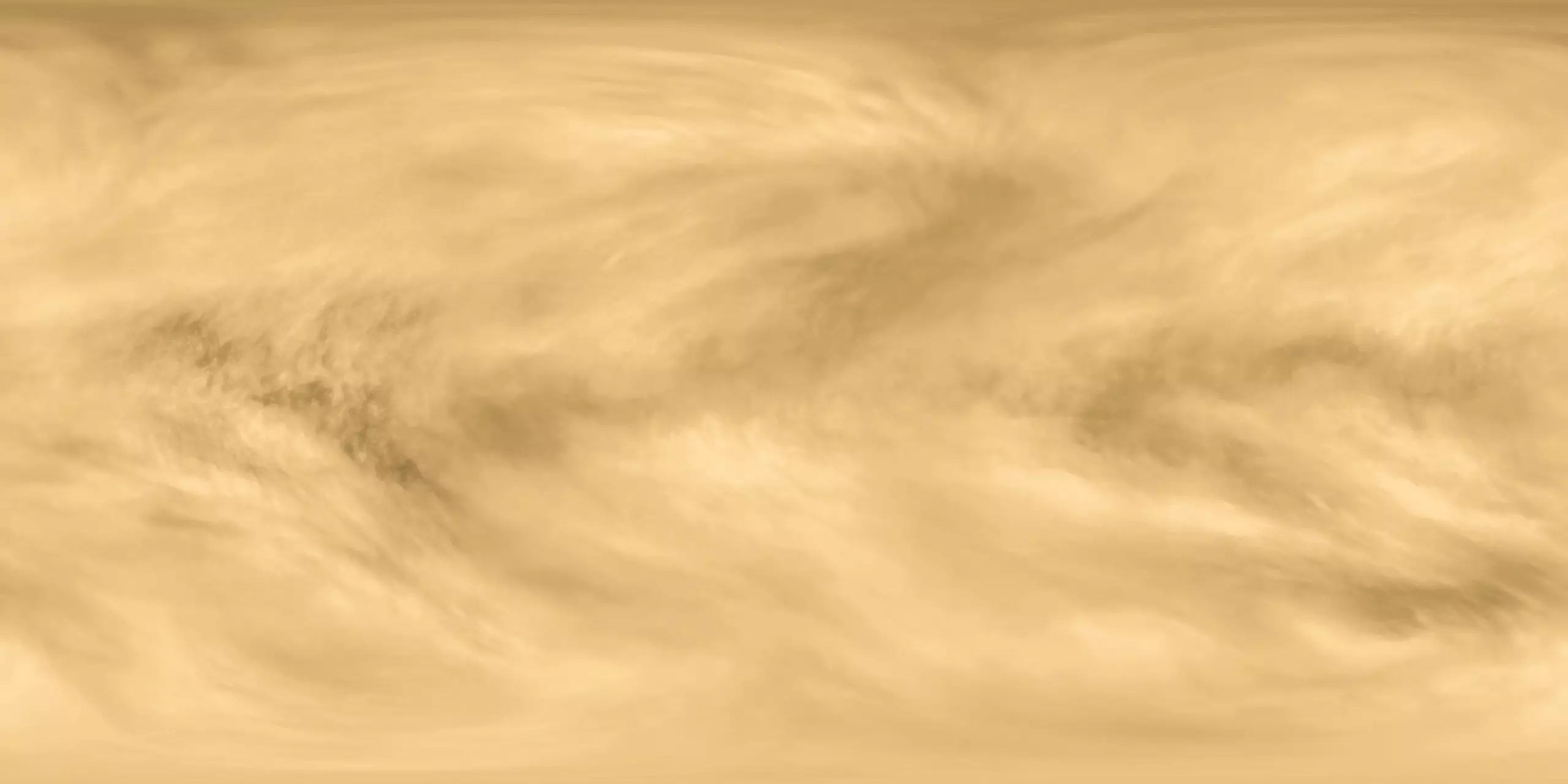
Comparative Planetary Atmospheres
To grasp the extremity of the Venusian environment, it is helpful to compare it directly to the conditions we experience on Earth. The table below outlines the stark contrasts in atmospheric composition and baseline metrics.
| Planetary Metric | Earth Standard | Venus Reality |
|---|---|---|
| Primary Composition | Nitrogen 78%, Oxygen 21% | Carbon Dioxide 96.5%, Nitrogen 3.5% |
| Mean Surface Temperature | 15 Degrees Celsius | 464 Degrees Celsius |
| Surface Atmospheric Pressure | 1 Bar | 92 Bar |
| Cloud Composition | Water Ice and Liquid H2O | Sulfuric Acid H2SO4 |
| Visual Illumination at Surface | Bright, clear shadows | Dim orange glow, diffuse lighting |
Surface Conditions: The Great Crusher
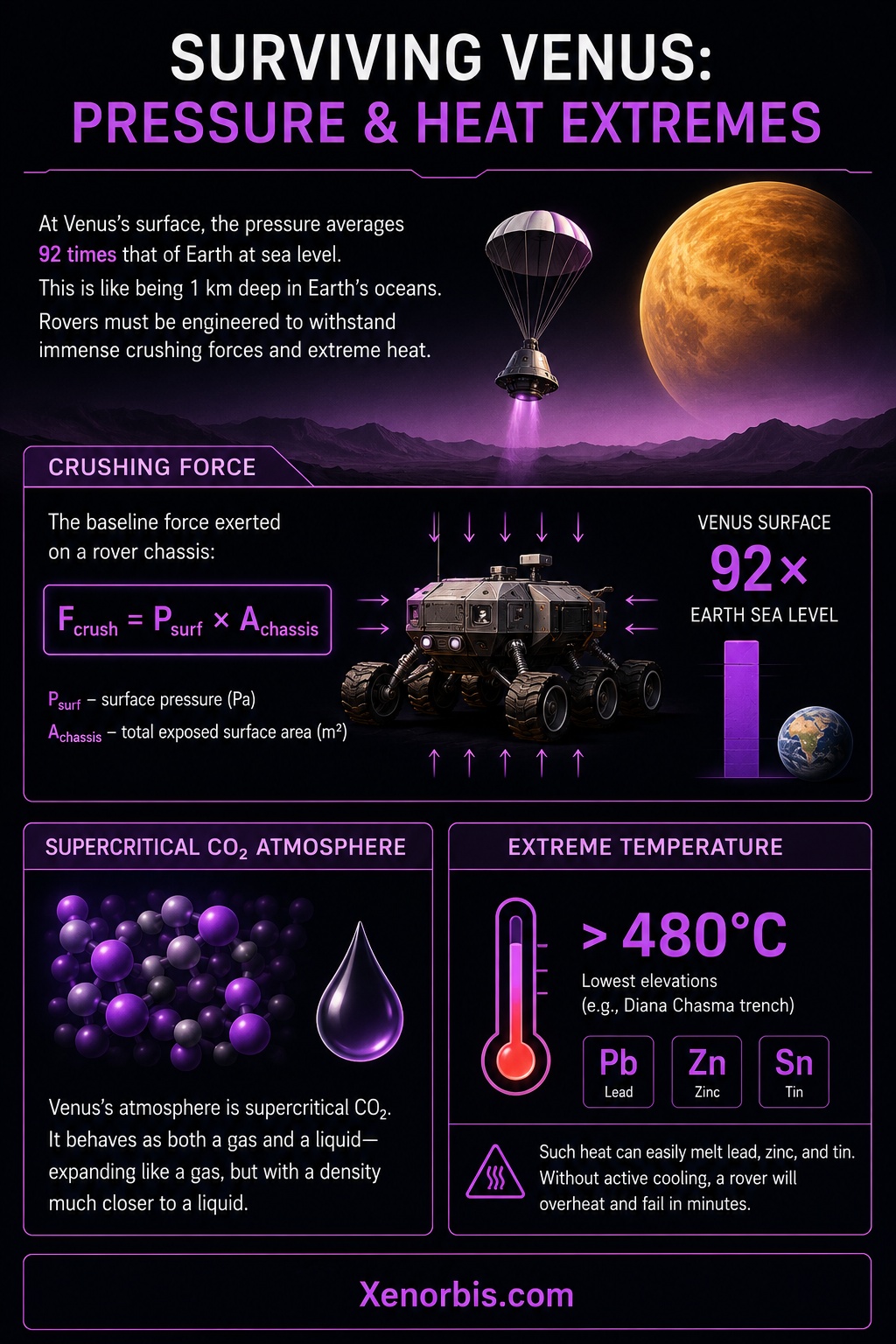
Upon breaking through the lower atmospheric haze, a descending probe or virtual rover faces the ultimate engineering challenge — atmospheric pressure. At the surface of Venus, the pressure averages 92 times that of Earth at sea level. This is functionally equivalent to being submerged nearly one kilometer deep in Earths oceans. To calculate the baseline force exerted on a rover chassis, mechanical engineers use modified hydrostatic equations taking into account the unique state of the gas.
The standard pressure force calculation is expressed as:
Fcrush = Psurf × Achassis
In this relationship, Psurf represents the immense surface pressure in Pascals, and Achassis is the total exposed surface area of the rover. However, the carbon dioxide on the surface of Venus is not merely a dense gas. Due to the combination of extreme pressure and high temperature, the atmosphere exists as a supercritical fluid. A supercritical fluid acts simultaneously as a gas and a liquid, expanding to fill its container like a gas but possessing a density much closer to a liquid solvent.
The temperature at the lowest elevations, such as the bottom of the Diana Chasma trench, routinely exceeds four 480 degrees Celsius. This ambient heat is sufficient to easily melt lead, zinc, and tin. Any rover landing here without active cooling will literally cook from the inside out in a matter of minutes.
Engineering for Hell: Material Science and Survivability
Building a robust rover for the Venus Descent Simulator environment requires an understanding of advanced, heat-resistant material science. Standard commercial electronics rely heavily on silicon processors. These standard silicon-based chips begin to experience critical thermal runaway and fail entirely at approximately 250 degrees Celsius. A true Venus rover cannot use them.
Instead, theoretical and future rovers must rely on high-bandgap semiconductors fabricated from silicon carbide or gallium nitride. These exotic materials can maintain structural and electrical integrity at temperatures exceeding 500 degrees Celsius. Furthermore, standard pneumatic rubber tires are utterly useless. They would vaporize instantly upon touching the basaltic rock. Rovers designed for this planet utilize solid metallic wheels, often milled from aerospace-grade titanium or specialized high-carbon steel alloys.
| Material Type | Melting Point Celsius | Suitability for Venus Surface Operations |
|---|---|---|
| Standard Silicon Electronics | Thermal failure at 250 | Completely Unsuitable — Requires active cooling |
| Silicon Carbide Semiconductors | Over 2700 | Highly Suitable — Functions in ambient heat |
| Lead Solder | 327 | Completely Unsuitable — Melts immediately |
| Titanium Alloy Ti-6Al-4V | 1604 | Highly Suitable — Excellent pressure hull material |
| Teflon PTFE | 327 | Completely Unsuitable — Melts and degrades rapidly |
Power Generation in the Murk
Harvesting energy on the surface of our sister planet is incredibly difficult. Solar panels, the traditional lifeblood of Martian and Lunar rovers, are practically useless on Venus. The thick, multi-layered cloud cover reflects the vast majority of incoming solar radiation back into space. The remaining light that manages to filter down is absorbed heavily by the thick carbon dioxide atmosphere.
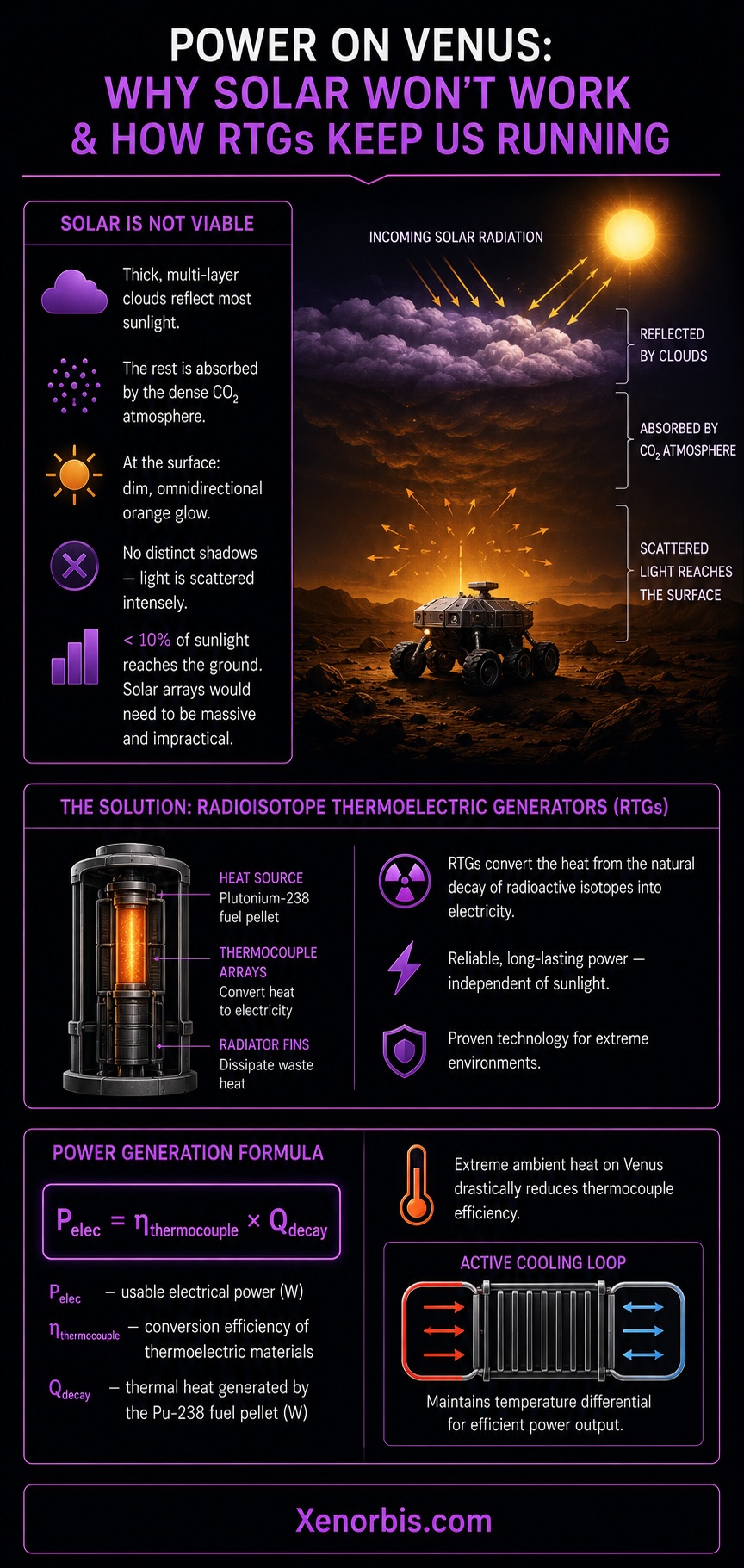
By the time the light reaches the ground, it is reduced to a dim, omnidirectional orange glow. There are no distinct shadows on the surface of Venus because the light is scattered so intensely by the supercritical atmosphere. With less than 10 % of incoming sunlight reaching the ground, solar arrays would need to be impractically massive.
⚡ Therefore, surface machinery must generate power internally. The most reliable solution is the use of Radioisotope Thermoelectric Generators. These devices convert the heat released by the natural decay of radioactive isotopes into electricity using arrays of thermocouples.
The electrical power generation formula is:
Pelec = ηthermocouple × Qdecay
Where Pelec is the usable electrical power, ηthermocouple is the conversion efficiency rate of the thermoelectric materials, and Qdecay is the thermal heat generated by the plutonium-238 fuel pellet. The extreme ambient heat of the Venusian environment drastically lowers the efficiency of standard thermocouples, requiring complex active cooling loops simply to maintain a temperature differential.
Historical Triumphs: The Soviet Venera Program
The concept of dropping a probe into an acid hell is not mere science fiction. During the Cold War, the Soviet Union executed one of the most audacious and successful campaigns in the history of spaceflight — the Venera program. They sent a fleet of heavily armored spacecraft directly into the crushing atmosphere to gather invaluable telemetry and photographic data.
- Venera 4: The first spacecraft to measure the atmosphere of another planet in situ, confirming the massive concentration of carbon dioxide and the staggering atmospheric density before being crushed mid-descent.
- Venera 7: Achieved the first ever soft landing on another planet, transmitting faint but crucial temperature data from the surface for exactly 23 minutes before the intense heat destroyed its transmitter.
- Venera 9: Made history by transmitting the very first black-and-white photographs from the surface of Venus, revealing a harsh, rocky landscape devoid of dust, proving that the surface was subject to intense erosion.
- Venera 13: Survived for an astonishing 127 minutes. It utilized a heavy titanium pressure hull and internal phase-change cooling materials like lithium nitrate trihydrate to absorb heat. It transmitted iconic color panoramas of the orange, flat rocks surrounding its landing ring.
These historical missions prove that surviving the planet, even temporarily, is possible with rigorous engineering and heavy metallic armor.
Locomotion and the Drag of Supercritical Gas
Moving across the Venusian landscape presents a unique set of physics challenges. Because the atmosphere is a supercritical fluid, a rover driving across the surface must essentially plow through a dense medium. Driving on Venus feels less like off-roading through thin air on Earth and much more like driving a submarine across the ocean floor.
Aerodynamic drag becomes a massive impediment to speed and efficiency. The kinetic energy required to move even slowly is massive. The drag force formula dictates this relationship:
Fdrag = 0.5 × ρatmosphere × v2 × Cd × Afrontal
The atmospheric density factor ρatmosphere is roughly sixty-five kilograms per cubic meter. Because of this extreme density, even a slow surface breeze of one to two meters per second carries the forceful impact of a rushing river. Rovers must possess a wide, low-slung center of gravity to avoid being physically tipped over by the sluggish but overwhelmingly heavy winds.
Geological Features and Terrain Navigation
🌕 Users participating in a 3D rover landing simulator will encounter a heavily fractured, volcanically active landscape. Venus is a world dominated by volcanism. It lacks the tectonic plate system found on Earth. Instead, it operates on a stagnant lid tectonic model. Heat builds up continuously in the mantle beneath the thick crust until it reaches a critical threshold, leading to massive, planet-wide volcanic resurfacing events.
The terrain consists of sprawling, flat basaltic plains, towering shield volcanoes such as Maat Mons, and complex, highly deformed regions known as tesserae. The rock is sharp, unweathered by water, and highly abrasive. A successful descent vehicle must land on a relatively flat lava plain to avoid tipping over, as the dense atmosphere renders terminal descent correction maneuvers incredibly sluggish and difficult.
Mathematical Modeling of Venusian Heat Transfer
Understanding thermal dynamics is absolutely critical for maintaining the illusion and challenge of a true Venus simulation. The primary mode of heat transfer destroying machinery on the surface is a combination of intense convection from the dense carbon dioxide atmosphere and aggressive infrared radiation emitting from the superheated ground itself.
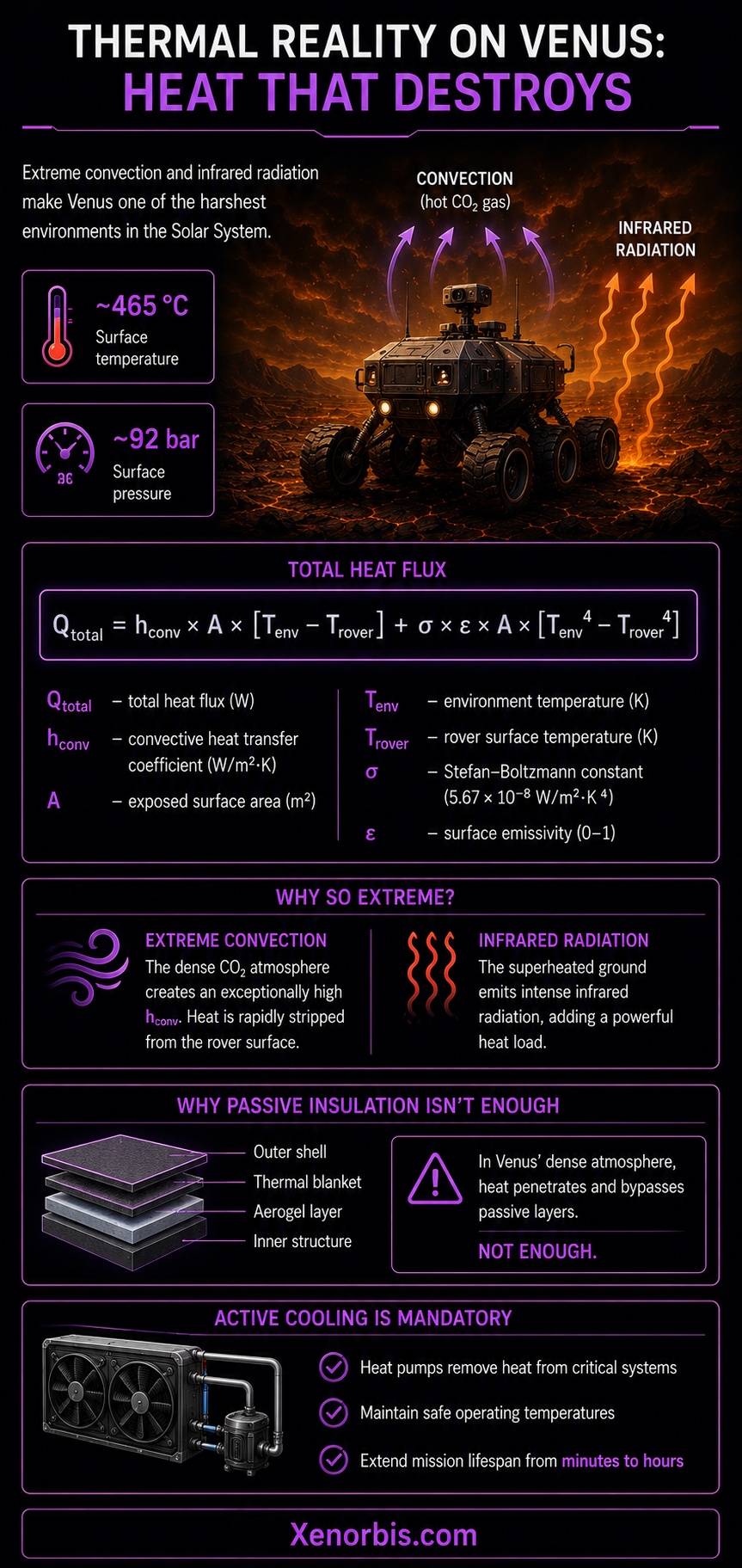
The total heat flux acting upon the rover shell is calculated via:
Qtotal = hconv × A × [Tenv – Trover] + σ × ε × A × [Tenv4 – Trover4]
Because the atmosphere is so dense, the convective heat transfer coefficient hconv is exceptionally high. Simple thermal blankets and aerogels, which work perfectly in the vacuum of space or the thin air of Mars, are insufficient here. The dense gas acts as a perfect thermal conductor, bridging the gap between the blazing environment and the fragile internal electronics. Active mechanical cooling, relying on robust heat pumps, is the only way to extend a missions lifespan from minutes to hours.
Planetary Data Reference Guide
For enthusiasts wishing to calculate their own descent trajectories or understand the gravitational constants involved in landing maneuvers, the following reference table provides exact planetary metrics.
| Planetary Parameter | Value | Simulator Implication |
|---|---|---|
| Equatorial Radius | 6051 Kilometers | Near-Earth gravity requires heavy landing thrusters. |
| Surface Gravity | 8.87 Meters per Second Squared | Objects fall at roughly 90 percent the speed they do on Earth. |
| Solar Day Length | 116 Earth Days | Nightfall takes months; solar power is consistently blocked anyway. |
| Atmospheric Density at Surface | ~65 Kilograms per Cubic Meter | Parachutes become highly effective, but aerodynamic drag hinders driving. |
| Axis Tilt | 177.3 Degrees | The planet rotates backward relative to most of the solar system. |
Future Missions and Mechanical Solutions
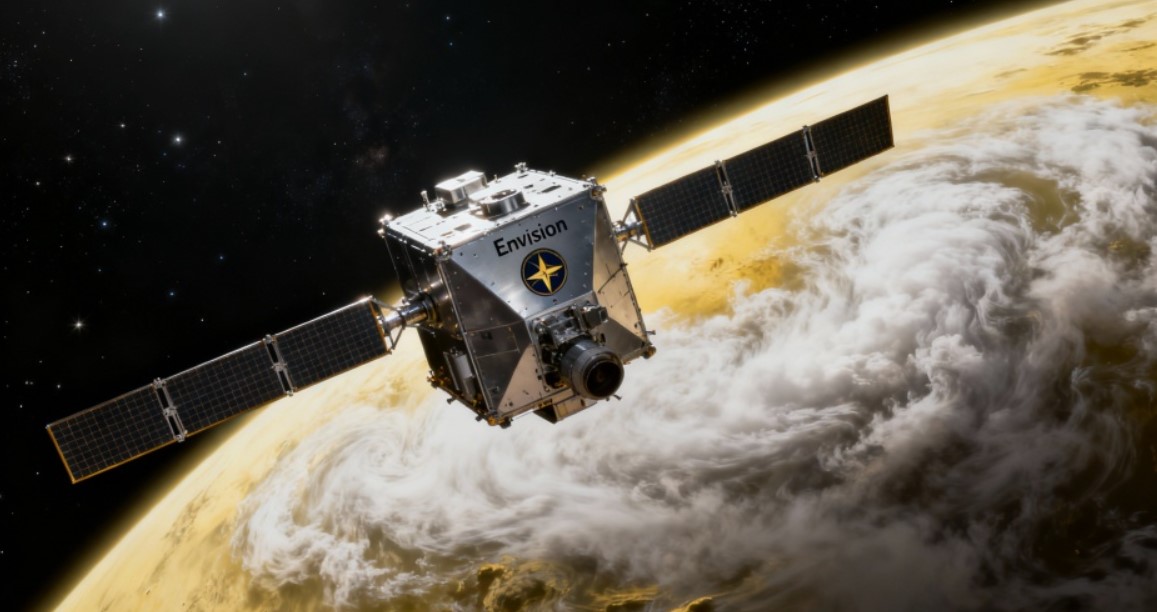
While software provides an interactive and safe way to experience this nightmare world, international space agencies are actively preparing real hardware to return to the acid hell. NASA has approved the DAVINCI+ and VERITAS missions to analyze atmospheric chemistry and map the surface using high-resolution radar. The European Space Agency is simultaneously developing the EnVision orbiter to study the relationship between the planets geological activity and its atmosphere.
Furthermore, visionary engineers are designing concepts like the Automaton Rover for Extreme Environments. This theoretical rover discards fragile electronic processors entirely. Instead, it relies on clockwork logic — physical gears, levers, and mechanical computers driven by wind turbines — to navigate the surface and record data. By removing silicon from the equation, these mechanical rovers could theoretically survive for months in the crushing heat.
The Educational Value of Interactive Simulation
Engaging with a specialized descent and landing application bridges the gap between abstract astrophysical textbooks and practical engineering challenges. Reading that the surface pressure is ninety atmospheres is a dry fact. Struggling to steer a heavy, virtual metallic rover against the dense, sluggish resistance of supercritical carbon dioxide, all while watching internal heat gauges slowly climb toward critical failure, cements the reality of planetary exploration in the mind.
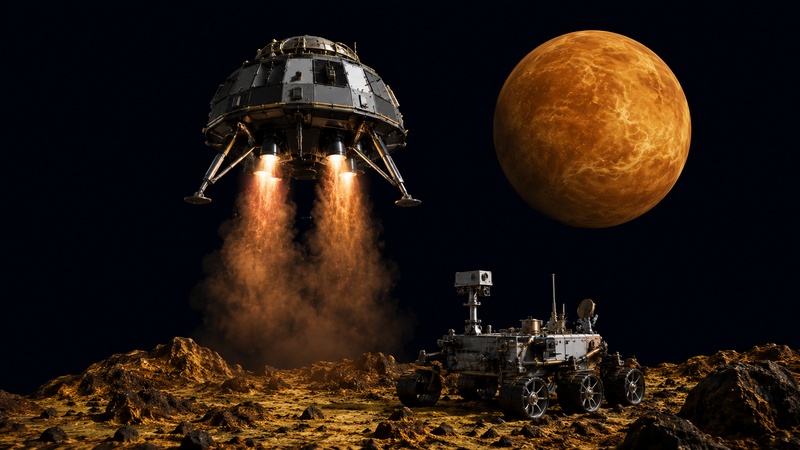
This virtual environment highlights the incredible ingenuity required by aerospace engineers. Every ounce of weight, every square centimeter of surface area, and every choice of metallic alloy is a matter of life and death for a robotic probe. Conquering the second planet remains one of the ultimate tests of human technology.
Essential Reading for Planetary Engineers
For those looking to expand their knowledge beyond the digital terrain and dive deeper into the chemistry, history, and engineering of our sister planet, the following literature is highly recommended:
- Venus Revealed by David Harry Grinspoon — A beautifully written, comprehensive look at the geological history, atmospheric evolution, and lingering mysteries of the planet.
- Robotic Exploration of the Solar System by Paolo Ulivi and David M. Harland — An incredibly detailed technical account of the Soviet Venera missions, analyzing the engineering flaws and eventual triumphs.
- The Soviet Exploration of Venus by Wesley T. Huntress Jr. and Mikhail Ya. Marov — An insider perspective on the immense technological hurdles overcome by the Soviet space program during the Cold War.
- Planetary Atmospheres by C.B. Farmer — A deep, academic dive into the mathematical and chemical processes driving super-rotation, acid rain, and weather on other worlds.
- Spacecraft Thermal Control Handbook by David G. Gilmore — The definitive engineering reference for designing cooling systems, radiators, and insulation for extreme aerospace environments.

Julian D. Thorne — Celestial Mechanics Developer
Researcher and 3D engine developer focused on interactive stellar systems. Julian bridges the gap between theoretical physics and real-time browser-based cosmos exploration.


