Welcome to the ultimate digital expedition into the outer solar system. The Pluto 3D simulator serves as a premier interactive portal for space enthusiasts, astronomy students, and planetary science fans. Journeying 5,000,000,000 kilometers away from Earth is now possible directly from a web browser. The simulator offers an unprecedented 360 degree view of the most famous dwarf planet, bringing the icy frontier to life with high resolution topographic maps, accurate orbital tracking, and detailed planetary data.
🔭 Gone are the days when the distant world was just a 9 pixel blur in the best telescopes. Thanks to modern digital rendering and precise astronomical data gathered during the 2015 flyby, users can explore every crater, mountain range, and frozen plain in spectacular detail. The interactive environment allows planetary explorers to rotate the globe, track the path of the famous New Horizons probe, and visualize the complex orbital dance of the celestial body and its 5 moons.
Contents
The Historical Context and Discovery
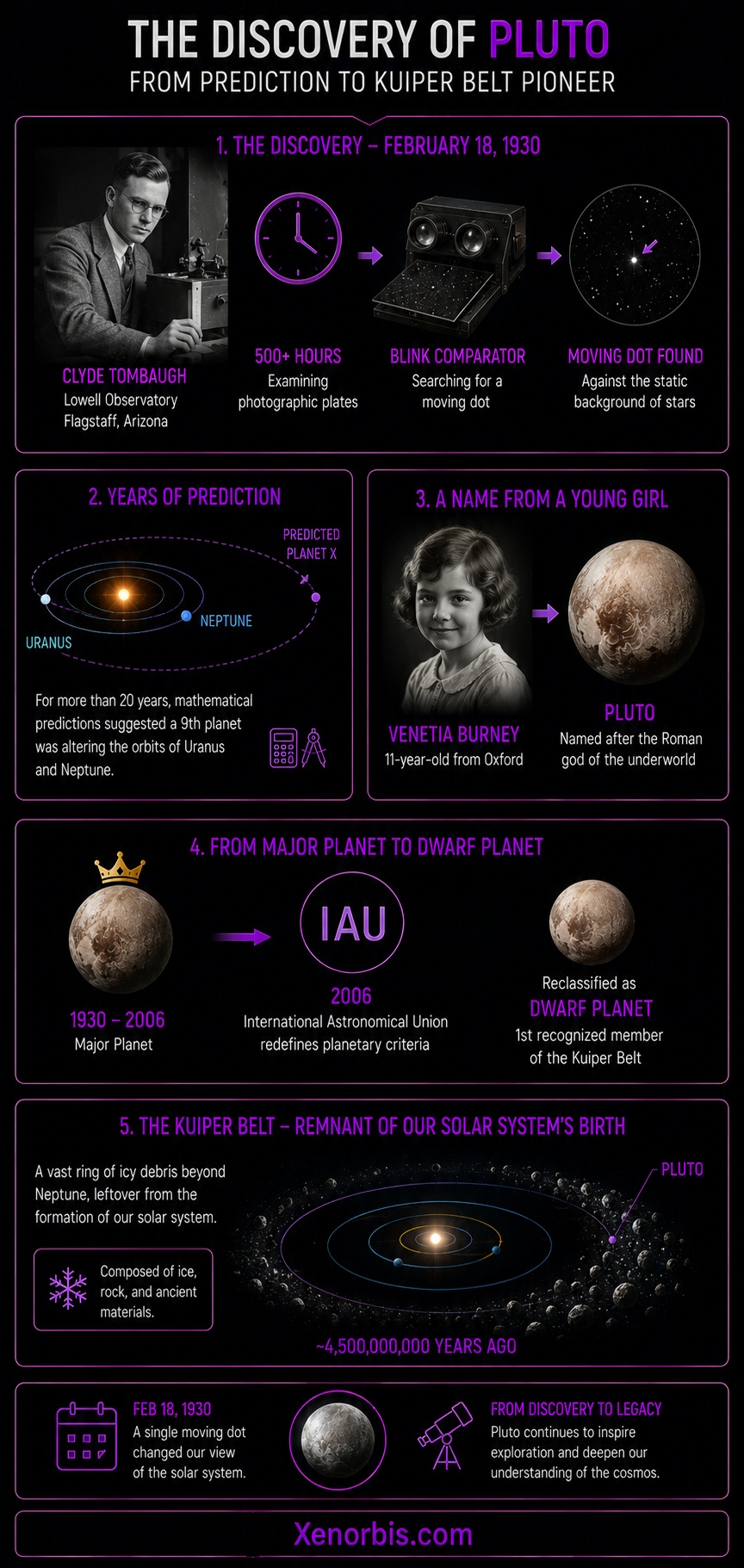
The story of this distant world began on February 18, 1930. Astronomer Clyde Tombaugh, working at the Lowell Observatory in Flagstaff, Arizona, spent more than 500 hours examining photographic plates. Using a blink comparator, Tombaugh searched for a moving dot against the static background of stars. After more than 20 years of mathematical predictions regarding a 9th planet altering the orbits of Uranus and Neptune, the elusive body was finally captured. An 11 year old girl from Oxford named Venetia Burney suggested the name, honoring the Roman god of the underworld. For 76 years, the celestial body held major planet status until 2006, when the International Astronomical Union redefined planetary criteria. It was reclassified as a dwarf planet and the 1st recognized member of the Kuiper Belt — a vast ring of icy debris left over from the formation of our solar system 4,500,000,000 years ago.
| Planetary Parameter | Metric Value | Imperial Value |
|---|---|---|
| Equatorial Diameter | 2376 km | 1476 miles |
| Overall Mass | 1.309 * 1022 kg | 2.88 * 1022 lbs |
| Surface Gravity | 0.62 m/s2 | 2.03 ft/s2 |
| Average Temperature | -229 °C | -380 °F |
| Orbital Period | 247.94 Earth years | 90560 Earth days |
| Surface Pressure | 1.0 microbars | 0.000014 psi |
The Epic Voyage of New Horizons
Humanity launched its most ambitious robotic explorer on January 19, 2006. The New Horizons spacecraft launched atop an Atlas V 551 rocket, achieving an Earth escape velocity of 16.26 kilometers per 1 s. This incredible speed made it the fastest human made object launched from Earth at that time. On February 28, 2007, the probe performed a critical gravity assist maneuver around Jupiter, boosting its velocity by an additional 4,000 meters per 1 s and cutting 3 years off the total transit time.

For the next 8 years, the probe coasted in electronic hibernation through the dark expanse of the outer solar system. It awoke in December 2014 to prepare for the historic encounter. The closest approach occurred on July 14, 2015, when the spacecraft flew just 12,500 kilometers above the icy surface at a relative velocity of 13.78 kilometers per 1 s. Because the distance to Earth was approximately 32 Astronomical Units, telemetry signals took 4.5 hours to travel 1 way, traveling at the absolute speed of light.
Advanced Scientific Payload
To capture the incredible details rendered in this 3D simulator, the spacecraft carried 7 specialized scientific instruments. The Long Range Reconnaissance Imager, known as LORRI, provided the highest resolution photographic data. LORRI is a digital camera featuring a 20.8 centimeter aperture telescope, capable of spotting objects as small as 50 meters across from a distance of 10,000 kilometers. The Ralph instrument handled visible color imaging and infrared mapping, allowing scientists to determine the exact surface composition of various ices. The Alice ultraviolet spectrometer analyzed the atmospheric gases and the escaping nitrogen. To study the solar wind interaction, the Solar Wind Around Pluto instrument, or SWAP, measured charged particles. The Radio Science Experiment, called REX, used radio waves to measure the atmospheric temperature and pressure down to the surface. Finally, the Student Dust Counter recorded microscopic dust impacts throughout the entire 9 year journey across the solar system.
| Instrument Name | Primary Function | Key Capability |
|---|---|---|
| LORRI | Optical Imaging | 50 meter resolution mapping |
| Ralph | Infrared Spectrometer | Surface composition tracking |
| Alice | Ultraviolet Spectrometer | Atmospheric gas analysis |
| REX | Radio Science Experiment | Temperature depth profiling |
| SWAP | Solar Wind Measurement | Charged particle monitoring |
| PEPSSI | Energetic Spectrometer | Ion escape rate measurement |
Telemetry and Orbital Mechanics
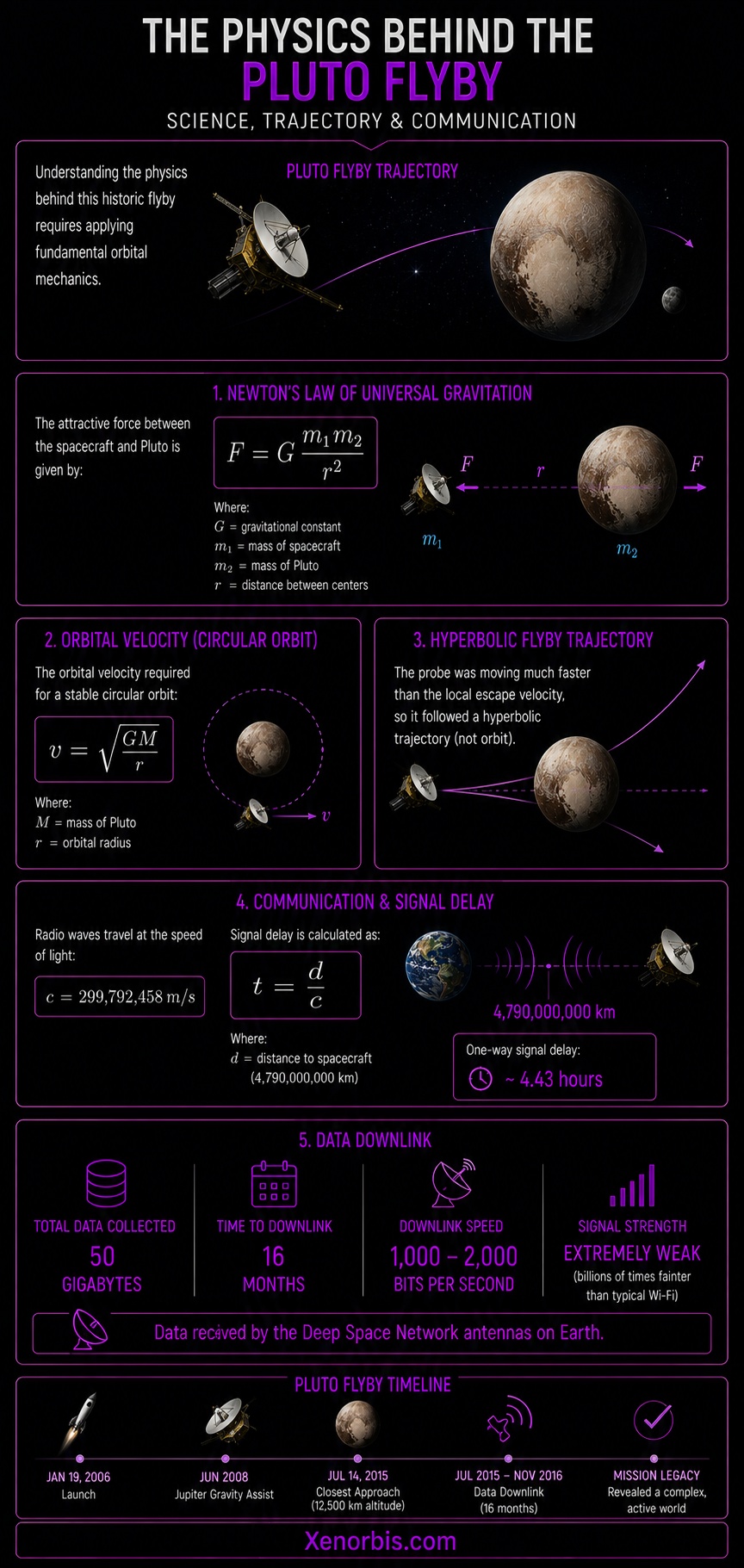
Understanding the physics behind this historic flyby requires applying fundamental orbital mechanics. The Pluto 3D simulator models these complex forces to accurately render the trajectory. Newton’s law of universal gravitation dictates the attractive force between the spacecraft and the dwarf planet. The force calculation is expressed as
F = G * m1 * m2 / r2
where G is the gravitational constant, m1 and m2 are the masses, and r is the distance between their centers. The orbital velocity required for a stable circular orbit is calculated as
v = √[ G * M / r ]
However, the probe was moving much faster than the local escape velocity, meaning it followed a hyperbolic trajectory rather than entering orbit. The communication link relied on radio waves traveling at 299,792,458 meters per 1 s. The signal delay formula is simply
t = d / c
where d is the immense distance of 4,790,000,000 kilometers. Transmitting the 50 gigabytes of collected data took 16 months, with downlink speeds ranging from 1,000 to 2,000 bits per 1 s due to the extremely weak signal strength received by the Deep Space Network antennas on Earth.
Topographical Wonders — The Heart of Ice
Users of the simulator will immediately notice the dominant bright feature named Tombaugh Regio, famously shaped like a massive heart. This striking geological formation measures 1,590 kilometers across. The western lobe of this heart is called Sputnik Planitia, a vast basin spanning 1,050 kilometers by 800 kilometers. Unlike any terrain seen on Earth, this plain is completely devoid of impact craters, indicating a remarkably young surface estimated to be less than 10,000,000 years old. The surface consists of frozen nitrogen, carbon monoxide, and methane. Deep beneath the crust, scientists hypothesize the existence of a subsurface liquid water ocean. Heat from the rocky core drives convection currents within the nitrogen ice, creating polygonal cells measuring 16 to 48 kilometers wide. The center of these cells rises upward, while the colder edges sink downward at a rate of just 2 to 3 centimeters per 1 year. The interactive simulator provides high contrast topological overlays allowing users to visually trace these active convection boundaries.
Mountains of Water and Bladed Terrains
Bordering the flat expanses of Sputnik Planitia are towering mountain ranges, but they are absolutely not made of rock. In the extreme cold of the outer solar system, water ice becomes as hard as granite. Tenzing Montes is a rugged mountain range with peaks soaring 6,200 meters above the surrounding plains. Hillary Montes reaches elevations of 3,400 meters. These massive blocks of water ice are floating on the denser nitrogen ice like icebergs in a frozen sea. Further east lies the enigmatic Tartarus Dorsa region, characterized by penitentes — towering blades of methane ice aligned from north to south. These jagged formations reach heights of 500 meters and are spaced 3,000 to 5,000 meters apart. They form through a process called sublimation, where methane ice turns directly into gas without becoming a liquid 1st, driven by the faint but persistent sunlight. The interactive application allows explorers to zoom closely into these rugged terrains, offering an accurate scale representation of the dramatic planetary topography.
| Region Name | Feature Type | Primary Composition |
|---|---|---|
| Sputnik Planitia | Convection Basin | Nitrogen Ice |
| Tenzing Montes | Mountain Range | Water Ice |
| Wright Mons | Cryovolcano | Water and Ammonia |
| Tartarus Dorsa | Bladed Terrain | Methane Ice |
| Cthulhu Macula | Dark Equatorial Region | Organic Tholins |
| Serenity Chasma | Tectonic Canyon | Mixed Ices |
Cryovolcanism and Geothermal Activity
Among the most fascinating discoveries showcased in the topological models are features strongly indicating cryovolcanism — literal ice volcanoes. Wright Mons and Piccard Mons are massive mounds with deep central depressions. Wright Mons stands 4,000 meters tall and spans 150 kilometers across, making it comparable in size to Mauna Loa on Earth. Instead of erupting molten lava, these cryovolcanoes likely erupted a viscous slurry of liquid water, ammonia, and methane. The lack of impact craters on the flanks of Wright Mons suggests that these eruptions occurred relatively recently in astronomical time, perhaps within the last 100,000,000 years. Ammonia acts as a powerful antifreeze, lowering the melting point of water ice and allowing it to flow in the minus 229 degree Celsius environment. These geological anomalies suggest that the internal heat generated by the radioactive decay of elements in the rocky core is sufficient to drive active geology on a world previously thought to be completely dead and frozen solid.
The Hidden Subsurface Ocean
Below the frozen nitrogen crust of Sputnik Planitia lies a hidden world. Theoretical models derived from the gravitational data suggest an extensive subsurface ocean of liquid water mixed with ammonia. This hidden ocean is estimated to be 100 kilometers deep, lying beneath an ice crust that is 300 kilometers thick. The presence of this liquid layer perfectly explains the absence of an equatorial bulge on the dwarf planet. Furthermore, as the subsurface water slowly freezes over 20,000,000 years, it expands. This expansion stretches the outer crust, creating the massive tectonic fractures visible on the 3D surface map. Massive faults and deep canyons stretch for distances exceeding 400 kilometers, suggesting that the freezing of the subsurface water ocean caused the outer crust to crack and split apart. Users can navigate along these canyon systems in the 3D environment, adjusting the simulated sun angle to cast deep shadows that emphasize the dramatic depth of these ancient tectonic scars.
The Alien Atmosphere and Haze Layers
The simulator also visualizes the stunning, tenuous atmosphere enveloping the dwarf planet. Despite its small mass and weak gravity, the celestial body maintains a dynamic atmospheric envelope composed of 99 percent nitrogen, with trace amounts of methane and carbon monoxide. The surface atmospheric pressure fluctuates significantly depending on the orbital position, currently measuring between 1.0 and 3.0 microbars — roughly 100,000 times less than the atmospheric pressure at sea level on Earth. When ultraviolet radiation from the Sun strikes the upper atmosphere, it breaks apart methane molecules, triggering complex chemical reactions that produce heavier hydrocarbon gases. These gases condense into solid particles called tholins, forming distinct layers of blue haze that extend up to 200 kilometers above the surface. The spacecraft detected at least 20 concentric layers of this haze. Eventually, the tholins rain down onto the surface, giving the equatorial regions their characteristic reddish brown color. Due to the weak gravitational pull, atmospheric gases constantly escape into space at a rate exceeding 400 tons per 1 hour.
Orbital Dynamics and Extreme Seasons
The orbital mechanics simulated in this software highlight a chaotic and eccentric dance. The orbit is highly elliptical, meaning the distance from the Sun varies dramatically. At perihelion, the closest point, the distance is 29.7 Astronomical Units. At aphelion, the farthest point, it retreats to 49.3 Astronomical Units. Exactly 1 complete orbit takes 248 Earth years. Currently, it is moving away from the Sun, causing the atmosphere to gradually freeze and collapse onto the surface as seasonal snow. The orbit is also tilted 17.1 degrees relative to the ecliptic plane of the 8 major planets. Furthermore, the axial tilt is a drastic 122.5 degrees, meaning the dwarf planet rotates on its side, much like Uranus. This extreme tilt subjects the poles to continuous daylight or continuous darkness lasting for 40 years at a time. The rotational period is 6.38 Earth days, and it rotates backwards — from east to west — in a retrograde motion. The 3D engine accurately models this rotation, letting users manipulate time to observe the changing illumination angles across the frozen landscape.
| Satellite Name | Average Diameter | Orbital Distance |
|---|---|---|
| Charon | 1212 km | 19591 km |
| Hydra | 51 km | 64738 km |
| Nix | 49 km | 48694 km |
| Kerberos | 19 km | 57783 km |
| Styx | 16 km | 42656 km |
Charon and the Minor Satellites
No exploration of this system is complete without examining its 5 known moons. The largest moon, Charon, measures 1,212 kilometers in diameter, making it just over 50 percent the size of its parent body. Because Charon is so massive relative to its host, the center of mass — the barycenter — lies exactly 960 kilometers outside the surface of the main body. They form a true binary system, orbiting a shared empty point in space. The 2 bodies are mutually tidally locked, meaning they always show the same face to each other, permanently frozen in a celestial stare. Charon features a massive canyon system named Serenity Chasma, stretching 1,000 kilometers long and 9 kilometers deep, dwarfing the Grand Canyon on Earth. The northern pole of Charon is stained red by trapped methane gas escaping from the main dwarf planet, a region named Mordor Macula. The other 4 moons — Styx, Nix, Kerberos, and Hydra — are highly elongated and irregular. They are not tidally locked. Instead, they tumble chaotically through space, heavily influenced by the shifting gravitational field of the central binary pair. Hydra, for example, rotates 89 times during 1 single orbit around the binary center.
Final Thoughts on the Digital Frontier
The Pluto 3D simulator is highly valuable as an educational tool and an interactive archive. It stands as a testament to human ingenuity and our relentless drive to understand the cosmos. The 9 year, 5,000,000,000 kilometer journey of New Horizons transformed a blurry dot into a complex, geologically active, and stunningly beautiful world. By mapping the coordinate data and rendering the high definition textures onto a spherical mesh, the simulator preserves that historic achievement for anyone to explore directly from their screen. Whether analyzing the convection cells of Sputnik Planitia, marveling at the blue atmospheric haze, or tracking the chaotic tumble of the minor moons, users are invited to partake in the thrill of planetary discovery. The outer solar system remains a dark and mysterious frontier, but digital tools like this simulator shine a light on the icy depths, proving that even at the very edges of our stellar neighborhood, dynamic and wondrous worlds await.
Recommended Reading
- Chasing New Horizons: Inside the Epic 1st Mission by Alan Stern and David Grinspoon. — Details the early mission design and the 2015 spacecraft flyby.
- Beyond: Our Future in Space by Chris Impey. — Explores the outer solar system and future robotic missions launched from Earth.
- The System After New Horizons by S. Alan Stern. — A high level scientific compilation of the geological and atmospheric findings from the 2015 data.
- Discovering the Edge of the Solar System by Dale P. Cruikshank. — Historical context of the 1930 discovery up through modern spectral analysis.
- Ice Worlds of the Solar System by Michael Carroll. — Examines cryovolcanism and geothermal activity on frozen moons and dwarf planets.

Julian D. Thorne — Celestial Mechanics Developer
Researcher and 3D engine developer focused on interactive stellar systems. Julian bridges the gap between theoretical physics and real-time browser-based cosmos exploration.


