Earth sails through a crowded cosmic firing range. Millions of celestial bodies, ranging from microscopic dust grains to massive mountain-sized blocks of rock and metal, cross our orbital path daily. While the vast majority of these interstellar intruders incinerate harmlessly within the upper atmosphere as shooting stars, larger objects pose an existential threat to human civilization. Visualizing and quantifying these catastrophic events requires complex mathematical models that translate celestial mechanics into tangible terrestrial destruction. An interactive asteroid impact simulator serves as a critical bridge between theoretical physics and planetary defense, allowing researchers and space enthusiasts to calculate the devastating yield of cosmic collisions.

Predictive accuracy is the cornerstone of planetary defense strategy. When an automated telescope detects a new near-Earth object on a potential collision course, scientists must rapidly determine its likely environmental toll. Will the object disintegrate into a spectacular but harmless high-altitude bolide, or will it punch through the atmospheric shield to excavate a massive crater into the crust? By adjusting variables such as diameter, velocity, density, and impact angle within a dedicated simulation tool, users can witness how subtle shifts in cosmic trajectories can dramatically rewrite the fate of our biosphere.
Contents
The Crucial Metric of Hypervelocity Kinetic Energy
The fundamental driver of any impact catastrophe is kinetic energy. Unlike terrestrial explosions that rely on chemical reactions or nuclear fission, a cosmic strike generates its destructive yield entirely through the instantaneous stoppage of hypervelocity motion. The mathematical equation governing this colossal release of energy is elegant but terrifying in its implications:
E = 0.5 · m · v2
In this fundamental physical formula, E represents the total kinetic energy liberated upon deceleration, m denotes the mass of the incoming asteroid, and v signifies the relative impact velocity. Because the velocity variable is squared, even incremental increases in the speed of an incoming object result in massive exponential leaps in destructive potential. Typical asteroid velocities relative to Earth range from eleven kilometers per second up to seventy-two kilometers per second, transforming relatively modest rocky blocks into weapons of planetary devastation.
To put this cosmic energy scale into perspective, scientists frequently convert the resulting Joules into megatons of TNT equivalent. A single megaton corresponds to the energy release of four point one times ten to the power of fifteen Joules. While the most powerful nuclear weapon ever detonated by humanity yielded approximately fifty megatons, a modest iron asteroid measuring only one hundred meters in diameter can easily deliver an impact energy exceeding several hundred megatons, instantly vaporizing localized ecosystems.
Evaluating Mass and Projectile Density Profiles
To accurately compute the kinetic energy yield, an impact simulator must first determine the total mass of the celestial intruder. This calculation requires finding the volume of the object, usually assuming a spherical geometry for simplification, and multiplying it by the native material density of the cosmic body:
m = ρ · π · d3 / 6
Within this equation, ρ represents the material density of the asteroid, π is the mathematical constant pi, and d represents the characteristic diameter of the object. The density variable fluctuates dramatically depending on the cosmic origin and evolutionary history of the projectile. The following reference table outlines the primary density classifications utilized in real-world cosmic collision calculations.
| Impactor Classification | Density Range kg/m³ | Primary Physical Composition |
|---|---|---|
| Cometary Volatiles | 600 to 1000 | Porous water ice, frozen methane, carbon dioxide, and fine silicate dust residues. |
| Carbonaceous Chondrites | 2200 to 2800 | Porous carbon-rich lithology containing primitive solar system matter and hydrated minerals. |
| Stony Silicates | 3000 to 3500 | Dense crystalline rocky minerals primarily composed of olivine and pyroxene complexes. |
| Metallic Iron-Nickel | 7000 to 8000 | Solid crystalline iron-nickel alloys originating from fragmented protoplanetary cores. |
Choosing the correct density is paramount because a dense iron-nickel projectile will easily penetrate the atmospheric envelope, whereas a porous cometary nucleus of the same size may fragment completely at high altitudes, venting its kinetic energy into the air column rather than striking the solid crust.
Atmospheric Friction and the Airburst Phenomenon
Before a cosmic body can scar the surface of Earth, it must survive passage through the planetary atmosphere. The atmosphere serves as a dynamic defensive shield, subjecting the incoming bolide to extreme aerodynamic drag and thermal stress. As the asteroid rams into the increasingly dense air columns at supersonic speeds, the gases directly ahead of the projectile undergo intense adiabatic compression, heating the front face of the rock to several thousand degrees Kelvin.
☄ This aerodynamic interaction creates immense mechanical pressure on the leading edge of the asteroid, while the trailing edge remains in a relative vacuum. The resulting differential stress can easily exceed the internal compressive strength of the rock. When this threshold is breached, the asteroid experiences catastrophic fragmentation, spreading its mass laterally and exponentially increasing its surface area. This runaway process culminates in an airburst, a massive mid-air explosion that converts kinetic energy into an acoustic blast wave and thermal flash without forming a physical surface crater.
Simulators model this atmospheric degradation using coupled differential equations tracking deceleration and ablation. The rate of mass loss due to thermal vaporization is calculated via the following relationship:
dm / dt = -0.5 · CH · ρa · v3 · A / Q
In this complex equation, CH represents the heat transfer coefficient, ρa is the ambient atmospheric density at the current altitude, v is the instantaneous velocity, A represents the cross-sectional area of the body, and Q represents the heat of ablation, which is the specific energy required to vaporize a unit mass of the asteroid material. Concurrently, the velocity decreases due to atmospheric drag according to this standard aerodynamic formula:
dv / dt = -0.5 · CD · ρa · v2 · A / m
Where CD represents the drag coefficient of the projectile geometry. The historic Chelyabinsk event of two thousand and thirteen served as a vivid demonstration of these physics, where a twenty-meter stony asteroid exploded roughly thirty kilometers above Russia, generating an intense airblast that shattered glass and injured over a thousand people while leaving the ground crust intact.
The Mechanics of Excavation and Crater Scaling Laws
When an impactor is sufficiently large or dense to survive its atmospheric descent, it strikes the terrestrial target at a significant fraction of its cosmic velocity. The resulting contact generates a localized pressure wave that can reach hundreds of gigapascals, far exceeding the elastic limit of any geological formation. This shockwave propagates downward into the target rock and upward into the projectile, completely vaporizing the asteroid and a matching volume of target material within microseconds.
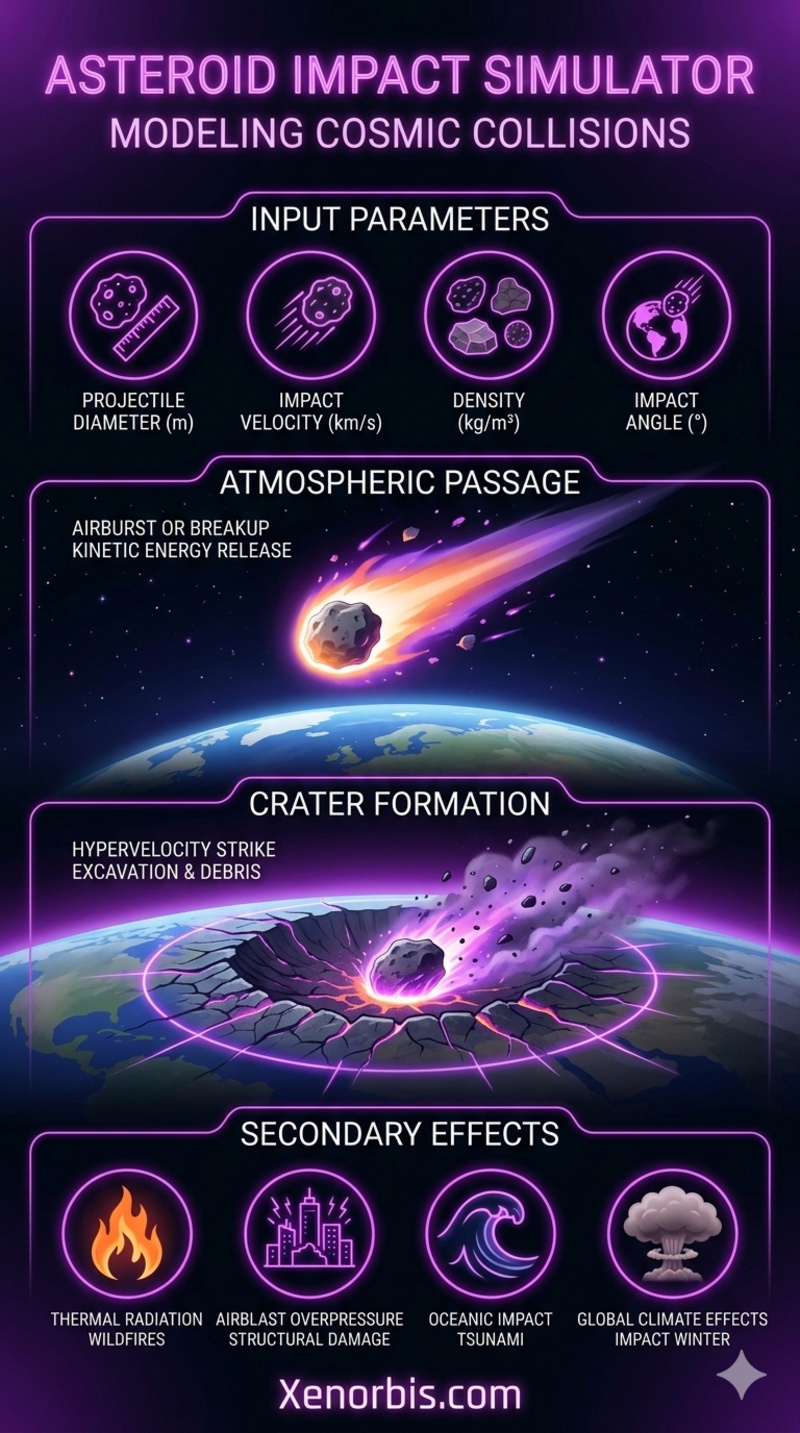
The subsequent formation of an impact crater occurs across distinct chronological phases. Following initial contact, the expanding shockwave initiates the excavation phase, pushing millions of tons of fractured, shock-melted rock upward and outward along ballistic trajectories. This creates a temporary, unstable opening known as the transient crater. To calculate the final size of this geological feature, modern collision simulators rely on empirical scaling laws derived from laboratory hypervelocity experiments and historical nuclear testing data. The diameter of the transient crater can be mathematically approximated using this specialized formula:
Dt = 1.16 · ρi0.33 · ρt-0.33 · L0.78 · v0.44 · g-0.22
Here, Dt signifies the final diameter of the transient cavity, ρi is the impactor density, ρt is the target rock density, L represents the physical diameter of the asteroid, v is the unattenuated impact velocity, and g represents the gravitational acceleration of the host planet. Once the transient crater reaches its maximum size, gravity takes over during the modification phase, causing the steep, unstable walls of the cavity to slide inward, which significantly alters the final morphology of the crater structure.
| Crater Typology | Diameter Range On Earth | Structural Morphological Characteristics |
|---|---|---|
| Simple Bowl Craters | Under 2 to 4 kilometers | Parabolic bowl geometry featuring a raised rim and a floor lined with breccia and fallback debris. |
| Complex Peak Craters | 4 to 40 kilometers | Flat floors with a distinct central peak created by the gravitational rebound of deep crustal layers. |
| Multi-Ring Basins | Exceeding 40 kilometers | Highly collapsed geological structures featuring concentric rings of faults and massive internal melt sheets. |
The transition from a simple bowl crater to a complex peak crater depends heavily on the gravitational pull of the planet and the material strength of the target crust. On Earth, this transition occurs at roughly three to four kilometers in crystalline rock formations.
Secondary Environmental Catastrophes
The creation of a physical crater represents only a fraction of the total destructive footprint of an asteroid strike. A robust simulation engine must account for secondary environmental effects, which frequently extend far beyond the localized blast zone. These phenomena include intense thermal radiation, destructive atmospheric overpressure waves, severe seismic shaking, and regional megatsunamis if the strike takes place within an oceanic basin.
Thermal radiation travels outward at the speed of light from the expanding, superheated impact fireball. The intense radiant energy can ignite wildfires and cause severe thermal burns across immense distances. The total thermal fluence received at a specific distance from the point of impact can be calculated using this radiation model:
F = Erad / 4 · π · r2
Where F represents the thermal fluence in Joules per square meter, Erad is the total energy converted into radiant light, and r signifies the straight-line distance from the center of the fireball. If the thermal fluence exceeds specific thresholds, combustible materials like forests and wood-framed structures will spontaneously combust, creating widespread firestorms.
Close behind the thermal flash comes the acoustic airblast wave. As the vaporized rock and compressed air expand outward from the crater rim, they form a supersonic shockwave that sweeps across the landscape. This blast wave carries a massive overpressure peak that physically flattens structures and vegetation. The severity of the airblast damage decays as the wave expands, but it remains a primary driver of regional destruction across hundreds of kilometers. Simultaneously, a significant portion of the initial kinetic energy couples directly into the planetary crust, triggering severe seismic waves that mimic major tectonic earthquakes, fracturing infrastructure and destabilizing slopes over massive radial distances.
Quantifying Global Risks and Threat Scales
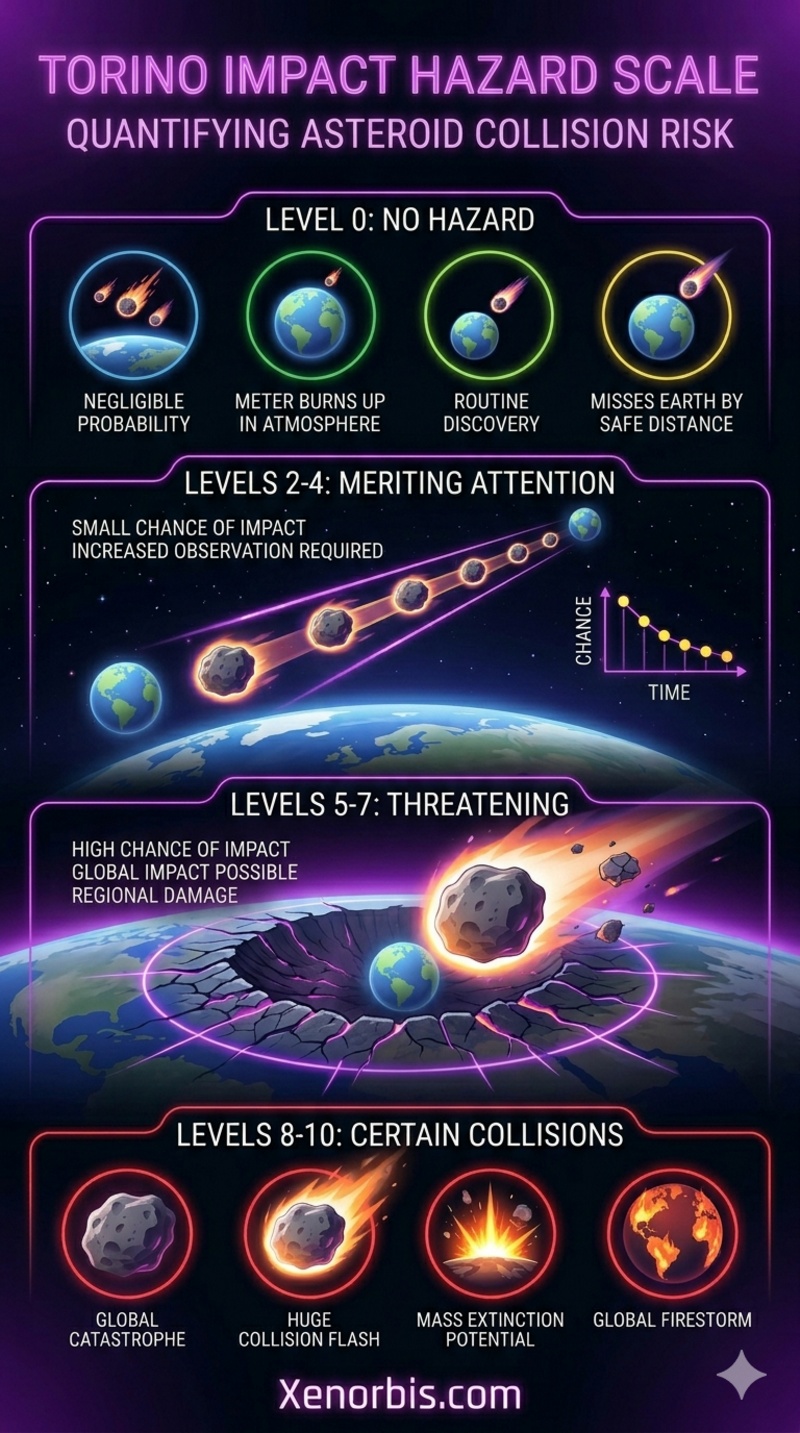
To contextualize the potential damage of near-Earth objects, astronomers and planetary defense specialists utilize standardized hazard metrics. The most famous public classification system is the Torino Impact Hazard Scale, which ranks predicted threat levels on a scale from zero to ten. A rating of zero denotes a completely negligible probability of collision or an object so small it will burn up harmlessly in the air, while a ten signifies a certain collision capable of causing a global climatic catastrophe.
For technical assessments, professionals rely on the Palermo Technical Impact Hazard Scale. This mathematical metric compares the calculated risk of a specific potential impact against the background hazard level posed by all other space objects of equal or greater size over the intervening years until the potential event date. This allows scientists to isolate highly anomalous threats that require immediate tracking or intervention. The following reference table connects the total kinetic energy yield of an impact event with its statistical frequency and typical environmental consequences.
| Energy Yield Megatons | Average Interval Years | Expected Biospheric and Infrastructure Damage |
|---|---|---|
| 0.1 to 10 MT | 100 to 1000 | Localized airburst events capable of leveling forests or damaging coastal infrastructure via small tsunamis. |
| 10 to 1000 MT | 1000 to 50000 | Regional devastation with the potential to completely obliterate metropolitan areas or trigger severe regional earthquakes. |
| 1000 to 100000 MT | 50000 to 1000000 | Continental crises featuring massive cratering, global atmospheric dust loading, and widespread crop failures due to dimming. |
| Exceeding 100000 MT | Over 10000000 | Global extinction events characterized by permanent climatic shifts, global firestorms, and prolonged impact winters. |
By compiling these varied mathematical and physical parameters into an accessible web interface, an asteroid impact simulator demystifies the complex mechanics of cosmic collisions. It shifts the conversation from abstract science fiction into quantifiable, verifiable physics, offering users an unvarnished look at the delicate celestial balance that preserves life on our planet.
Literature
For those wishing to dive deeper into the mathematics, geology, and history of cosmic collisions, the following texts represent the foundational academic and popular literature on the subject.
- Impact Cratering: A Geologic Process by H. J. Melosh — The definitive academic textbook outlining the physics of shock compression, excavation, and crater scaling laws.
- Hazards Due to Comets and Asteroids by Tom Gehrels — A comprehensive collection of scientific papers focusing on planetary defense strategies, tracking systems, and impact mitigation.
- The Cosmic Winter by Victor Clube and Bill Napier — An analytical look at the historical role of cometary fragmentation and its influence on terrestrial civilizational crises.
- Traces of Catastrophe: A Handbook of Shock-Metamorphic Effects in Terrestrial Meteorite Impact Structures by Bevan M. French — An essential field manual detailing the microscopic and petrographic evidence used to identify ancient terrestrial impact zones.

Julian D. Thorne — Celestial Mechanics Developer
Researcher and 3D engine developer focused on interactive stellar systems. Julian bridges the gap between theoretical physics and real-time browser-based cosmos exploration.


