
The dawn of accessible web-based 3D rendering has transformed astronomical education and space mission visualization. The Explore the Lunar Surface in 3D application stands as a prime example of this technological leap. It offers an interactive, mathematically grounded simulation of our nearest celestial neighbor. Users can seamlessly transition from a macro-level orbital overview to a micro-level surface perspective, observing scaled models of exploration rovers and descent modules. This tool bridges the gap between abstract astrophysical data and tangible visual understanding. By manipulating the virtual camera and environment controls, observers gain a profound appreciation for the sheer scale and harsh realities of off-world environments.
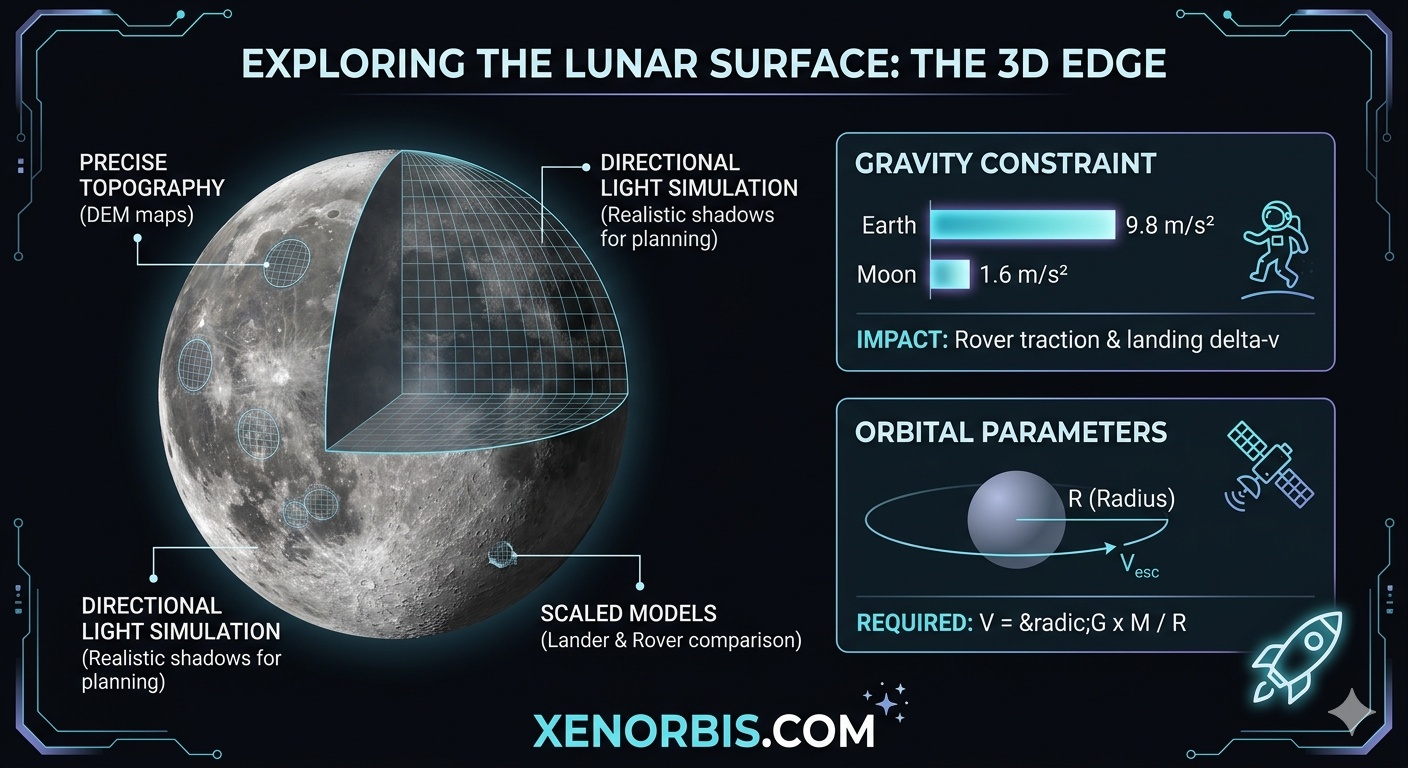
Navigating the lunar environment is not a simple matter of driving a vehicle across a sandy beach. The Moon presents a uniquely hostile theater for both manned and unmanned missions. Its surface is completely devoid of atmosphere, meaning there is no aerodynamic drag to slow down descending spacecraft and no weather systems to erode impact craters. What remains is a pristine, silent record of cosmic bombardment spanning billions of years. The 3D simulator meticulously recreates these conditions, utilizing high-resolution displacement maps and accurate directional lighting to cast realistic, stark shadows across the regolith. These shadows are not merely aesthetic enhancements; they are critical navigational constraints that real mission controllers must calculate when planning a rover traverse or a module landing.
Contents
The Physics of Lunar Orbit and Descent
Before a spacecraft can deploy a surface rover, it must successfully navigate the complex orbital mechanics governing the Earth-Moon system. The transition from a trans-lunar injection trajectory to a stable low lunar orbit requires precise velocity adjustments. The mathematical foundation of these maneuvers relies on classical mechanics. Calculating the correct orbital velocity is the first step in ensuring a module does not either crash into the surface or drift away into deep space. The fundamental formula governing this orbital velocity is expressed as
V = √G x M / R
In this equation, G stands for the universal gravitational constant, M represents the total mass of the Moon, and R is the radial distance from the center of the lunar body to the orbiting spacecraft.
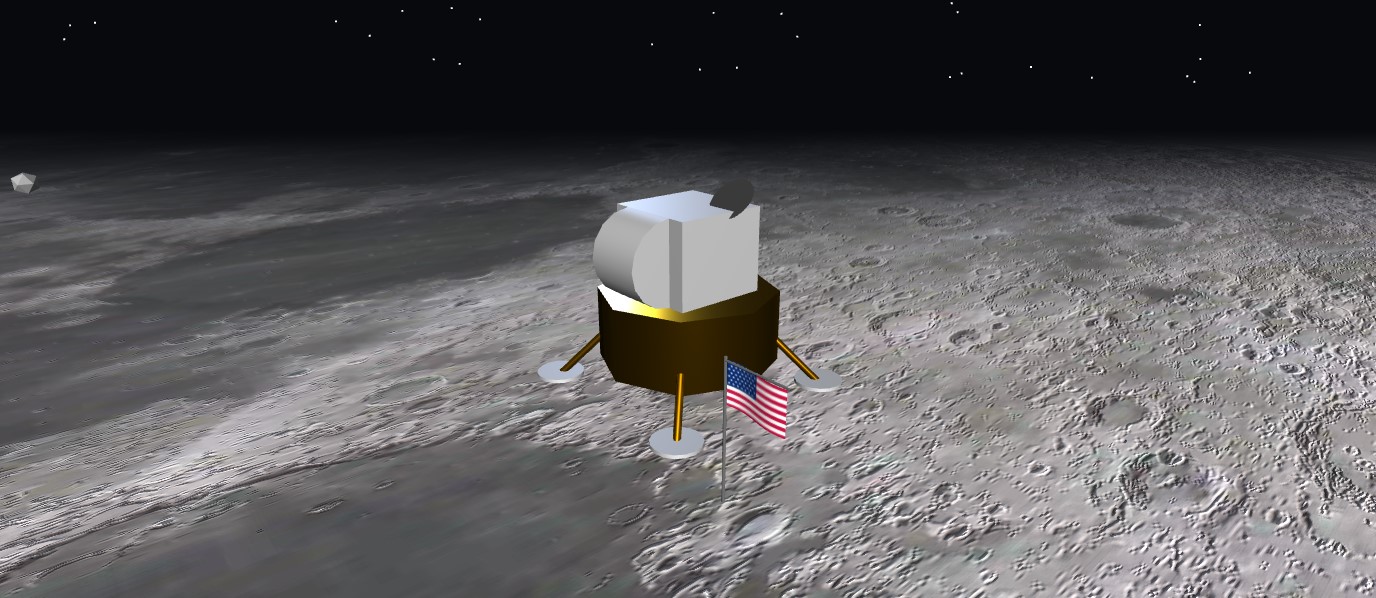
If a spacecraft needs to abort its descent or eventually return to Earth, it must achieve escape velocity. This is the minimum speed required to break free from the gravitational pull of the celestial body entirely. The equation for lunar escape velocity is
Vesc = √2 x G x M / R
Because the Moon possesses only about one-sixth of Earth gravity, its escape velocity is significantly lower, which greatly reduces the propellant mass required for a return journey. Furthermore, mission planners must know the exact duration of each orbit to maintain communication windows with Earth-based tracking stations. The orbital period T can be determined using Kepler’s Third Law, formulated as
T = 2 x π x √a3 / μ
Here, a is the semi-major axis of the orbit, and μ is the standard gravitational parameter of the Moon.
| Parameter | Value | Standard Unit | Mission Significance |
|---|---|---|---|
| Mass | 7.342 x 10²² | Kilograms | Determines the overall gravitational pull and orbital parameters. |
| Equatorial Radius | 1738.1 | Kilometers | Used as the baseline for calculating surface altitude and orbital height. |
| Surface Gravity | 1.62 | Meters per second squared | Dictates the structural limits of rovers and the thrust needed for landing. |
| Escape Velocity | 2.38 | Kilometers per second | Critical for designing ascent modules for return trajectories. |
The actual descent to the lunar surface is arguably the most perilous phase of any mission. A spacecraft must decelerate from thousands of kilometers per hour to a gentle hover just above the dust. This powered descent relies on throttleable rocket engines capable of precise thrust adjustments. The change in velocity required for this maneuver is known in aerospace engineering as delta-v. Calculating delta-v is done using the famous Tsiolkovsky rocket equation, written as
Δv = Isp x g0 x ln m0 / mf
In this context, Isp is the specific impulse indicating engine efficiency, g0 is standard Earth gravity used as a conversion constant, m0 is the initial mass of the spacecraft before the burn, and mf is the final mass after the propellant has been consumed. Efficiently managing the mass ratio is the ultimate key to a successful landing.
Surface Operations and Rover Mechanics
Once the descent stage has touched down, the focus shifts entirely to surface operations. The Explore the Lunar Surface in 3D application features a dedicated rover mode, allowing users to inspect the intricate geometry of a typical lunar vehicle. These rovers are engineering marvels designed to operate in extreme temperature fluctuations, ranging from intense solar radiation during the lunar day to the bitter cold of the lunar night. The surface itself consists of regolith, a fine, powdery dust composed of sharp, unweathered glass fragments. This abrasive material clings to everything due to static electricity, posing a severe threat to moving mechanical joints, thermal radiators, and optical lenses.
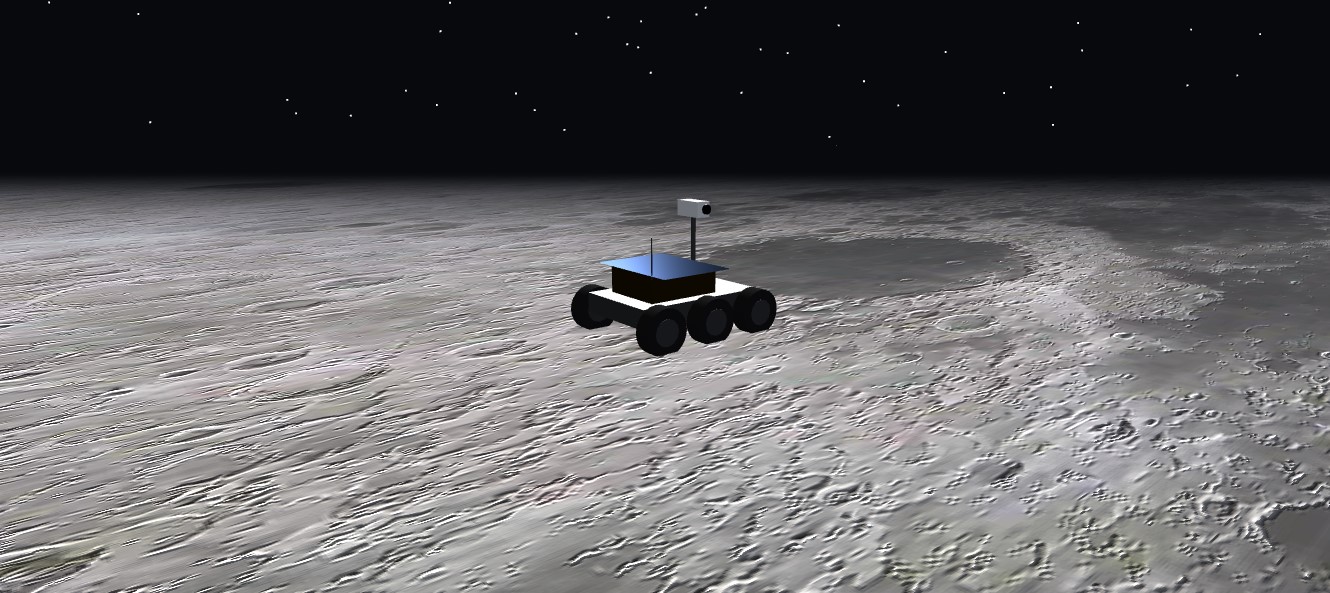
Mobility on such unpredictable terrain requires specialized drive systems. Rovers cannot rely on pneumatic tires like terrestrial vehicles. Instead, they use rigid wheels made of woven metallic mesh or solid aluminum with aggressive cleats for traction. To calculate the tractive effort Ft required to climb the rim of a crater, engineers use the formula
Ft = W x sin θ + W x Crr x cos θ
Here, W represents the weight of the rover under lunar gravity, θ is the incline angle of the crater wall, and Crr is the coefficient of rolling resistance depending on soil compaction. If the applied torque exceeds the shear strength of the regolith, the wheels will simply dig themselves into a trap.
Electrical power is the lifeblood of any robotic explorer. While some missions utilize radioisotope thermoelectric generators, the vast majority rely on deployable solar arrays. The energy gathered from these panels must power the drivetrain, the scientific instruments, and the crucial communication antennas. The power output Pout generated by a solar array can be estimated using
Pout = A x η x S x cos φ
In this formulation, A is the total active area of the solar panels, η signifies the energy conversion efficiency of the photovoltaic cells, S is the solar irradiance at the Moon, and φ is the angle of incidence between the incoming sunlight and the perpendicular normal of the panel surface. Maintaining the correct orientation towards the Sun is a continuous priority for surface operations.
| Rover Designation | Deploying Agency | Year of Operation | Primary Objective |
|---|---|---|---|
| Lunokhod 1 | Soviet Space Program | 1970 | First remote-controlled robot to land on another celestial body. |
| Lunar Roving Vehicle | NASA | 1971 | Manned transportation extending the exploration radius of Apollo astronauts. |
| Yutu-2 | CNSA | 2019 | Exploration of the lunar far side and analysis of deep mantle materials. |
| VIPER | NASA | Planned | Prospecting for water ice inside permanently shadowed craters at the south pole. |
Thermal Management and Deep Space Communications
Operating hardware on the lunar surface requires rigorous thermal management systems. The temperature variations are extreme and immediate. During the two-week-long lunar day, surface temperatures at the equator can soar to well over one hundred degrees Celsius. Conversely, during the lunar night, the environment plunges to deeply cryogenic levels. Rovers and landing modules must be equipped with complex active and passive cooling solutions to protect sensitive electronics. Radiators must reject excess heat generated by onboard computers and battery discharge while facing the cold vacuum of space, carefully avoiding the direct glare of the Sun. Heat pipes containing ammonia or freon are often utilized to transfer thermal energy away from the core systems. In the context of the 3D simulation, the visual representation of gold foil, formally known as multi-layer insulation, serves a crucial purpose. This insulation reflects incoming solar radiation and prevents the spacecraft from overheating, showcasing how engineering constraints directly dictate the visual aesthetics of space hardware.
Communication with Earth is another massive hurdle for lunar surface operations. Because the Moon is tidally locked to our planet, the near side always faces Earth, allowing for direct line-of-sight radio contact. However, any mission targeting the far side requires a relay satellite positioned in a stable halo orbit around the Earth-Moon Lagrange point. The signal strength received at the ground station depends heavily on the transmission power, the gain of the antennas, and the free-space path loss. The basic link budget equation used by communications engineers is defined simply as
Pr = Pt + Gt + Gr – Lp
In this formulation, Pr is the received power, Pt is the transmitter power, Gt is the gain of the transmitting antenna on the rover, Gr is the gain of the receiving dish on Earth, and Lp encompasses the path loss over the vast distance of three hundred eighty-four thousand kilometers. Maintaining accurate pointing of the high-gain parabolic dish is vital, as even a slight misalignment can result in a complete loss of telemetry and control data.
Topographical Challenges and Visualizing the Unknown
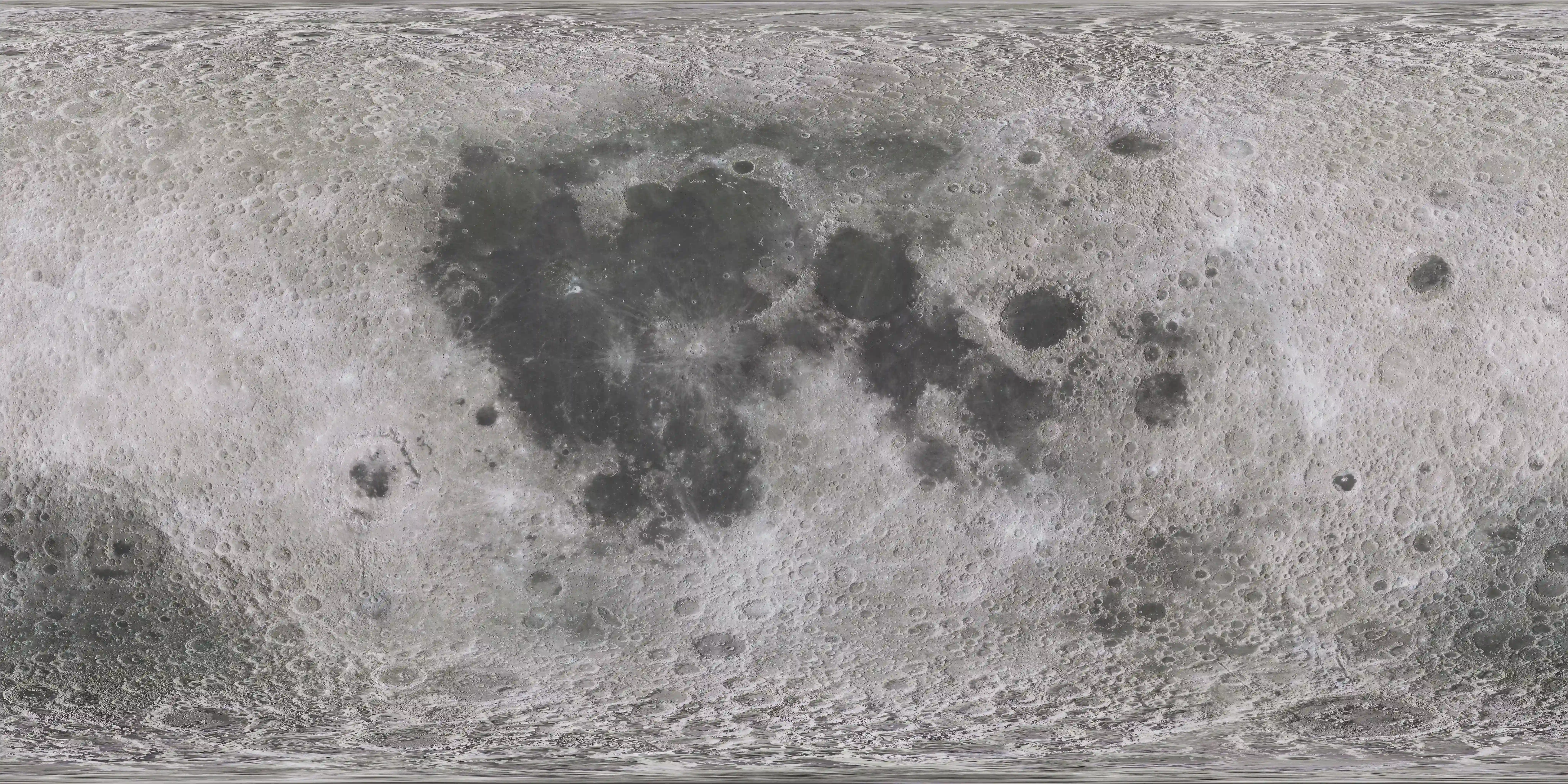
The visual fidelity of the 3D web application brings the stark topography of the Moon to life. By observing the simulation, it becomes evident why landing sites are chosen with such extreme caution. The lunar maria, the large dark basaltic plains formed by ancient volcanic eruptions, are generally the safest places to land due to their relative flatness. However, the lunar highlands, which are older and far more heavily cratered, hold the greatest scientific value. Navigating a rover through these chaotic regions requires constant stereo imaging to build localized 3D elevation maps. Without a magnetic field to shield it, the Moon’s surface is fully exposed to galactic cosmic rays and solar flares, further complicating the electronics design of any exploration hardware.
One of the most fascinating aspects of modern lunar exploration — which users can simulate by adjusting the light angles in the 3D viewer — is the investigation of permanently shadowed regions. Near the lunar poles, the angle of incoming sunlight is so shallow that the bottoms of deep craters have not seen a single ray of light in billions of years. Temperatures in these dark abysses hover just above absolute zero. Scientific consensus strongly suggests that these craters act as cold traps, capturing and preserving water ice deposited by ancient comet impacts. This ice is considered the most valuable resource in the inner solar system. It can be mined, melted for drinking water, or electrolyzed into hydrogen and oxygen to produce breathable air and highly efficient rocket propellant for deep space missions.
The Engineering Behind the Simulation
- Creating an accurate, real-time 3D simulation of a planetary body within a web browser is a significant technical achievement. It requires optimizing complex geometry and massive texture files to ensure smooth performance across various devices. The application leverages WebGL libraries to calculate the position of thousands of background stars dynamically, ensuring the celestial sphere is accurately represented. The deployment of anisotropic filtering prevents the high-resolution lunar texture from blurring at grazing angles, providing crisp visibility all the way to the horizon.
- The procedural generation of the rover and landing modules ensures that users can scrutinize the mechanical details without experiencing severe frame rate drops. Elements like the gold foil insulation on the descent stage, the complex suspension systems of the rover, and the parabolic communication dishes are rendered with precise metallic and roughness values. This attention to material properties allows the virtual sunlight to glint off the solar panels and scatter realistically across the dusty ground. It is this combination of accurate mathematical scale and high-fidelity rendering that elevates the application from a simple toy to a powerful educational instrument.
- Interactive tools like this empower the next generation of engineers, astrophysicists, and planetary geologists. By allowing the public to freely explore the mechanics of spaceflight and the topography of alien worlds, the platform democratizes the science of space exploration. Every time a user adjusts the zoom slider or switches from orbital view to surface level, they are participating in the same visual exercises utilized by actual mission planners. Understanding the relationship between thrust, mass, gravity, and power generation is the first step toward expanding humanity’s presence beyond Earth orbit.
Essential Reading for Aspiring Space Explorers
For those looking to expand their knowledge beyond this 3D simulation, the following texts provide deep insights into planetary science, vehicle engineering, and the history of spaceflight. These resources cover everything from the granular composition of lunar dust to the complex orbital mechanics required to reach it.
- Lunar Sourcebook: A User’s Guide to the Moon by Grant Heiken, David Vaniman, and Bevan M. French — The definitive reference work detailing the geology, chemistry, and physics of the lunar surface.
- Spaceflight Dynamics by William E. Wiesel — An excellent introduction to orbital mechanics, spacecraft attitude control, and the mathematics of rocket trajectories.
- Planetary Rovers: Robotic Exploration of the Solar System by Alex Ellery — A comprehensive engineering guide covering rover locomotion, autonomy, and power management in extraterrestrial environments.
- Fundamentals of Astrodynamics by Roger R. Bate, Donald D. Mueller, and Jerry E. White — A classic text providing clear explanations of Keplerian orbits, transfer maneuvers, and deep space navigation.
- The Apollo Spacecraft: A Chronology by Ivan D. Ertel — A detailed historical account of the engineering decisions, testing, and operational procedures that led to the successful manned lunar landings.
- Introduction to Flight by John D. Anderson Jr. — While primarily focused on atmospheric flight, its sections on spaceflight performance and rocket propulsion are foundational for aerospace understanding.

Julian D. Thorne — Celestial Mechanics Developer
Researcher and 3D engine developer focused on interactive stellar systems. Julian bridges the gap between theoretical physics and real-time browser-based cosmos exploration.


