The journey from the launchpad of Earth to the ancient regolith of the Moon represents one of the greatest engineering triumphs of civilization. Operating an interactive flight simulator requires more than just mechanical inputs; it demands a foundational understanding of orbital mechanics, propulsive efficiency, and gravitational interactions. This comprehensive technical guide serves as an educational companion to cislunar flight profiles, stripping away implementation complexities to focus purely on the immutable laws of physics and thermodynamics that govern the cosmos.
Contents
The Foundations of Astrodynamics and Flight Parameters
Objects in space do not travel in straight lines, nor do they respond to steering inputs in the manner of terrestrial vehicles. Spacecraft operate within a continuous state of freefall inside a gravitational field, where every maneuver alters the geometry of an orbital ellipse. To move between celestial bodies, a vessel must carefully manage its kinetic and potential energy states. The primary currency of this spatial navigation is delta-v, which represents the total change in velocity achieved by executing a propulsive burn.
Every maneuver consumes chemical propellant, reducing the instantaneous mass of the vehicle. This relationship means that a rocket becomes progressively lighter and more responsive as the mission advances, fundamentally altering its acceleration characteristics. Understanding this dynamic mass variation is crucial for predicting the outcome of long-duration burns during interplanetary transfers.
The Governing Equations of Rocketry
At the absolute core of all aerospace trajectory planning lies the classical relationship formulated at the dawn of the twentieth century by Konstantin Tsiolkovsky. This fundamental principle dictates how much velocity change a vehicle can extract from a specific mass of fuel based on the efficiency of its propulsion system.
Δv = Isubsp/sub · gsub0/sub · ln [msubinitial/sub / msubfinal/sub]
In this equation, Δv represents the net change in velocity, Isubsp/sub signifies the specific impulse of the engine system, gsub0/sub represents the standard acceleration of gravity at sea level, msubinitial/sub is the total initial mass of the vehicle including all fuel, and msubfinal/sub is the dry mass remaining after the propellant is spent. The natural logarithm indicates that adding more fuel yields diminishing returns, as the rocket must expend energy simply to accelerate its own unburned propellants.
To determine the instantaneous speed of a vehicle at any given point along its elliptical path, trajectory analysts utilize the vis-viva equation. This formula is derived directly from the conservation of mechanical energy within a two-body gravitational system.
vsup2/sup = μ · [2 / r – 1 / a]
Here, v represents the orbital velocity of the spacecraft relative to the primary body, μ is the standard gravitational parameter of that primary body, r is the current scalar distance from the center of the primary body to the spacecraft, and a is the semi-major axis of the orbit. If the value of a is positive, the orbit is an ellipse; if it is infinite, the path is a parabola representing escape velocity; if it is negative, the vehicle is on a hyperbolic escape trajectory.
The Mechanics of Atmospheric Ascent and Gravity Turns
🚀 Leaving the surface of Earth requires overcoming both gravitational pull and atmospheric resistance. A vertical launch is necessary initially to clear the dense lower layers of the atmosphere as quickly as possible, minimizing aerodynamic drag and structural stress. However, traveling straight up will never result in an orbit. To achieve a stable orbit, the vehicle must execute a gravity turn, a maneuver where the rocket pitches slightly away from the vertical axis early in flight, allowing gravity to pull its trajectory downward toward the horizon.
This optimization technique ensures that the rocket engine thrust aligns directly with the velocity vector, reducing steering losses to zero. The efficiency of this phase is heavily dependent on the thrust-to-weight ratio of the launch vehicle.
TWR = F / [m · gsub0/sub]
The variable TWR must comfortably exceed 1.0 at the moment of liftoff; typical orbital launchers utilize a ratio between 1.2 and 1.5. In this formula, F represents the combined thrust of the first-stage engines measured in Newtons, m represents the total liftoff mass, and gsub0/sub is the local gravitational acceleration. If the ratio is too low, the vehicle wastes excessive fuel fighting gravity without gaining horizontal velocity, a phenomenon known as gravity loss.
Reference Data for Cislunar Environments
Planning a mission across the Earth-Moon system requires precise knowledge of the physical characteristics of both the departure planet and the target moon. The vast differences in mass, radius, and gravitational pull dictate entirely different operational profiles for launch, capture, and landing phases.
Celestial Boundary Values
| Celestial Entity | Standard Gravitational Parameter μ | Surface Escape Velocity |
|---|---|---|
| Earth Platform | 398600.44 square kilometers per second cubed | 11.19 kilometers per second |
| Lunar Target | 4902.80 square kilometers per second cubed | 2.38 kilometers per second |
| Solar Primary | 132712440018.00 square kilometers per second cubed | 617.50 kilometers per second |
The data highlights why the energy profiles for leaving Earth and leaving the Moon are so asymmetric. Escaping Earth requires nearly five times the velocity needed to escape the Moon, meaning the initial launch vehicle must be orders of magnitude larger than the vehicle designed to return from the lunar surface.
Mission Stage Velocity Demands
A typical lunar profile can be broken down into discrete segments, each requiring a specific velocity modification. These values represent the nominal requirements for a standard flight path, assuming minimal steering errors and optimal launch windows.
| Mission Phase Name | Nominal Velocity Shift Requirement | Primary Physical Objective |
|---|---|---|
| Low Earth Orbit Insertion | 9300 to 10000 meters per second | Overcoming atmospheric friction and reaching orbital speed |
| Trans-Lunar Injection | 3150 to 3250 meters per second | Raising orbital apogee to intersect the lunar sphere of influence |
| Lunar Orbit Insertion | 800 to 1000 meters per second | Decelerating to enter a stable circular lunar parking orbit |
| Powered Descent to Surface | 1800 to 2000 meters per second | Canceling orbital velocity to achieve zero-speed touchdown |
| Lunar Ascent to Orbit | 1650 to 1800 meters per second | Re-establishing a stable circular parking orbit from the surface |
| Trans-Earth Injection | 800 to 950 meters per second | Escaping lunar gravity to place the craft on an Earth return path |
This sequential velocity budget demonstrates that the total mission requires a cumulative capability of approximately 18000 meters per second of velocity modification, a feat that cannot be accomplished by a single rocket stage using current chemical propellants due to structural mass limits.
The Physics of Deep Space Navigation
Once a spacecraft successfully establishes a low Earth parking orbit, it sits at a stable altitude where its speed matches the circular orbital velocity requirement. To break away from this cradle and head toward the Moon, the crew or automated flight computer must execute the Trans-Lunar Injection maneuver.
The Trans-Lunar Injection Ellipse
The Trans-Lunar Injection burn is essentially a massive acceleration profile executed at a precise location along the circular parking orbit. This maneuver adds approximately 3200 meters per second of velocity, instantly transforming the low circular path into a highly elongated elliptical orbit. The point of closest approach to Earth, known as perigee, remains at the launch altitude, while the farthest point, known as apogee, is extended outward into deep space to match the orbital distance of the Moon.
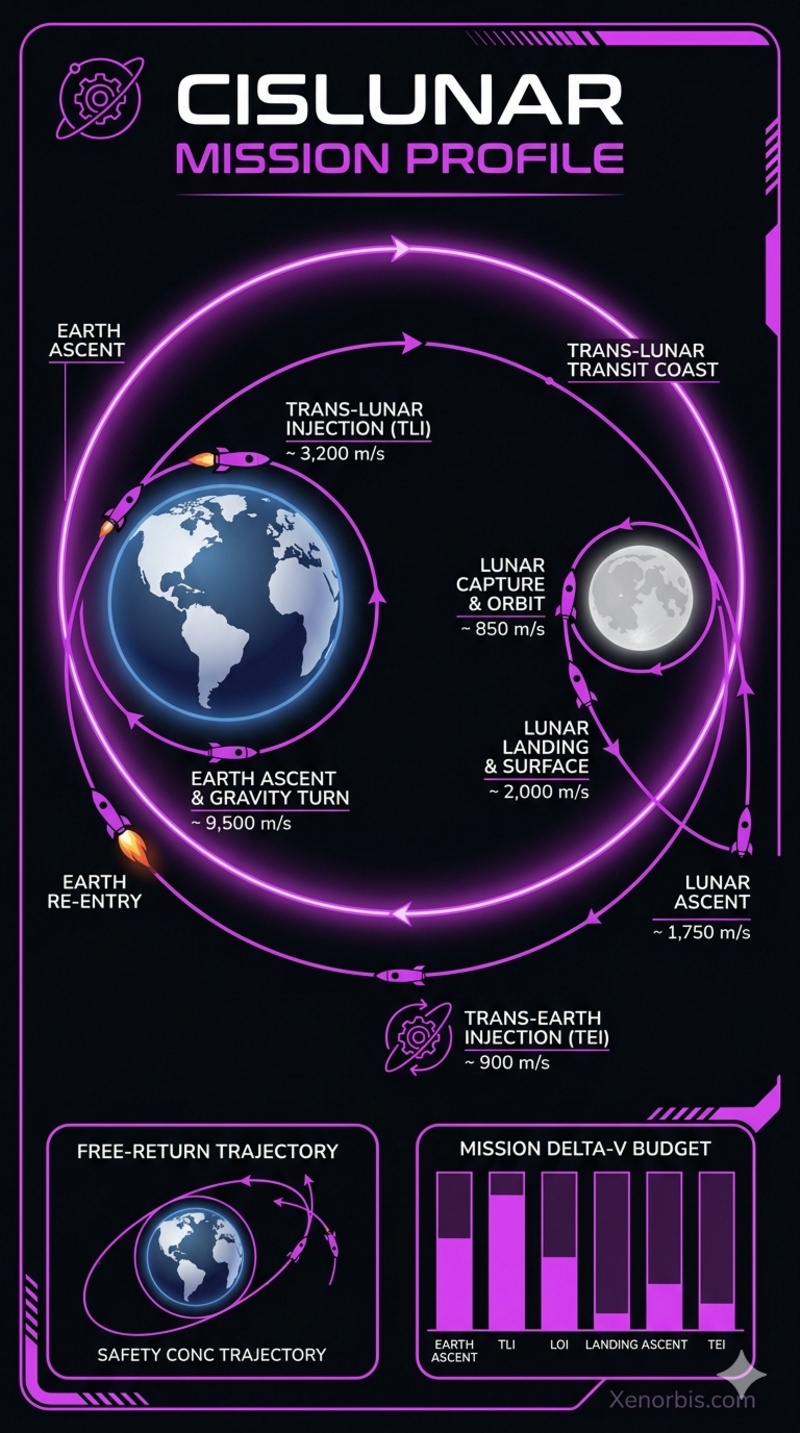
Crucially, this burn must be timed with extreme precision. The Moon is moving constantly along its own circular path at roughly one kilometer per second. The spacecraft does not aim at where the Moon is during the burn; it aims at an empty point in space where the Moon will arrive approximately three days later. If the burn occurs even a few seconds too early or too late, the spacecraft will miss the lunar sphere of influence entirely and swing back toward Earth in a useless loop.
The Concept of Free-Return Trajectories
During the early era of human lunar exploration, safety considerations led engineers to develop a specialized orbital design known as the free-return trajectory. This path acts as an abort-safety mechanism. The spacecraft is placed on an ellipse that deliberately misses the leading edge of the Moon and passes slightly behind it.
As the vessel enters the lunar gravitational field, the Moon pulls on the craft, bending its path around the far side. This interaction acts as a natural gravitational slingshot, reversing the direction of travel and redirecting the spacecraft back toward Earth without requiring a single drop of engine propellant. If the main propulsion system suffers a catastrophic failure during the transit phase, the laws of gravity will ensure that the crew returns safely to Earth’s atmosphere automatically.
The Realities of Propulsion Systems
The choice of rocket engine technology dictates the entire design and capability of a space vehicle. Propulsion systems are categorized primarily by their chemical propellants and the specific impulse they generate. Higher specific impulse means the engine extracts more energy from each kilogram of fuel, allowing for a lighter overall vehicle architecture.
Comparative Analysis of Engine Families
| Propulsion Unit Model | Vacuum Specific Impulse | Chemical Propellant Mix |
|---|---|---|
| F-1 First Stage Booster Engine | 304 seconds | Refined Petroleum and Liquid Oxygen |
| J-2 Vacuum Upper Stage Engine | 421 seconds | Liquid Hydrogen and Liquid Oxygen |
| RS-25 Sustainer Core Engine | 452 seconds | Liquid Hydrogen and Liquid Oxygen |
| Raptor Modern Architecture | 380 seconds | Liquid Methane and Liquid Oxygen |
| Lunar Ascent Storable Unit | 311 seconds | Aerozine 50 and Nitrogen Tetroxide |
Each chemical combination serves a distinct purpose. Liquid hydrogen and liquid oxygen provide the highest efficiency, but hydrogen requires massive, heavily insulated storage tanks due to its low density. Refined petroleum and liquid methane are much denser, allowing for smaller, lighter rocket structures, making them ideal for the high-thrust booster stages that must break through the dense lower atmosphere.
Conversely, the engines used on the lunar surface prioritize mechanical reliability over maximum efficiency. Storable hypergolic propellants ignite spontaneously upon contact with each other, completely eliminating the need for complex, heavy ignition systems. This absolute reliability is vital when an engine must ignite flawlessly to bring a crew home from the surface of another world.
Lunar Capture and the Powered Descent Phase
As the spacecraft approaches the end of its three-day transit coast, it crosses the imaginary boundary where the gravitational pull of the Moon becomes stronger than the pull of Earth. This boundary is known as the lunar sphere of influence. At this point, the craft is traveling along a hyperbolic flyby path; it is moving too fast for the weak gravity of the Moon to hold it permanently.
The Deceleration into Lunar Orbit
🌘 To avoid flying past the Moon and entering a permanent solar orbit, the vessel must execute the Lunar Orbit Insertion burn. The spacecraft is rotated 180 degrees so that its main engine nozzle points forward along its direction of travel. Firing the engine in this retrograde orientation acts as a powerful brake, removing kinetic energy from the vehicle.
This maneuver lowers the apogee of the hyperbolic flyby until it closes into a stable, circular orbit around the Moon, typically at an altitude of 100 kilometers above the cratered surface. From this parking orbit, the landing crew can verify systems, inspect the target site, and prepare for the final descent.
The Dynamics of the Powered Descent Inititation
Landing on the Moon presents an entirely unique set of physics challenges compared to landing on Earth. Because the Moon has no atmosphere, aerodynamic braking is impossible. Parachutes, drag chutes, and aerodynamic heat shields are completely useless in a hard vacuum. Every single unit of velocity must be canceled out through pure propulsive counter-force.

The phase known as Powered Descent Initiation begins with a brief burn that lowers the low point of the orbit down to roughly fifteen kilometers above the terrain. As the vehicle reaches this low point, the main landing engine fires continuously at maximum throttle. This phase is broken down into three distinct sub-phases:
- The Braking Phase: This initial segment focuses entirely on removing the massive horizontal orbital speed, which sits at roughly 1700 meters per second. The vehicle flies nearly flat, pointing its engine against the horizontal travel vector to shed velocity rapidly.
- The Approach Phase: As the horizontal speed drops to a few dozen meters per second, the vehicle pitches upward, bringing the crew or landing sensors into a vertical orientation. This allows the optical tracking systems to view the landing zone and identify hazardous boulders or craters.
- The Vertical Descent Phase: In the final few hundred meters, the engine throttles down precisely to match the local lunar gravity, allowing the craft to drop straight down at a controlled rate of one or two meters per second until contact is made with the soil.
Returning from the Lunar Surface
Leaving the Moon is significantly less demanding than launching from Earth, though it relies on the exact same physical principles. Because lunar gravity is only one-sixth of Earth’s value, and there is no atmospheric drag to contend with, the vehicle does not need a massive multi-stage booster to reach orbit.
The ascent stage ignites its engine and launches directly from the landing platform, which remains behind on the surface as a launchpad. The vehicle executes a rapid pitch maneuver toward the horizon to build horizontal orbital velocity. Once a stable lunar orbit is re-established, the vehicle rendezvous with the return capsule and prepares for the final Trans-Earth Injection burn, which adds the necessary 900 meters per second of speed to break out of lunar orbit and drop back down the gravitational well toward home.
Recommended Literature and Essential Reading
- Rocket Propulsion Elements by George P. Sutton and Oscar Biblarz
- Fundamentals of Astrodynamics by Roger R. Bate, Donald D. Mueller, and Jerry E. White
- Orbital Mechanics for Engineering Students by Howard D. Curtis
- Ignition: An Informal History of Liquid Rocket Propellants by John D. Clark
- Apollo EECOM: Journey of a Lifetime by Sy Liebergot and David M. Harland

Julian D. Thorne — Celestial Mechanics Developer
Researcher and 3D engine developer focused on interactive stellar systems. Julian bridges the gap between theoretical physics and real-time browser-based cosmos exploration.


