For most of human history, the night sky was seen as a majestic, albeit flat, canvas. Stars were points of light fixed upon a celestial sphere, offering no hint of the staggering depths that lay between them. We knew the Milky Way as a faint, ghostly band stretching across the heavens, a curiosity with an unknown structure. Modern technology, however, has fundamentally shattered this ancient perspective. The advent of advanced astrometry and powerful 3D visualization software, such as the immersive Explore the Milky Way Galaxy in 3D application, has converted this two-dimensional view into a rich, navigable three-dimensional reality. This transformation is not merely aesthetic; it is a critical shift in how we conceptualize, study, and appreciate our home spiral galaxy. For any user seeking a deeper understanding of our place in the universe, an interactive 3D tool is an absolute necessity, providing insights that static images or traditional charts can never convey.
Contents
The Internal View Problem and How 3D Solves It
Mapping our galaxy from the *inside out* presents a monumental challenge. We are embedded within the Galactic Disk, thousands of light-years from the core. This position is akin to trying to map a dense forest while standing behind a single massive tree. Obscuring our view is cosmic dust, an interstellar fog that absorbs visual light, effectively hiding vast regions of the Milky Way, including the central nucleus. For centuries, this meant astronomers could only guess at the true structure of our galactic home.

3D visualization tools synthesize data from various observational techniques that pierce this dust. By utilizing infrared and radio wave data, which pass relatively unimpeded through cosmic dust, scientists have mapped the locations of giant molecular clouds, star clusters, and the hydrogen gas that defines the spiral arms. A 3D model takes these precise galactic coordinates and plots them, allowing a user to virtually step outside the solar system and perceive the spiral structure, the central bar, and the sprawling halo in their true relationship. It converts abstract data into an intuitive, tactile experience, making the immense scale of the Milky Way comprehensible to the human mind.
Deconstructing the Galactic Architecture: Bulge, Disk, and Halo
When visualizing the Milky Way in 3D, it is helpful to understand the primary structural components that define its shape and dynamics. Far from a simple uniform distribution of stars, the galaxy exhibits complex, distinctly defined regions. Mapping these regions requires vast amounts of accurate stellar data. Modern 3D astronomy software relies on major stellar catalogs, particularly the groundbreaking data provided by the European Space Agency’s Gaia satellite survey. Gaia has measured the precise positions, distances, and proper motions of over one billion stars, providing the essential scaffold for any high-fidelity 3D galactic model.
| Component | Physical Structure | Primary Stellar Content | Approximate Scale |
|---|---|---|---|
| Central Bulge | Spherical to bar-shaped nucleus; the dynamic center of the Milky Way. Contains Sgr A*. | Populated by ancient stars; predominantly older, metal-poor red giants. | Roughly 10,000 light-years in diameter. Significant vertical thickness. |
| Galactic Disk | The thin, flattened region where the spiral arms reside. Our location. Contains gas and dust. | Hosts the majority of the galaxy’s young stars, open clusters, and active star formation. | Roughly 100,000 to 120,000 light-years in diameter. Extremely thin compared to width. |
| Stellar Halo | A vast, sparsely populated sphere surrounding the disk and bulge. Includes dark matter. | Contains the oldest stars in the galaxy, many residing in globular clusters. Very low density. | Extends much further than the visible disk, possibly several hundred thousand light-years. |
| Spiral Arms | Regions of enhanced density within the disk; not solid structures, but density waves. | High concentration of gas, dust, blue giant stars, and vibrant emission nebulae. | Define the major structure within the 100,000+ light-year diameter disk. |
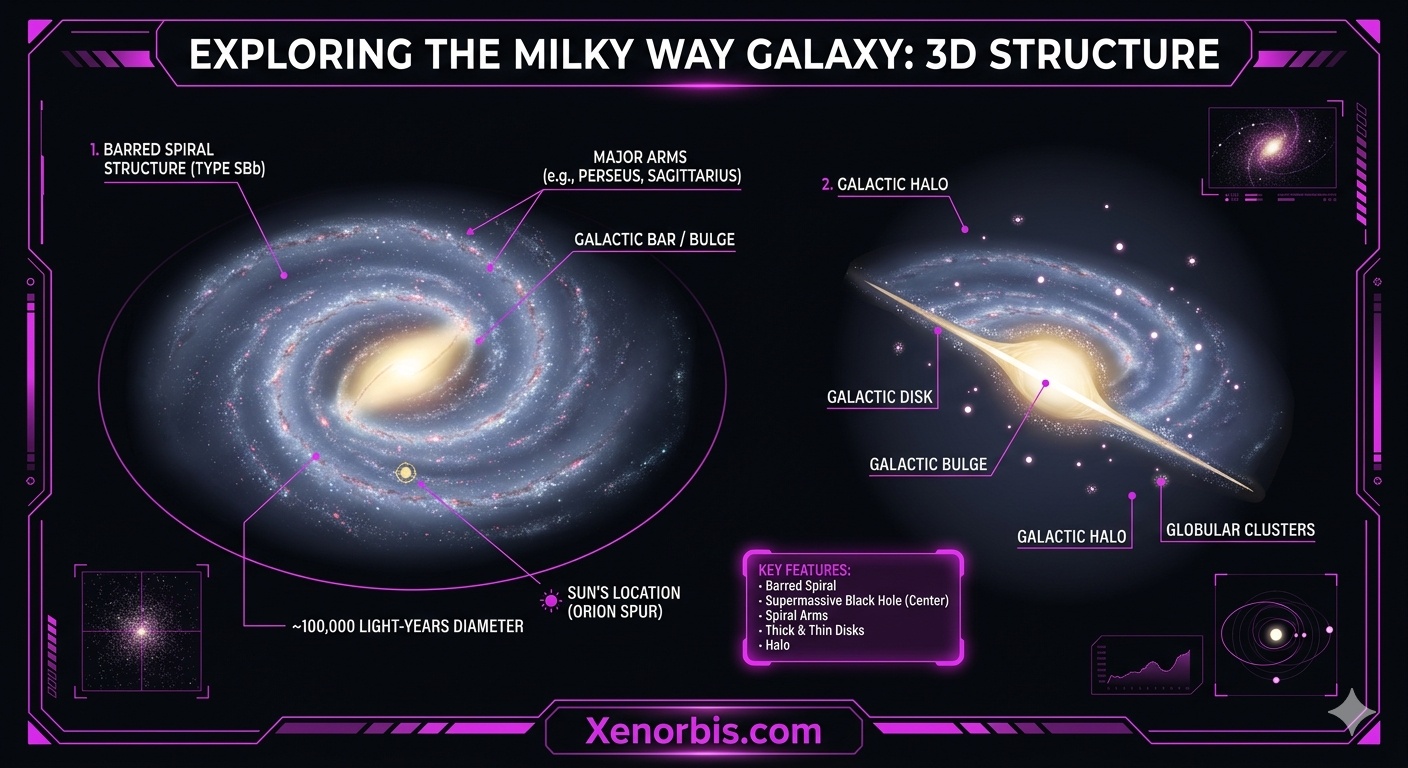
The core region, or Galactic Bulge, is a dense hub of stars that, in the Milky Way, is shaped more like a distinct bar than a perfect sphere. Modern 3D maps clearly show this bar structure, angled relative to our line of sight. Within the very center of this bulge lies Sagittarius A*, the supermassive black hole around which the entire galaxy orbits. Surrounding the bulge is the vast Galactic Disk, the region we inhabit, which is remarkably thin compared to its staggering width. This disk contains the interstellar medium, the raw material for future star formation. Beyond the visible boundaries of the disk and bulge is the Stellar Halo, a sparse region containing the oldest globular clusters and a mysterious concentration of dark matter that gravitationally binds the entire system.
The Intricacies of the Spiral Structure
Perhaps the most captivating feature revealed by 3D visualization is the complex architecture of the spiral arms. These are not permanent, rigid spokes on a wheel; rather, they are complex, dynamic density waves traveling through the galactic disk. Stars, gas, and dust are gravitationally slowed as they pass through these waves, causing a temporary pile-up. It is this compression of gas that triggers vibrant waves of new star formation, making the spiral arms illuminated bands of young, hot blue stars and massive nebulae.
Accurately mapping these arms from within the disk is incredibly challenging. Astronomers rely heavily on radio observations of neutral hydrogen, the most abundant element in the cosmos, which radiates a specific 21-centimeter wavelength. By observing the Doppler shift of this radiation, they can calculate the velocity and distance of this gas, allowing them to trace the spiral patterns. Modern 3D models consolidate this radio data with optical and infrared mappings of star clusters and masers to provide a cohesive view. For any user, 3D visualization is paramount for appreciating the scale of these arms and identifying major structures such as the Sagittarius Arm, the Perseus Arm, and the minor Orion-Cygnus Arm, also called the Orion Spur, which holds our sun.
Real Galactic Math: Distances and Velocities
The creation of any useful 3D astronomical map requires rigorous, real-world mathematical calculations. Determining the three-dimensional position of a star is the foundational task. Astronomers use a combination of Galactic longitude, l, Galactic latitude, b, and the calculated distance from the sun, d, to generate standard Cartesian coordinates, X, Y, Z, within the galactic reference frame. The critical, and often most difficult, variable to determine is d.
The gold standard for distance measurement is stellar parallax, the tiny apparent shift in a star’s position against the background stars when viewed from opposite sides of Earth’s orbit around the sun. This effect is mathematically inverted to determine distance. If p represents the measured parallax angle in arcseconds, the distance in parsecs, dpc, can be found with extreme simplicity.
dpc = 1 / parcsec
For stars too distant for this direct geometric method, astronomers must rely on indirect, more complex techniques, such as spectroscopic parallax. This involves analyzing a star’s spectrum to determine its true brightness, or absolute magnitude, and comparing it to its apparent brightness as seen from Earth. This relationship, which accounts for the predictable dimming of light over distance, is known as the distance modulus equation. Here, m represents the apparent magnitude and M represents the absolute magnitude, allowing distance, d, to be calculated.
m – M = 5 * log10(d) – 5
Furthermore, stars are not fixed points in 3D maps; they are constantly in motion. Understanding this motion is critical for dynamic galactic models and simulations of past and future galactic structure. This complex calculation requires measuring a star’s velocity in two directions: its radial velocity, Vr, along our line of sight, and its proper motion, μ, the across-the-sky movement. By combining these variables, astronomers can calculate the true 3D space velocity, Vs, using a fundamental geometric theorem.
Vs = √(Vr2 + (d * μ)2)
A sophisticated 3D visualization tool like the Milky Way Galaxy in 3D application doesn’t just show a static snapshot; it synthesizes this velocity data to show how different populations of stars, such as old stars in the halo versus young stars in the arms, move in distinctly different ways through the galactic system.
Galactic Neighbors and Significant Mappings
A comprehensive 3D map extends beyond the major structural components and integrates specific regions and dynamic features. The Milky Way is part of a complex system, constantly interacting with a retinue of smaller satellite galaxies and streams of gas, all of which are revealed through deep 3D mapping and visualization. Many of these regions contain some of the most iconic objects in astronomy.
| Region/Feature | Description | Importance to Astrometry | Key Visual Content |
|---|---|---|---|
| Orion-Cygnus Arm | A minor spiral structure, often called the Orion Spur, situated between major arms. | Crucial for understanding our immediate interstellar environment. | Contains the Sun, the Orion Nebula, and the Gould Belt star forming region. |
| Galactic Center | The chaotic nucleus around Sgr A*. Impassable in visual light due to extreme dust blocking. | Dynamic hub; testing ground for general relativity near a supermassive black hole. | A massive concentration of ancient stars; intense radio and X-ray sources. |
| Galactic Halo (Outer) | The furthest, sparse sphere surrounding the galaxy. Mostly invisible to optical telescopes. | Holds key clues to galactic formation and a significant concentration of dark matter. | Home to over 150 identified globular clusters, dynamic streams of tidal gas. |
| Magellanic Clouds | Two major dwarf galaxies orbiting the Milky Way, located primarily in the southern sky. | Nearby satellite laboratories; vital for calibrating cosmic distance measurements. | Vibrant regions of active star formation; rich in young massive clusters and nebulae. |
Our immediate neighborhood within the Orion-Cygnus Arm is particularly well-mapped. This region contains the local interstellar cloud, a low-density region of gas through which the solar system is currently traveling. Understanding this local environment is vital for studying solar wind and interstellar interaction. 3D maps also reveal the fascinating structures of the Magellanic Clouds, two major companion galaxies that are gravitationally bound to the Milky Way. These satellites are not merely distant observers; they are dynamically linked to our galaxy, pulling long tidal streams of hydrogen gas, known as the Magellanic Stream, across the galactic halo. A sophisticated 3D model visualizes these large-scale tidal interactions, showing how these external systems directly affect the Milky Way itself.
Why 3D is Essential for Future Discovery
Static charts are no longer sufficient. Modern astronomical data, particularly from revolutionary surveys like Gaia, is inherently multidimensional and staggering in volume. The human mind cannot parse millions of X, Y, Z coordinates and velocity vectors from a table. 3D visualization is the only method for synthesizing this overwhelming cascade of information into a cohesive, meaningful representation. This technology allows scientists to identify previously unknown stellar streams, trace the migration of stars over billions of years, and create dynamic simulations of galactic collisions. For educators and enthusiasts, a tool that allows them to virtually navigate the galaxy, zoom from the sun to the core, and perceive the correct spatial arrangement of stars creates an entirely new level of engagement. Interactive 3D tools provide the essential context for modern astronomy, transforming the Milky Way from a distant band of light into a vibrant, complex, and understandable three-dimensional home. This technology doesn’t just display data; it creates immersive galactic explorers, preparing everyone to appreciate the next wave of discoveries in galactic mapping and stellar dynamics.
Books on Milky Way Astronomy and Mapping
- The Milky Way: An Autobiography of Our Galaxy by Moiya McTier – A unique narrative approach, telling the story of our galaxy from its own perspective, but filled with accurate science on its structure and evolution.
- Astrobiology: A Very Short Introduction by David C. Catling – While focusing on life, this book provides a solid, concise foundation on the formation and structure of planetary systems within a galaxy like the Milky Way.
- Galactic Dynamics by James Binney and Scott Tremaine – The definitive, highly technical textbook on how stars and galaxies move. Not for beginners, but essential for understanding the mathematics behind 3D space velocities.
- Cosmos by Carl Sagan – The classic introduction to astronomy. While not solely about the Milky Way, it provides foundational insights and the captivating context that inspires galactic exploration.
- Gaia: The Unfolding Story of Our Galaxy by various contributors from the ESA Gaia team – For anyone fascinated by the data source behind modern 3D galactic maps, this provides insights into the revolutionary ESA mission that is currently mapping over one billion stars.

Julian D. Thorne — Celestial Mechanics Developer
Researcher and 3D engine developer focused on interactive stellar systems. Julian bridges the gap between theoretical physics and real-time browser-based cosmos exploration.


