Observers of the night sky have long been captivated by the sudden appearance of brilliant, glowing streaks across the stars. For centuries, these celestial wanderers were viewed as omens or supernatural messengers. Today, modern astronomy recognizes comets as ancient relics from the dawn of our solar system. These icy bodies offer invaluable clues about the formation of planets, the delivery of water to Earth, and the complex gravitational dance that governs planetary motion. Utilizing an interactive comet simulation provides an unparalleled opportunity to grasp the sheer scale and dynamic physics behind these cosmic phenomena.
🌠 To truly appreciate the visual spectacle of a comet blazing past the Sun, one must delve into the intricate physical processes and orbital mechanics at play. An interactive space simulator bridges the gap between abstract mathematical theories and tangible visual understanding. By manipulating orbital parameters and observing real-time changes in trajectory, enthusiasts and professionals alike can explore the delicate balance of forces that guide these frozen nomads through the void.
This comprehensive guide explores the structural anatomy of comets, their dark origins at the edge of the solar system, the mathematics dictating their paths, and the profound impact they have had on the evolution of habitable worlds. Whether studying celestial physics for academic purposes or simply exploring the mechanics of the universe, understanding cometary behavior is a fundamental pillar of modern astrophysics.
Contents
The Structural Anatomy of a Comet
Contrary to their massive appearance in the night sky, the solid core of a comet is surprisingly small. Astronomer Fred Whipple famously coined the term “dirty snowball” to describe this core, a fitting analogy for a body composed primarily of frozen water, carbon dioxide, methane, ammonia, and rocky dust. When a comet resides in the deep freeze of the outer solar system, it remains a dark, inert lump of cosmic debris. The dramatic transformation begins only when its orbit brings it into the inner solar system, where solar radiation triggers a profound metamorphosis.
As the comet crosses the frost line — the distance from the Sun where ice begins to turn directly into gas — a process called sublimation takes over. The frozen volatile compounds rapidly convert from solids to gases without passing through a liquid phase. This erupting gas carries dust particles away from the surface, forming a massive, glowing spherical envelope known as the coma. While the solid nucleus might only be a few kilometers across, the coma can expand to become larger than the planet Jupiter.
☄ The most visually striking features of a comet are undoubtedly its tails. It is a common misconception that a comet’s tail trails behind it indicating the direction of travel. In reality, cometary tails are shaped by the Sun and always point away from it, regardless of which way the comet is moving. The dust tail, composed of microscopic rocky particles, is pushed outward by the physical pressure of sunlight — radiation pressure. This tail appears yellowish-white as it reflects sunlight and slightly curves along the comet’s orbital path due to the conservation of angular momentum.
Simultaneously, a second tail forms. The ion tail, or plasma tail, consists of gas molecules that have been ionized by the Sun’s ultraviolet radiation. The solar wind — a high-speed stream of charged particles emanating from the Sun — catches these ions and drags them straight outward along the solar magnetic field lines. The ion tail glows with a faint blue light due to the emission spectra of carbon monoxide ions and always points strictly away from the Sun, forming a perfectly straight line that contrasts with the gently curving dust tail.
| Component | Primary Composition | Key Characteristics |
|---|---|---|
| Nucleus | Water ice, carbon monoxide, silicates, organic matter | The solid central body, highly porous, very low albedo — darker than coal. |
| Coma | Water vapor, carbon dioxide, dust particles | The temporary atmosphere forming near the Sun, highly reflective, massive in volume. |
| Dust Tail | Microscopic silicate grains, organic dust | Curved shape, pushed by photon radiation pressure, reflects yellow-white sunlight. |
| Ion Tail | Ionized carbon monoxide, water ions, plasma | Straight shape, carried by solar wind magnetic fields, emits blue light. |
Celestial Origins: The Kuiper Belt and Oort Cloud
Comets do not simply manifest out of nowhere; they originate from two distinct reservoirs at the icy frontiers of our solar system. Understanding these source regions is crucial for predicting cometary orbits and frequencies.
- The first region is the Kuiper Belt, a vast donut-shaped ring of icy bodies extending just beyond the orbit of Neptune. Objects in the Kuiper Belt are remnants from the original protoplanetary disk that failed to coalesce into planets. Comets originating from this region are classified as short-period comets, typically taking less than two hundred years to complete one orbit around the Sun. Their orbits lie roughly within the same plane as the planets, known as the ecliptic.
- The second, far more distant reservoir is the Oort Cloud. Unlike the flat Kuiper Belt, the Oort Cloud is believed to be a massive spherical shell surrounding the entire solar system, extending halfway to the nearest star. This frigid expanse contains trillions of icy bodies. Comets from the Oort Cloud are long-period comets, taking thousands or even millions of years to make a single journey around the Sun. Because the Oort Cloud is spherical, these comets can plunge into the inner solar system from any angle, exhibiting highly inclined and sometimes retrograde orbits.
The gravitational influence of passing stars, galactic tides, or massive planets like Jupiter and Saturn can perturb these icy bodies. A slight gravitational nudge can alter a comet’s velocity just enough to send it falling inward toward the Sun, beginning its long descent into the realm of the terrestrial planets. Jupiter plays a particularly vital role as the solar system’s gravitational vacuum cleaner. Its immense mass can either capture long-period comets into shorter orbits — creating the Jupiter-family comets — or completely eject them from the solar system entirely.
The Mathematics of Orbital Trajectories
At the heart of any interactive space simulation lies a robust engine of orbital mechanics. The motion of celestial bodies is governed by the laws of planetary motion formulated by Johannes Kepler and later mathematically proven by Isaac Newton’s law of universal gravitation. To model a comet accurately, one must employ specific formulas that dictate velocity, distance, and orbital period.
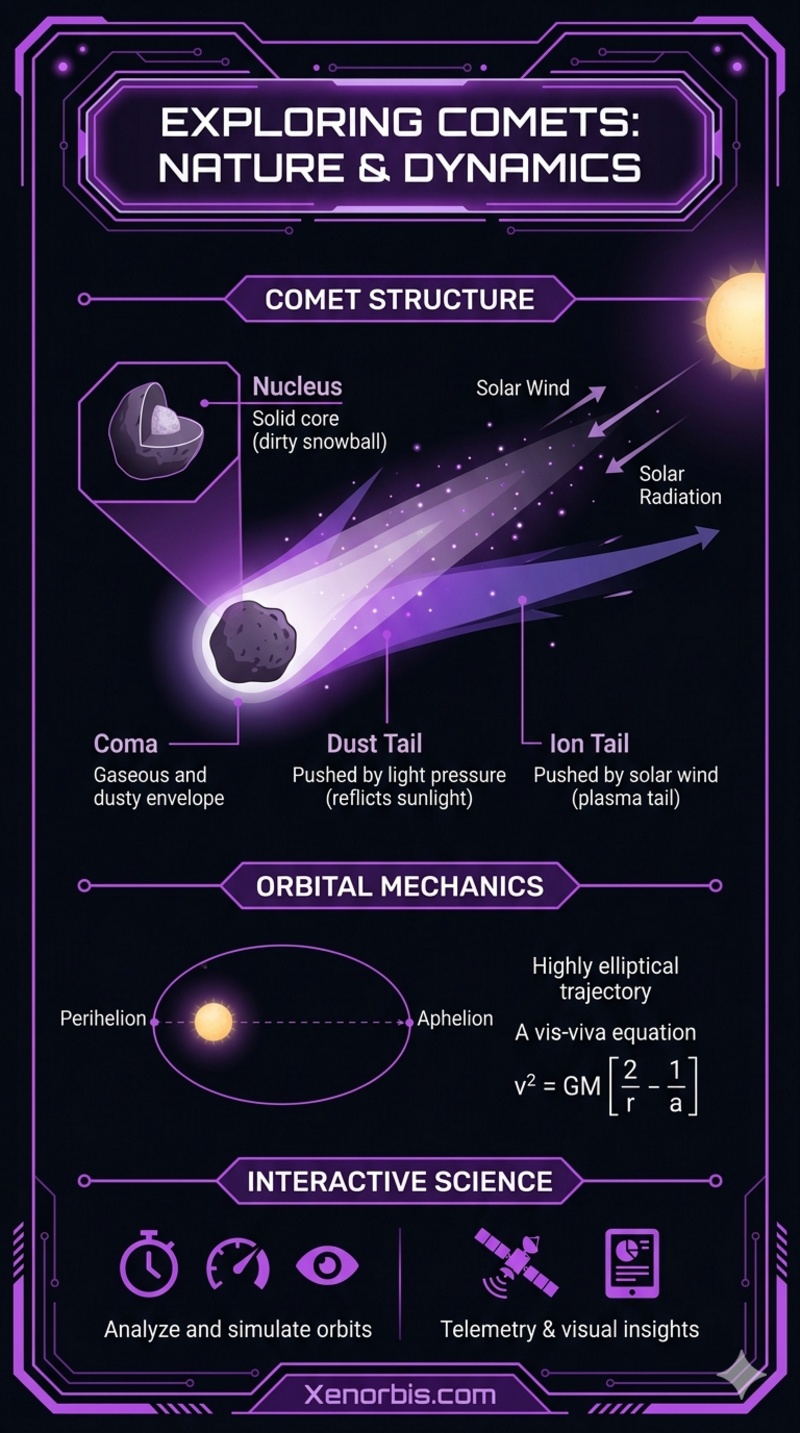
Comets typically follow highly elliptical orbits. The shape of an orbit is defined by its eccentricity, denoted by the letter e. A circular orbit has an eccentricity of exactly zero. An elliptical orbit has an eccentricity between zero and one. Parabolic and hyperbolic trajectories, which represent bodies that will pass by the Sun once and never return, have eccentricities of exactly one and greater than one, respectively. Most periodic comets have high eccentricities, often above 0.8, meaning their orbits are extremely elongated ovals.
☀ The point in a comet’s orbit where it is closest to the Sun is called the perihelion, while the furthest point is the aphelion. The speed of a comet is not constant; it accelerates as it falls toward the Sun due to increasing gravitational pull and reaches its maximum velocity at perihelion. As it moves away, climbing back out of the Sun’s gravity well, it gradually slows down, spending the vast majority of its life crawling through the freezing outer reaches of its orbit.
Essential Astrodynamics Formulas
Calculations in celestial mechanics rely on classical physics. To determine the gravitational force acting between the Sun and a comet, Newton’s law is applied. The formula for the gravitational force F is:
F = G * m1 * m2 / r2
Where G is the gravitational constant, m1 and m2 are the masses of the Sun and the comet respectively, and r is the distance between their centers. While mass is vital for calculating force, the trajectory of a small body orbiting a massive body is largely independent of the small body’s mass. This brings us to one of the most critical equations in astrodynamics — the vis-viva equation. This formula determines the orbital velocity v of a body at any given point in an elliptical orbit.
v2 = G * M * [ 2/r – 1/a ]
In this equation, M represents the mass of the central body — the Sun — while r is the current distance from the central body, and a is the semi-major axis of the orbit. The semi-major axis is essentially half the length of the longest diameter of the elliptical orbit. By utilizing the vis-viva equation, astronomical software can precisely calculate the real-time speed of a comet at any point along its path, allowing for smooth and scientifically accurate animations.
To calculate the exact distance at closest approach — perihelion, denoted as q — the following formula is used, relying on the semi-major axis a and the eccentricity e:
q = a * [ 1 – e ]
Conversely, the distance at aphelion — the furthest point, denoted as Q — is calculated as:
Q = a * [ 1 + e ]
| Comet Name | Orbital Period | Eccentricity |
|---|---|---|
| 1P/Halley | 75.3 years | 0.967 |
| Encke | 3.3 years | 0.848 |
| Hale-Bopp | 2,533 years | 0.995 |
| NEOWISE | 6,765 years | 0.999 |
| Churyumov-Gerasimenko | 6.4 years | 0.641 |
Non-Gravitational Forces: The Rocket Effect
While the mathematical models of gravity and ellipses work perfectly for planets and moons, comets present a unique challenge for celestial mechanicians. As a comet approaches the Sun and its icy crust sublimates, the outgassing does not occur symmetrically. Because the side facing the Sun heats up significantly faster than the dark side, jets of water vapor and dust erupt violently from the sunlit hemisphere.
🎓 According to Newton’s third law of motion, every action has an equal and opposite reaction. The intense outgassing acts like thousands of tiny rocket thrusters pushing against the comet’s nucleus. These thrusts create non-gravitational forces that can subtly but noticeably alter the comet’s trajectory over time. If a comet rotates, the afternoon side of the nucleus — the warmest part — will emit the strongest jets. Depending on the direction of rotation, this outgassing can either accelerate the comet along its path, effectively pushing it into a wider orbit, or decelerate it, causing its orbit to shrink.
Historically, this phenomenon explains why certain comets arrive at perihelion days or even weeks earlier or later than pure gravitational mathematics would predict. Advanced interactive simulations often incorporate sliders to represent outgassing intensity, allowing users to see how volatile material loss directly impacts orbital stability over millions of years. This jetting effect is also responsible for altering the rotation rate of the nucleus, sometimes spinning it up so fast that centrifugal forces tear the fragile, porous body apart entirely.
Modern Spacecraft Missions and Discoveries
Humanity’s understanding of comets has evolved exponentially thanks to robotic spaceflight. Ground-based telescopes can analyze the chemical spectra of glowing coma gas, but to truly understand the primordial material locked inside these bodies, direct encounters were necessary. The era of cometary exploration began in earnest during the 1986 return of Halley’s Comet, when a global armada of spacecraft was dispatched to intercept it. The European Giotto probe provided the very first close-up images of a cometary nucleus, revealing an incredibly dark, potato-shaped object violently spewing jets of gas.
Subsequent missions pushed the boundaries of engineering. The Stardust mission flew through the coma of Comet Wild 2, capturing pristine dust particles in silica aerogel and successfully returning them to Earth. Laboratory analysis of these grains revealed high-temperature minerals that must have formed very close to the young Sun, completely upending the theory that comets only contained material formed in the freezing outer reaches of the solar nebula. This proved that the early solar system was a highly dynamic environment with material violently mixing from the inner to the outer regions.
Perhaps the most aggressive study occurred during the Deep Impact mission, which intentionally crashed a copper projectile into Comet Tempel 1. The resulting explosion excavated a massive crater, allowing spectrometers to analyze the pristine material beneath the weathered surface crust. The data showed far more dust and far less ice than anticipated, blurring the traditional lines between rocky asteroids and icy comets.
The pinnacle of comet exploration was the Rosetta mission. After a ten-year chase through the solar system, Rosetta became the first spacecraft to orbit a comet — 67P/Churyumov-Gerasimenko. It mapped the bizarre, rubber-duck-shaped nucleus in unprecedented detail and deployed the Philae lander to the surface. Rosetta tracked the comet through its perihelion passage, observing the activation of surface jets, the collapse of sinkholes, and the complex interaction of the coma with the solar wind. The mission confirmed that the isotopic signature of water on this particular comet did not match Earth’s oceans, suggesting that while comets delivered organic material, asteroids might have been the primary source of Earth’s water.
| Spacecraft Mission | Target Object | Pioneering Achievement |
|---|---|---|
| Giotto | 1P/Halley | First direct photographs of a solid cometary nucleus. |
| Stardust | Wild 2 | First mission to return comet dust samples to Earth. |
| Deep Impact | Tempel 1 | First intentional kinetic impact to study internal subsurface composition. |
| Rosetta | Churyumov-Gerasimenko | First orbital insertion and soft landing on a comet surface. |
The Threat and Promise of Cometary Impacts
The study of cometary trajectories is not merely an academic exercise; it is a vital component of planetary defense. Due to their immense velocities — often striking Earth at speeds exceeding seventy kilometers per second — a cometary impact would release significantly more kinetic energy than an asteroid of the same size. The long orbital periods of Oort Cloud comets mean they can appear with only a few months of warning, leaving virtually no time to mount a deflection mission.
Historical evidence of such catastrophic encounters is etched into the surfaces of all terrestrial planets. The Tunguska event of 1908, which flattened millions of trees in Siberia, is widely theorized to have been caused by an airburst from a fragmented cometary body. Looking deeper into the past, during the Late Heavy Bombardment roughly four billion years ago, a relentless rain of comets and asteroids battered the young Earth. While this bombardment made the surface hellish, it was simultaneously delivering the building blocks of life. Spectral analysis of comas has detected complex organic molecules, including amino acids like glycine. It is a profound realization that the same cosmic mechanics that threaten life today may have seeded it in the primordial past.
Looking to the distant future, the very volatiles that cause cometary tails may become the fuel stations for interplanetary expansion. Water ice can be electrolyzed into liquid oxygen and liquid hydrogen — the most efficient chemical rocket propellants known. Ammonia and methane could serve as chemical feedstocks. Advanced space simulations help engineers model the complex rendezvous maneuvers required to intercept and eventually mine these high-velocity resources.
The Value of Interactive Visualizations
Grasping the scale of the solar system through text alone is notoriously difficult. The distances are too vast, and the speeds are too immense for the human brain to intuitively process. This is where interactive orbital simulations prove indispensable. By running a 3D model powered by real-world physics formulas, a user can visualize how the variables connect. Altering the eccentricity slider instantly demonstrates how an orbit flattens out, causing the simulation’s comet to accelerate violently as it whips around the Sun. Adjusting the inclination reveals the three-dimensional nature of the solar system, proving that planets and comets do not merely slide across a flat table.

Furthermore, rendering the dynamic dust and ion tails provides a clear visual indicator of solar radiation and solar wind vectors. As the virtual comet rounds the Sun, the user watches the tails swing outward like a celestial weather vane, staying pinned away from the central star regardless of the comet’s forward momentum. These tools bridge the gap between heavy academic equations and visual intuition, transforming dense astrodynamics into an accessible, engaging experience.
Recommended Astrodynamics and Astronomy Literature
For those eager to move beyond visualizations and master the underlying science of celestial mechanics and cometary physics, a robust library of specialized literature is required. The following texts offer deep insights ranging from observational history to orbital mathematics.
- Fundamentals of Astrodynamics by Roger R. Bate, Donald D. Mueller, and Jerry E. White. An absolute classic in orbital mechanics. This text breaks down the mathematics of two-body problems, Kepler’s laws, and orbital maneuvering in a rigorous yet understandable manner.
- Comets: Creators and Destroyers by David H. Levy. Written by one of the most prolific comet discoverers in history. This book details the dual role comets play as both the bringers of life-essential organic compounds and the agents of mass extinction events.
- Physics and Chemistry of Comets edited by Walter F. Huebner. A dense, high-level scientific reference detailing the thermodynamic processes of sublimation, coma plasma dynamics, and the chemical composition of solar system remnants.
- Orbital Mechanics for Engineering Students by Howard D. Curtis. A modern, highly practical textbook that provides step-by-step algorithms and equations for calculating three-dimensional orbits, complete with MATLAB-friendly logic perfect for programming custom space simulators.
- The Rosetta Mission: Exploring Comet 67P by various European Space Agency scientists. A comprehensive overview of the engineering challenges and unprecedented scientific discoveries resulting from humanity’s first attempt to orbit and land on an active comet nucleus.

Julian D. Thorne — Celestial Mechanics Developer
Researcher and 3D engine developer focused on interactive stellar systems. Julian bridges the gap between theoretical physics and real-time browser-based cosmos exploration.


