Understanding the sheer scale and complexity of the cosmos requires more than just reading textbooks. A physics-driven 3D universe evolution simulator transforms abstract astronomical concepts into a visually stunning interactive experience. By mapping out billions of years of cosmic history, such an application provides users with a profound perspective on how everything around us came to be. From the explosive inception of the Big Bang to the delicate orbital mechanics of our Solar System, interacting with a real-time cosmological model brings the deepest mysteries of astrophysics directly to the screen.

Space visualization tools are essential for students, educators, and science enthusiasts. They bridge the gap between complex mathematics and intuitive understanding. Manipulating time, adjusting simulation speed, and exploring different developmental stages allows observers to grasp the immense timescales involved in galactic formation. The mechanics driving these digital environments rely on real mathematical equations and established physical laws, ensuring that every rotating galaxy and expanding star cluster behaves realistically.
Contents
The Physics Behind the Screen: Why We Need Cosmic Simulations
Astrophysics is inherently mathematical. The distances are too vast and the processes too slow for direct human observation. We cannot watch a star collapse or a galaxy form in real time because these events take millions or even billions of years. This is precisely why interactive cosmological models are indispensable. They accelerate time and compress space, offering a functional laboratory where the laws of nature are computed at thousands of frames per second.
✍ Underneath the stunning graphics of expanding nebulas and swirling galaxies lies a rigid framework of numerical integration. When a simulator models planetary motion or stellar drift, it calculates the gravitational forces acting upon multiple bodies simultaneously. This is commonly known as the N-body problem. Since solving gravity for thousands of interacting objects analytically is impossible, computer models step through time, updating positions and velocities frame by frame using sophisticated algorithms.
Beyond gravity, visualizing the expansion of the universe requires rendering the stretching of space itself. According to modern cosmology, dark energy drives this accelerating expansion, pulling distant galaxy clusters apart. A robust simulation visualizes this metric expansion, showing the user how the observable universe grows exponentially while local structures like planetary systems remain bound together by gravity.
Astrophysical Formulas Driving the Universe
To accurately render the mechanics of space, simulators rely on foundational physics equations. These formulas govern everything from the speed of expanding galaxies to the orbital periods of planets. Below are some of the critical calculations used in realistic space modeling.
Hubble’s Law of Cosmic Expansion
The universe is expanding, and the speed at which a distant galaxy recedes from an observer is directly proportional to its distance. This is expressed as
v = H0 * d
Here, v represents the recessional velocity, H0 is the Hubble constant, and d is the proper distance to the galaxy. Simulators use this principle to scale the positions of background galaxies over time.
Newton’s Law of Universal Gravitation
For local interactions like solar systems and star clusters, classical gravity is often sufficient. The force between two masses is calculated as
F = G * m1 * m2 / r2
In this equation, F is the gravitational force, G is the gravitational constant, m1 and m2 are the interacting masses, and r is the distance separating their centers. This formula is the engine behind realistic planetary orbits.
Kepler’s Third Law of Planetary Motion
To ensure planets orbit at the correct speeds relative to their distance from a star, the relationship between orbital period and radius is essential. The law is written as
T2 = a3
where T is the orbital period in Earth years and a is the semi-major axis in astronomical units. This ensures that inner planets move faster than outer planets in the digital solar system.
Mass-Energy Equivalence
During the earliest stages of the cosmos, matter and energy were interchangeable. Albert Einstein famously described this with
E = mc2
where E is energy, m is mass, and c is the speed of light in a vacuum. This concept is crucial when simulating the Quark-Gluon Plasma epoch, where pure energy constantly converted into the first fundamental particles.
Chronological Stages of the Cosmos
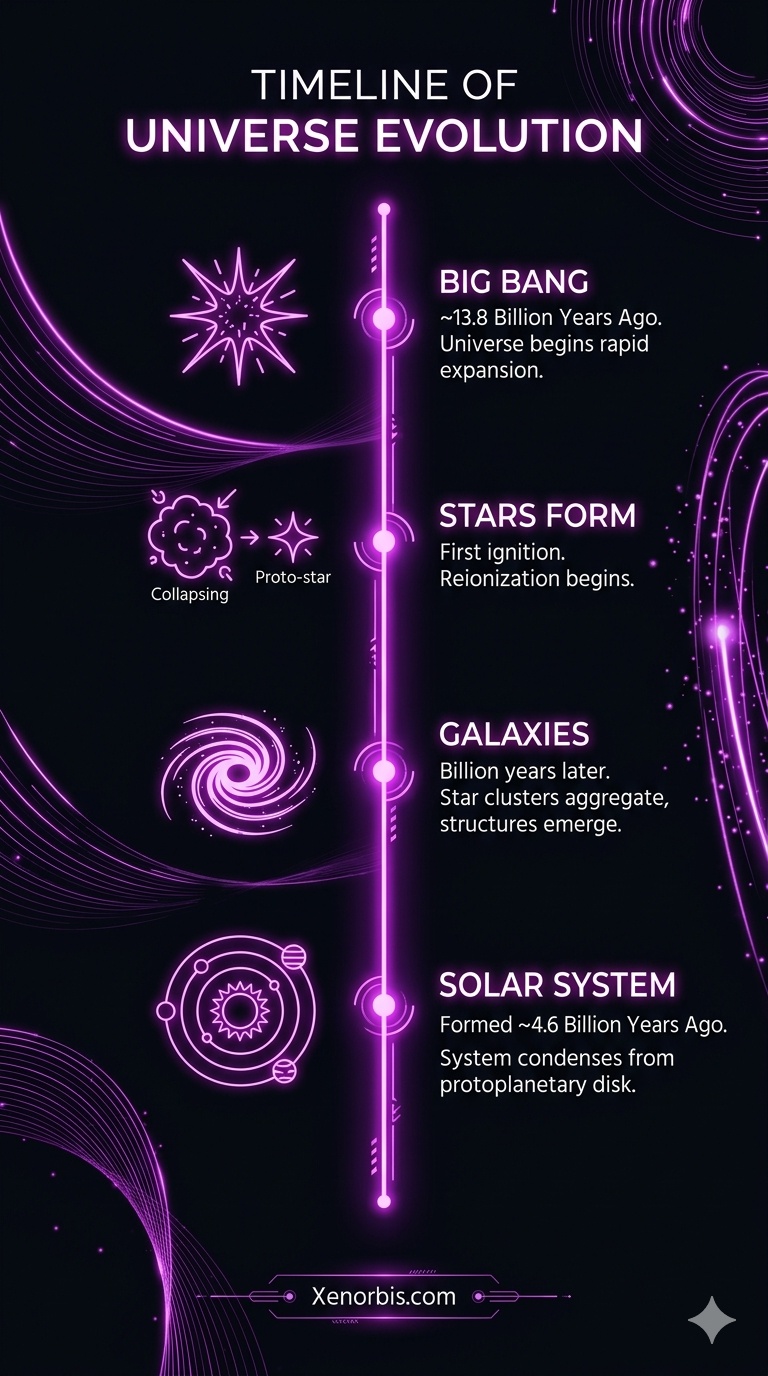
A comprehensive universe simulator divides cosmic history into distinct evolutionary phases. Traversing these stages offers a clear view of how raw energy transformed into intelligent life.
The Big Bang and Rapid Inflation
Everything began as an infinitely dense singularity. The simulator initiates with a brilliant, blinding explosion, representing the sudden expansion of space itself. Almost immediately, the inflation phase takes over. In a fraction of a microsecond, the universe expanded exponentially, smoothing out irregularities and setting the stage for the distribution of matter. Visually, this is represented by an extremely rapid outward burst of high-energy particles.
Quark-Gluon Plasma
Following inflation, the cosmos was far too hot for atomic nuclei to exist. Instead, it was filled with a super-dense, hyper-heated soup of quarks and gluons. In the digital environment, this appears as a violently chaotic, glowing plasma. As the universe continued to expand, the temperature gradually dropped, allowing these elementary particles to bind together and form the first protons and neutrons.
Recombination and the Cosmic Microwave Background
Approximately 380,000 years after the initial expansion, a monumental shift occurred. The universe cooled enough for electrons to bind to nuclei, forming the first stable atoms of hydrogen and helium. This event is called recombination. Suddenly, light could travel freely without scattering off free electrons. The universe became transparent. This first burst of traveling light is what we now detect as the Cosmic Microwave Background radiation.
The Dark Ages
With no stars yet burning, the universe entered a prolonged period of darkness. Hydrogen gas clouds drifted endlessly, slowly clumping together under the subtle influence of gravity and dark matter. In a simulation, this era feels vast and empty, with only slight variations in gas density hinting at the colossal structures that would eventually form.
First Stars and Galactic Formation
Gravity eventually won. The dense pockets of hydrogen gas collapsed under their own weight, igniting nuclear fusion and giving birth to the first generation of massive, brilliant stars. These stellar pioneers lived fast and died in violent supernova explosions, seeding the void with heavier elements. Over hundreds of millions of years, these stars congregated into the first primeval galaxies. The simulator showcases this as thousands of glowing points merging into swirling disks and elliptical clusters.
The Milky Way and the Solar System
Fast forward billions of years, and the universe is populated by mature galaxies. Our own Milky Way formed its distinct spiral arms. Within one of these quiet outer arms, a cloud of gas and dust collapsed to form the Sun. The leftover material flattened into a protoplanetary disk, crashing together over millions of years to build the planets. Simulators render this local view with stunning precision, showing the chaotic early solar system settling into the stable orbits we recognize today.
Tables of Cosmological Reference
To fully grasp the mechanics operating within the visualization, it is helpful to reference the specific parameters defining our reality. The following tables outline the eras, constants, and classifications driving cosmic evolution.
| Cosmic Epoch | Time After Beginning | Defining Event |
|---|---|---|
| Planck Epoch | Zero to 10-43 seconds | Fundamental forces unified |
| Inflationary Epoch | 10-36 seconds | Exponential spatial expansion |
| Nucleosynthesis | 3 to 20 minutes | Formation of initial helium |
| Recombination | 380,000 years | First atoms, transparent space |
| Stellar Era | 400 million years to present | Continuous star formation |
The mathematics of the simulation relies on fundamental parameters that dictate how fast things move and how strongly they attract one another. Altering these values in a physics engine would result in a vastly different universe.
| Physical Constant | Standard Value | Impact on Simulation |
|---|---|---|
| Speed of Light | 299,792 km per second | Sets the cosmic speed limit |
| Gravitational Constant | 6.674 × 10⁻¹¹ N m2 / kg2 | Determines orbital mechanics |
| Hubble Constant | Approx 70 km/s per Megaparsec | Rate of galactic separation |
| Cosmological Constant | Approx 10-52 m-2 | Drives dark energy acceleration |
Galactic Mechanics and Planetary Motion
Exploring a planetary system model provides immediate insight into the delicate balance of momentum and gravity. Planets do not simply float; they are constantly falling toward their star, but their lateral velocity ensures they keep missing it. This perpetual free-fall creates a stable orbit. A well-programmed simulator allows users to witness how varying a planet’s speed or distance immediately changes the shape of its orbit from a perfect circle to an elongated ellipse.
On a much larger scale, galactic rotation presents a fascinating physics puzzle. According to classical physics, stars at the outer edges of a spinning galaxy should move much slower than those near the dense galactic center. However, observations show that outer stars move much faster than expected. This anomaly is the primary evidence for dark matter, an invisible substance providing the extra gravitational glue needed to keep the rapidly spinning galaxy from flying apart. Modern simulators often incorporate dark matter halos into their structural algorithms to maintain realistic galactic shapes.
The Fate of the Universe: Three Scenarios
Just as the simulator models the past, it can extrapolate into the deep future. Depending on the density of matter and the strength of dark energy, the cosmos faces a few possible ultimate destinies.
| End Scenario | Driving Force | Ultimate Result |
|---|---|---|
| The Big Freeze | Continuous expansion | Stars die, absolute zero reached |
| The Big Crunch | Gravity overtakes expansion | Collapse into a new singularity |
| The Big Rip | Runaway dark energy | Atoms themselves are torn apart |
The current scientific consensus heavily favors the Big Freeze, also known as Heat Death. In this scenario, the universe expands forever. Eventually, the last stars will exhaust their fuel, leaving behind cold white dwarfs, neutron stars, and black holes. Over unimaginable trillions of years, even the black holes will evaporate via Hawking radiation. The simulator represents this bleak future as a slow fading of all light, leaving an infinitely vast, dark, and cold void.
How to Use the Simulator for Education and Research
Interactive space modeling serves as a highly effective educational platform. By granting users the ability to control time and space, learning becomes an active rather than passive experience. Teachers can utilize the tool to demonstrate orbital mechanics, showing students exactly why Mercury completes its year so much faster than Neptune. The visual representation of the inverse-square law becomes obvious when zooming out from a star and watching its light and gravitational influence diminish.
🕒 When operating the interface, manipulating the time slider is the most powerful feature. Moving from the hyper-accelerated moments of the early universe into the slower, deliberate pace of the modern era helps contextualize human existence. We occupy merely a fraction of a second on the grand cosmic clock. Pausing the simulation during the Dark Ages allows for a deep appreciation of the structural formation that eventually allowed for complex chemistry.
Advanced users can delve into the rendering technology itself. Using a robust 3D library in a web browser requires optimizing thousands of particles and light sources. The usage of additive blending creates the glowing effects of nebulas, while custom shaders generate realistic star textures and atmospheric scattering on planetary bodies. Understanding the coding architecture behind the visualizer is a lesson in computer science equally as valuable as the astronomy it portrays.
Stellar Evolution and the Cycle of Matter
No cosmic guide is complete without detailing the lifecycle of stars, which are the primary engines of creation in the universe. Stars are vast nuclear reactors, balancing the inward crush of gravity against the outward explosive pressure of nuclear fusion. Depending on their initial mass, their lives take very different paths, all of which are beautifully rendered in high-quality simulations.
- Average stars, much like the Sun, will spend billions of years steadily converting hydrogen into helium. As the hydrogen depletes, the core contracts and heats up, causing the outer layers to expand massively. The star becomes a Red Giant, swallowing its inner planets. Eventually, the outer layers drift away as a planetary nebula, leaving behind a small, incredibly dense, glowing core known as a white dwarf.
- Massive stars burn much hotter and faster. Their immense gravity allows them to fuse heavier and heavier elements, moving from carbon and oxygen all the way up to iron. Once iron forms in the core, fusion no longer produces energy; it consumes it. The outward pressure stops instantly, and the star collapses under its own weight in a fraction of a second. The resulting shockwave is a supernova explosion, outshining entire galaxies. What remains is either a hyper-dense neutron star or, if the mass is great enough, a point of infinite density where light itself cannot escape: a black hole.
This cycle of stellar birth, death, and rebirth is critical because it is the only natural way heavy elements are created. The carbon in our cells, the oxygen in the air, and the iron in the planet’s core were all forged in the heart of a dying star. A cosmic simulator emphasizes this by showing the chemical enrichment of the galaxy over successive generations of stars.
Navigating the Scales of Space and Time
The human brain is not naturally equipped to handle cosmological scales. When a simulator states that a galaxy is 100,000 light-years across, it is hard to internalize that a beam of light, traveling at nearly 300,000 kilometers every second, takes a hundred millennia to cross it. By providing smooth zooming capabilities, a 3D visualization anchors the observer.
🌌 Starting from a view encompassing the entire observable universe network of dark matter filaments, zooming in reveals individual galactic clusters. Zooming further isolates a single spiral galaxy. Plunging into the spiral arm reveals individual star systems, and finally, focusing on a single star brings terrestrial planets into view. This continuous shift in scale effectively communicates the sheer emptiness of space and the rarity of planetary bodies.
Time scale adjustments are equally vital. In the simulation, setting the speed to a low value is necessary to watch planets orbit. However, watching a galaxy rotate requires speeding time up by millions of years per second. This relativity of perception is a fundamental lesson in astrophysics: what appears static and unchanging to human eyes is actually a violent, dynamic, and constantly evolving system.
Essential Reading on Astrophysics and Cosmology
For those looking to expand their knowledge beyond interactive visualizers, the literary world offers incredible resources written by the brightest minds in physics. These books provide the deep mathematical context and historical background to the cosmic events simulated on screen.
- A Brief History of Time by Stephen Hawking. An absolute classic that explores the origins of the universe, the nature of black holes, and the arrow of time.
- Cosmos by Carl Sagan. A poetic and profoundly inspiring journey through the history of astronomical discovery and humanity’s place in the dark.
- Astrophysics for People in a Hurry by Neil deGrasse Tyson. A concise, digestible breakdown of complex cosmic phenomena, perfect for modern readers.
- The First Three Minutes by Steven Weinberg. A deeply detailed look at the extreme physics occurring immediately after the Big Bang expansion.
- The Fabric of the Cosmos by Brian Greene. An exploration of space, time, and the strange quantum mechanics that dictate the universe’s hidden layers.

Julian D. Thorne — Celestial Mechanics Developer
Researcher and 3D engine developer focused on interactive stellar systems. Julian bridges the gap between theoretical physics and real-time browser-based cosmos exploration.


