The evolution of web-based rendering engines has transformed theoretical astrophysics from abstract equations into immersive visual experiences. This interactive simulator utilizes advanced rendering methodologies to approximate the complex optical disruptions caused by immense gravitational fields. By calculating the path of light through curved spacetime, the application allows users to observe phenomena that were previously restricted to supercomputer clusters or conceptual illustrations. Understanding the underlying physical laws enhances the appreciation of these digital models and clarifies how real scientists analyze empirical data from deep space.
Contents
The Purpose of Relativistic Visualizations
For decades, black holes remained mathematical curiosities hidden within the equations of general relativity. The primary purpose of this simulation platform is to bridge the gap between rigorous mathematics and visual intuition. Educators, students, and space enthusiasts can manipulate physical parameters in real time to observe the immediate consequences of cosmic scale alterations. By altering variables such as mass and disk intensity, users can dissect the structure of warped spacetime without needing an advanced degree in tensor calculus.

In the scientific community, accurate visual models are critical for interpreting observations from instruments like the Event Horizon Telescope. When astronomers capture data from distant galaxies, they must compare the raw signals against synthetic images generated by computers. This application implements simplified versions of those exact visualization pipelines, demonstrating how gravitational lensing creates the characteristic rings and shadows associated with singular masses.
The Mathematics of Spacetime Curvature
General relativity states that mass does not merely pull objects across space; instead, it warps the very fabric of space and time. Around a static, non-rotating mass, this distortion is described by the Schwarzschild metric. Light photons travel along specific paths called null geodesics, which represent the shortest distance between two points in curved spacetime. When a photon passes near a compact object, its path bends toward the mass, resulting in the famous phenomenon known as gravitational lensing.
🌌 To render this effect on standard computer monitors, the software utilizes a technique known as raymarching. Unlike standard graphics pipelines that project straight lines from a camera lens, a raymarching engine integrates the equations of motion for individual light rays step by step. As a simulated ray approaches the center of gravity, a numerical solver calculates the local curvature and alters the direction vector of the ray. If the ray ventures too close, it intersects the event horizon and is completely absorbed, producing the central black shadow.
The critical boundary where the escape velocity exactly equals the speed of light is the event horizon. For a non-spinning singularity, this radius depends entirely on the mass of the object and is computed using a foundational equation:
Rs = 2 × G × M / c2
Within this relationship, G represents the universal gravitational constant, M signifies the mass of the compact body, and c denotes the speed of light in a vacuum. Any matter or radiation that crosses this threshold is permanently disconnected from the external universe.
Acoustic Analogues and Gravitational Soundscapes
While space is a vacuum where traditional sound waves cannot travel, astrophysicists frequently translate cosmic data into audio frequencies to detect subtle patterns. This process, known as data sonification, is simulated within the application to represent the increasing intensity of gravitational stress. The sound engine utilizes a modified low-pass filter fed by deep brown noise, which mimics the turbulent accretion environments observed by radio telescopes.
As an observer moves closer to the singularity, the simulated frequency shifts dynamically. This audio feedback represents the changing energy states of particles trapped within the gravity well. By linking the audio filter frequency to the distance metric, the simulation creates an immersive sensory analogue to the invisible forces of general relativity.
Accretion Disk Dynamics and Relativistic Shift
Matter orbiting a singularity rarely moves in a perfectly straight line toward the center. Instead, the conservation of angular momentum forces collapsing gas and dust to flatten into a rapidly spinning structure called an accretion disk. Friction between adjacent layers of matter generates immense thermal energy, causing the disk to glow brightly across multiple wavelengths of light.
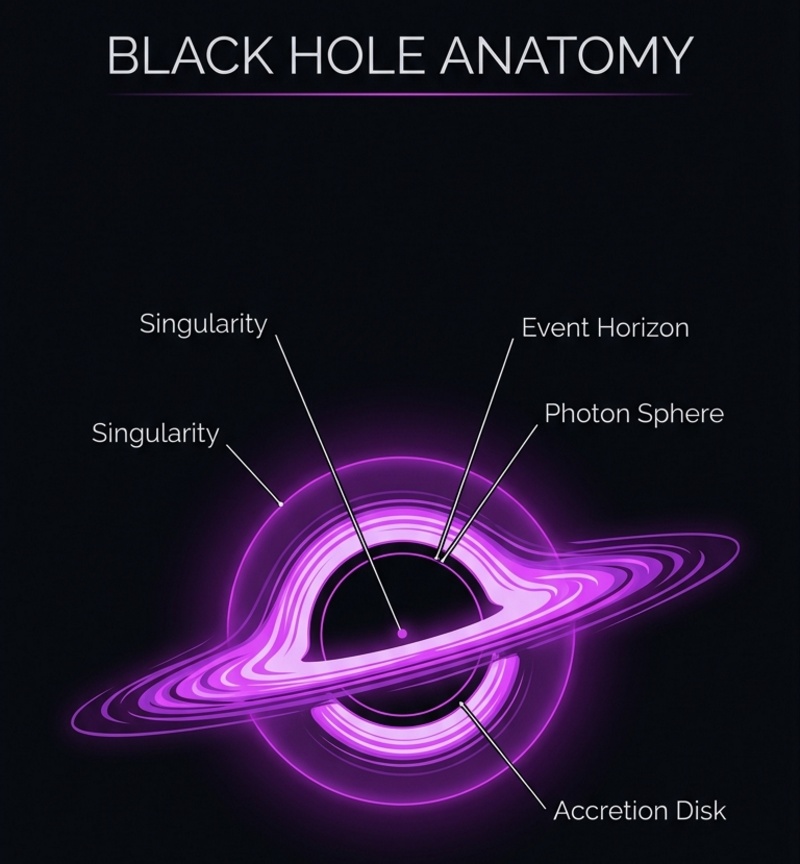
The visual asymmetry observed in the simulation disk is caused by relativistic Doppler beaming. Because the disk rotates at a significant fraction of the speed of light, matter on one side moves directly toward the observer, while matter on the opposite side recedes. This extreme velocity alters the perceived brightness and frequency of the emitted radiation. The side moving toward the watcher undergoes blueshift and appears intensely bright; the side moving away suffers redshift and undergoes severe dimming. This distinct visual signature was famously confirmed by the first direct images of the galaxy Messier 87.
Relativistic Phenomena by Proximity Zone
The physical behavior of matter changes dramatically depending on its distance from the central mass. The table below outlines the structural milestones encountered when approaching a non-rotating singularity, measured in units of the Schwarzschild radius.
| Distance Zone | Designation | Primary Observed Phenomenon |
|---|---|---|
| Greater than 6 Rs | Stable Orbit Zone | Matter orbits in predictable, stable circular paths similar to planetary motion. |
| Exactly 3 Rs | Innermost Stable Circular Orbit | The final boundary where material can maintain a circular path without falling inward. |
| Exactly 1.5 Rs | The Photon Sphere | Gravity is strong enough to force light photons into unstable circular orbits around the mass. |
| Exactly 1.0 Rs | The Event Horizon | The absolute point of no return where the escape velocity exceeds the speed of light. |
Temporal Distortions and Relativistic Telemetry
One of the most mind-bending aspects of general relativity is that gravity directly affects the rate at which time passes. According to the laws of gravitational time dilation, a clock positioned close to a massive object will tick significantly slower than a clock located far away in empty space. The exact mathematical ratio governing this temporal distortion is written as follows:
To = Tf × √(1 − Rs / r)
In this equation, To represents the time interval recorded by a local observer near the mass, Tf represents the coordinate time registered by a distant watcher, and r denotes the current radial distance from the center of the singularity. As the distance r approaches the Schwarzschild radius, the value inside the square root approaches zero, meaning that from the perspective of an outside observer, time for an incoming object appears to stop completely.
Astrophysical Parameters of Confirmed Cosmic Singularities
To ground the simulation constants in real-world observations, it is useful to examine the actual metrics of famous celestial bodies discovered by modern astronomers. The following data presents the estimated mass and calculated horizons for three well-studied objects.
| Object Identity | Estimated Mass | Calculated Schwarzschild Radius |
|---|---|---|
| Cygnus X-1 | 21 Solar Masses | Approximately 62 kilometers |
| Sagittarius A* | 4.1 Million Solar Masses | Approximately 12 million kilometers |
| Messier 87* | 6.5 Billion Solar Masses | Approximately 19 billion kilometers |
Tidal Forces and the Mechanics of Destruction
🌑 When an extended object like a planet or an asteroid approaches a singularity, it experiences massive gravitational differentials across its structure. The side of the object closer to the center is pulled with significantly more force than the side facing away. These differential forces are known as tidal forces, and they tend to stretch objects along the axis of acceleration while compressing them laterally.
The boundary where these tidal forces overcome the internal cohesive gravity of an approaching body is called the Roche limit. If a planet crosses this threshold, it undergoes catastrophic structural failure and shatters into fragments. The mathematical approximation for the fluid Roche limit is expressed through the following equation:
d = 2.44 × Rm × (MBH / Mm)1/3
Within this framework, d represents the critical disruption distance, Rm is the radius of the approaching body, MBH signifies the mass of the singularity, and Mm indicates the mass of the planet. In the simulation, activating the planet mode demonstrates this sequence. The planet orbits safely until it breaches this gravitational threshold, at which point the material stretches, heats up, and dissolves into a bright ring of incandescent debris, showcasing the process of spaghettification.
Simulation Constants and Computational Architecture
To run complex mathematical models smoothly inside a standard web browser, the simulation translates physical constants into normalized computational units. The table below outlines how these values align within the rendering framework.
| Engine Constant | Value in Simulation | Physical Translation |
|---|---|---|
| Normalized Speed of Light | 1.0 | Sets the base velocity for photon step calculations across the vertex grid. |
| Minimum Step Distance | 0.03 | Controls the rendering precision close to the event horizon boundary. |
| Escape Distance Boundary | 40.0 | The distance at which a ray is considered free from significant gravitational bending. |
Recommended Literature for Advanced Study
- Gravitation — Written by Charles W. Misner, Kip S. Thorne, and John Archibald Wheeler. This monumental textbook provides the absolute definitive academic foundation for general relativity and spacetime geometry.
- Black Holes and Time Warps: Einstein’s Outrageous Legacy — Written by Kip S. Thorne. An accessible yet deeply detailed exploration of the history and physics of singularities tailored for interested amateurs and scientists alike.
- General Relativity — Written by Robert M. Wald. A rigorous graduate-level text that explores the precise mathematical formulations of curved spacetime manifolds.
- The Future of Spacetime — Written by Stephen Hawking, Kip S. Thorne, Igor Novikov, Timothy Ferris, and Alan Lightman. A collection of essays discussing the extreme implications of gravitational physics and temporal mechanics.

Julian D. Thorne — Celestial Mechanics Developer
Researcher and 3D engine developer focused on interactive stellar systems. Julian bridges the gap between theoretical physics and real-time browser-based cosmos exploration.


