
Earth is surrounded by an ever-growing envelope of synthetic material, a tangible legacy of human space exploration spanning nearly seven decades. Millions of fragments cascade through various orbital regimes, posing a severe risk to operational satellites, scientific platforms, and crewed habitats. A real-time space debris simulator serves as a crucial bridge between abstract numerical datasets and practical visual understanding, turning millions of telemetry points into a coherent, dynamic environment. This comprehensive reference breakdown explores the core mechanics, engineering challenges, and mathematical frameworks that define modern space situational awareness.
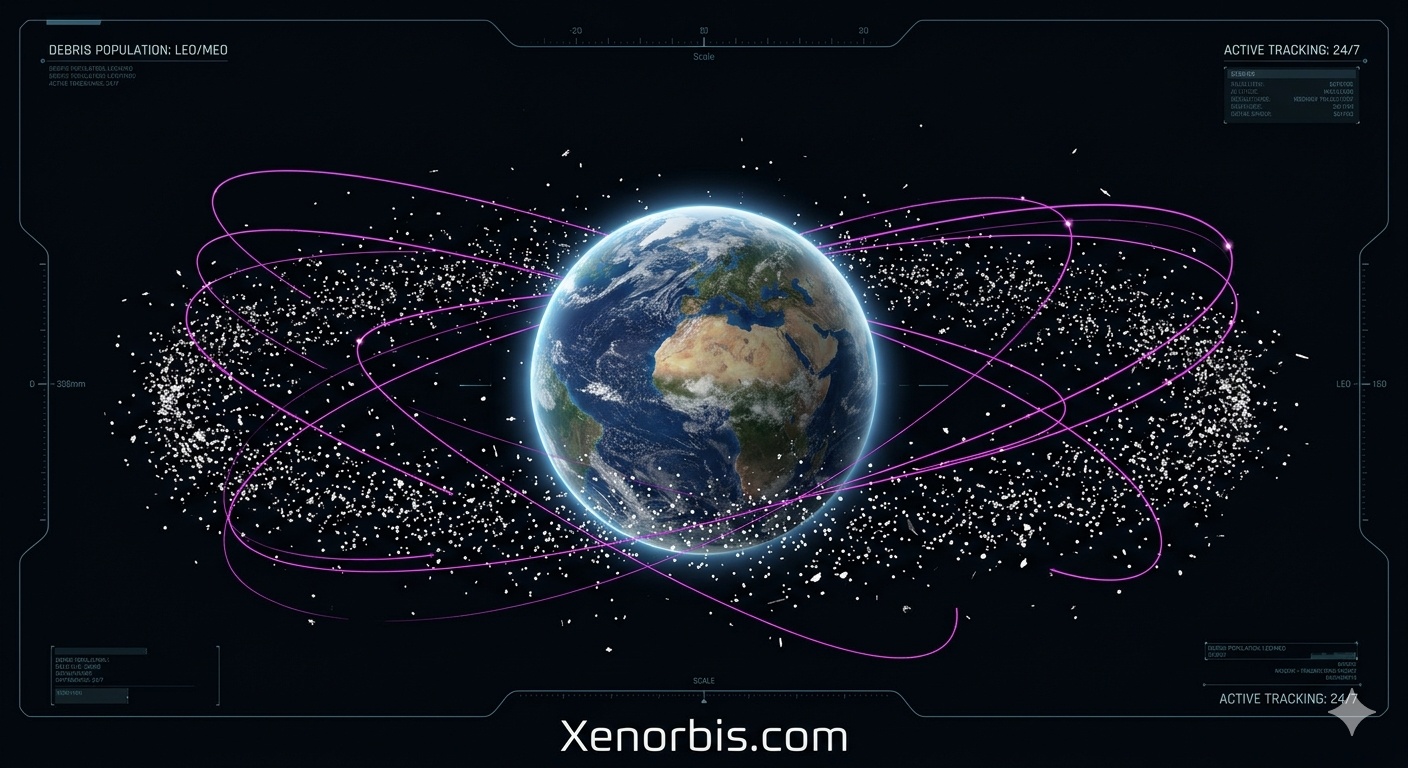
🚀 Visualizing this orbital junk is not merely about aesthetic representation. Spacecraft operators rely on precise models to map safe launch trajectories and execute complex avoidance maneuvers. When a piece of tracking hardware detects an uncooperative object, its vector path must be projected days into the future. A high-fidelity visual tool helps engineers instinctively grasp complex spatial distributions, such as the dense ring of hardware in geostationary paths or the chaotic swarm grid intersecting at the poles in low altitude zones.
Modern simulation platforms utilize accelerated GPU architectures to compute thousands of positions simultaneously. By integrating web-based graphics standards with standard astrodynamics algorithms, these tools bring professional orbital analysis straight to web browsers. This democratization of aerospace data allows researchers and enthusiasts alike to monitor the deteriorating health of our immediate cosmic neighborhood.
Contents
The Structural Hierarchy of Orbital Junk
To analyze the threat profile of space debris, specialists categorize objects based on their origin, dimension, and physical behavior. The vast majority of tracked elements do not consist of whole, dead satellites, but rather minute fragments resulting from historic collisions, upper stage explosions, and material degradation over decades of exposure to extreme solar radiation.
The primary threat categories are defined by whether an object can be tracked by ground-based assets. Objects larger than ten centimeters are cataloged continuously by planetary radar networks and optical sensors. Smaller particles, while impossible to monitor individually, are modeled statistically to predict their impact frequency on spacecraft shields.
Key Categories of Space Debris By Material Origin
- Defunct Spacecraft: Intact satellites that have depleted their fuel reserves, suffered terminal electronics failures, or reached the end of their operational lifespans without proper de-orbit execution.
- Spent Rocket Bodies: Massive upper stages left behind after payload deployment, often containing residual hypergolic propellants that run a high risk of spontaneous overpressurization and subsequent fragmentation.
- Mission-Related Debris: Items deliberately or accidentally released during extravehicular activities, including lens covers, structural clamps, toolkits, and payload separation hardware.
- Fragmentation Products: Microscopic shards produced by paint flecks peeling under thermal stress, solid rocket motor slag, and microscopic aluminum droplets resulting from hypervelocity impacts.
Understanding these classifications highlights the immense difficulty of clean-up operations. While a dead satellite can theoretically be targeted for active removal, capturing millions of millimeter-sized metal shards traveling at hypersonic velocities is beyond current engineering capabilities. Therefore, strict visual and statistical monitoring remains the primary line of defense.
Essential Reference Data for Space Situational Awareness
The following reference tables outline the physical realities of the orbital environment, focusing on particle size hazards, major historical fragmentation benchmarks, and the correlation between altitude zones and atmospheric cleansing effects.
Table 1: Space Debris Size Classification and Structural Hazard Profiles
| Size Dimension | Estimated Population | Tracking Capability | Typical Operational Impact Risk |
|---|---|---|---|
| Greater than 10 cm | 36 500 objects | Continuous by radar networks | Catastrophic breakup of target vessel |
| 1 cm to 10 cm | 1 000 000 objects | Statistical modeling only | Penetrates standard spacecraft shielding |
| 1 mm to 1 cm | 130 000 000 objects | Untrackable individually | Disables subsystems or solar arrays |
| Less than 1 mm | Trillions | Inferred from returned hardware | Surface erosion and sensor degradation |
The numbers listed above underscore the critical importance of predictive modeling. Even a tiny fragment measuring a few millimeters carries enough kinetic energy to compromise an astronaut’s spacesuit or rupture a high-pressure coolant line, making real-time velocity simulations a safety requirement for human spaceflight.
Table 2: Historical Orbital Fragmentation Benchmarks
| Event Identity | Calendar Year | Orbital Altitude Zone | Trackable Shards Generated |
|---|---|---|---|
| Fengyun-1C Destruction | 2007 | 865 km polar orbit | Over 3 500 cataloged pieces |
| Iridium 33 and Kosmos 2251 Collision | 2009 | 789 km intersection | Over 2 300 cataloged pieces |
| Kosmos 1408 Fragmentation | 2021 | 480 km low orbit | Over 1 500 trackable fragments |
| Resurs-P No.1 Breakup | 2024 | 350 km low orbit | Over 250 localized shards |
Each milestone listed in Table 2 dramatically altered the debris density maps across low Earth orbits. Shards from high-altitude events remain aloft for centuries, continuously crossing paths with newer commercial constellations and expanding the hazard profile of previously safe operational corridors.
Table 3: Altitude Zones and Environmental Decay Properties
| Altitude Region | Atmospheric Density Level | Average Clean-up Lifetime | Primary Debris Dynamic |
|---|---|---|---|
| Below 400 km | Highly significant residual drag | Days to several months | Rapid natural reentry and burnup |
| 400 km to 600 km | Moderate residual trace gases | Few years to several decades | Drag competes with solar storm swells |
| 600 km to 1000 km | Negligible atmosphere | Centuries to millennia | High-density collision hotspot zone |
| Above 1000 km | Complete hard vacuum void | Indefinite storage timeline | Permanent hazard for future assets |
Mathematical Foundations of Orbital Mechanics
To accurately render spacecraft and junk trajectories within a simulator, the underlying engine must continuously execute classical Keplerian laws and perturbation physics formulas. Below are the fundamental mathematical relationships utilized in real-world space surveillance calculations to determine orbital characteristics, velocity values, and impact mechanics.
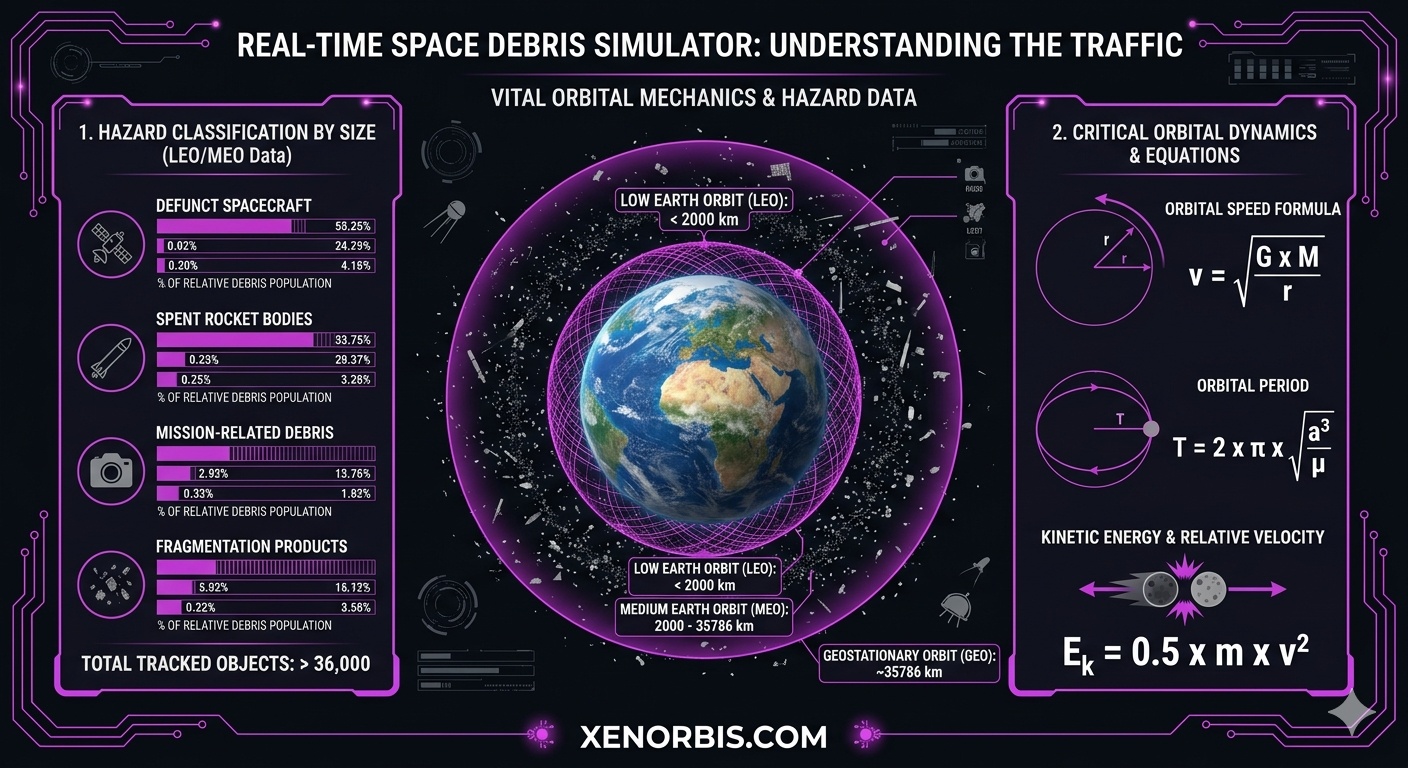
The foundational metric is the circular orbital speed formula, which dictates the required velocity an object must maintain to counter planetary gravitational acceleration at a specific distance from Earth’s center of mass:
v = √(G x M / r)
Within this relationship, v represents the orbital velocity value, G denotes the universal gravitational constant, M signifies the mass of Earth, and r is the scalar radius extending from the planetary center to the satellite position. This demonstrates why low-altitude objects travel much faster than distant hardware, magnifying the structural impact energy during unexpected orbital crossings.
When computing how long an item takes to complete a single full trip around the globe, developers implement a variation of Kepler’s Third Law to establish the orbital period:
T = 2 x π x √(a3 / μ)
Here, T defines the orbital period in seconds, a represents the semi-major axis of the elliptical path, and μ is the standard gravitational parameter of the primary planet, equal to the product of G and M. This calculation ensures that a simulator places objects at the exact point along their track relative to elapsed application time.
The destructive potential of an accidental intersection depends entirely on kinetic energy formulas. Due to hypervelocity physics, even lightweight items possess immense destructive capability, calculated as follows:
Ek = 0.5 x m x v2
In this dynamic, Esub>k represents the total kinetic energy value in Joules, m is the physical mass of the debris item in kilograms, and v is the relative closing velocity at the moment of structural contact. Because the velocity term is squared, doubling the impact speed quadruples the resulting explosive force, which explains why an ordinary aluminum bolt traveling at fifteen kilometers per second can obliterate a multi-ton weather station.
Finally, predicting collision likelihood over a specific operational timeframe involves calculating the probability flux density using simplified Poisson distributions:
P = F x A x Δt
Within this linear risk assessment approximation, P represents the localized probability value of an impact event occurring, F defines the debris flux density in particles per square meter per year, A is the total cross-sectional area of the threatened satellite hull, and Δt signifies the specific duration exposure window. If this value climbs above established tolerance limits, automated flight computers trigger thruster adjustments to steer the platform clear of danger.
The Physics of Hypervelocity Impacts
Collisions in orbit do not resemble highway accidents. Due to extreme speeds, the material properties of metals change drastically upon contact. When two objects collide at relative speeds exceeding several kilometers per second, the localized pressures far exceed the structural yield strength of the constituent alloys.
🌠 Upon impact, both the striking fragment and the target hull material behave like compressed fluids. The intense kinetic energy instantly vaporizes part of the structure, creating an expanding plasma plume. Simultaneously, an intense shockwave ripples through the interior framework of the spacecraft, flaking off lethal shards from the internal walls—a process known as spallation—which can destroy delicate electronics even if the main projectile fails to pierce the hull entirely.
This explosive vaporization explains why shielding design relies heavily on sacrificial barriers. Whipple shields use a thin outer bumper spaced a few centimeters away from the main wall. When a particle hits this first layer, it shatters and vaporizes, spreading its energy over a wider area before the gaseous debris cloud reaches the inner hull, protecting the vital instruments inside.
The Kessler Syndrome: Chain Reactions in Flight
The greatest long-term danger of orbital pollution is a cascading chain reaction known as the Kessler Syndrome. This theoretical scenario, proposed by scientist Donald Kessler, describes an environment where the density of objects is high enough that a single collision generates thousands of new shards, which then go on to strike other satellites, triggering an uncontrollable cascade of fragmentation events.
☄ If this threshold is crossed, certain orbital paths could become completely unusable for generations. Even if we stopped launching rockets immediately, the existing population of dead satellites would continue smashing into one another, steadily increasing the total number of lethal fragments. This creates an invisible barrier around the planet, limiting our ability to deploy future communication, weather, or scientific instruments safely.
A real-time simulator provides a vivid look at this impending threat. By simulating multi-generational cascade events, these digital tools help policymakers visualize how localized incidents can spiral out of control, highlighting the urgent need for international space traffic control frameworks and proactive debris removal technologies.
Modern Mitigation Strategies and Space Law
Addressing the orbital debris crisis requires a combination of strict engineering standards and binding legal policies. Spacefaring nations now design hardware with disposal rules in mind, aiming to prevent the generation of new orbital waste before a rocket even leaves the pad.
Key Pillars of Modern Waste Prevention Protocols
- Passivation of Propulsion Systems: Venting remaining fuel reserves and discharging onboard batteries at the end of a mission to prevent catastrophic internal explosions.
- The 25-Year Disposal Rule: An international guideline requiring satellite operators to lower their spacecraft’s altitude so that atmospheric drag naturally pulls it down to burn up within twenty-five years of decommissioning.
- Graveyard Orbit Relocation: Boosting high-altitude geostationary satellites into a high-clearance storage orbit well above active telecommunication channels.
- Active Debris Removal Technology: Developing experimental retrieval vessels equipped with robotic arms, magnetic harpoons, or net capture systems to physically de-orbit massive dead objects.
Enforcing these rules remains a complex legal challenge. Space law operates under historical treaties stating that a nation retains permanent ownership and liability for its registered space objects. This means capturing a drifting upper stage owned by another country without explicit permission could be viewed as a hostile act or an international treaty violation, highlighting the need for deep diplomatic cooperation alongside engineering breakthroughs.
Essential Literature for Orbital Engineers
For researchers, students, and software developers looking to build accurate orbital engines or dive deeper into the physics of space situational awareness, the following texts offer invaluable professional insights and mathematical frameworks.
- Orbital Debris: A Technical Assessment — National Research Council, National Academies Press, 1995. A foundational scientific text examining early tracking capabilities and modeling methods.
- Space Debris: Hazard Evaluation and Mitigation — Nickolay Smirnov, Taylor and Francis Group, 2002. A deep engineering analysis focused on hypervelocity physics and structural shielding designs.
- Fundamentals of Astrodynamics — Roger Bate, Donald Mueller, and Jerry White, Dover Publications, 2020. An essential textbook for coding simulation engines, providing clear breakdowns of Keplerian two-body problems and coordinate system transformations.
- Analytical Mechanics of Space Systems — Hanspeter Schaub and John Junkins, American Institute of Aeronautics and Astronautics, 2018. Advanced material detailing precise perturbation tracking, solar pressure forces, and orbital stabilization algorithms.
- Space Traffic Management: Navigating the Orbital Commons — Mark Sundahl and Ram Jakhu, Routledge, 2023. An exploration of the legal frameworks, policy challenges, and international treaties governing modern space safety.

Julian D. Thorne — Celestial Mechanics Developer
Researcher and 3D engine developer focused on interactive stellar systems. Julian bridges the gap between theoretical physics and real-time browser-based cosmos exploration.


