
Looking up at a clear night sky is an experience that transcends time. For 1000 years humanity has relied on the stars for navigation, timekeeping, and storytelling. The glowing dots scattered across the dark canopy inspired the earliest myths, guided ancient mariners across uncharted oceans, and laid the absolute foundation for modern astronomy. Stargazing is a profoundly rewarding pursuit. When you gaze at the distant stars, you are literally looking back in time. The light from distant suns takes years — sometimes 100s or 1000s of years — to reach our eyes. By understanding the patterns in the sky, commonly known as constellations, anyone can unlock the magnificent secrets of the cosmos.
Before the invention of telescopes and modern astronomical instruments, early civilizations connected the brightest stars to form imaginary outlines of gods, mythical beasts, and legendary heroes. The ancient Babylonians and Egyptians created some of the absolute earliest star catalogs known to human history. Later on, the influential Greek astronomer Ptolemy cataloged 48 specific constellations in his monumental astronomical treatise around the year 150. Fast forward to the year 1922, the International Astronomical Union officially divided the celestial sphere into exactly 88 distinct constellations. This modern and highly precise mapping ensures that every single point in the sky belongs to a specific celestial region, functioning very much like state borders on a geographical map.
Contents
Understanding the Mechanics of the Celestial Sphere
To navigate the stars with precision, astronomers use the foundational concept of the celestial sphere. Imagine a giant, invisible globe perfectly surrounding the Earth. The stars are fixed upon the inner surface of this massive sphere. As the Earth rotates on its axis every 24 hours, the entire sky appears to turn, causing most stars to rise in the east and set in the west. The celestial poles are direct outward extensions of the North and South poles of our Earth. The celestial equator perfectly divides the sky into northern and southern hemispheres.
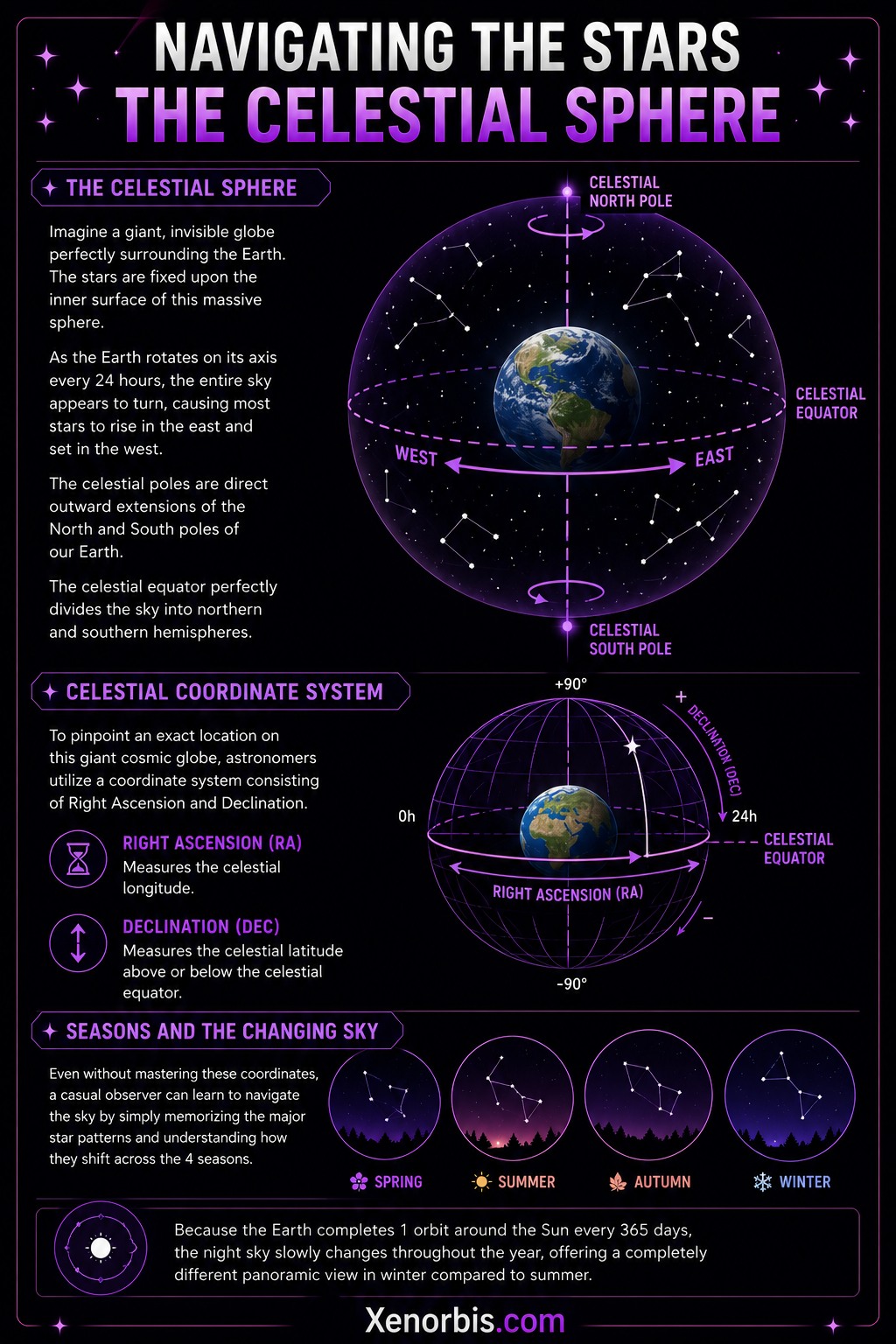
To pinpoint an exact location on this giant cosmic globe, astronomers utilize a coordinate system consisting of Right Ascension and Declination. Right Ascension effectively measures the celestial longitude, while Declination accurately measures the celestial latitude above or below the celestial equator. Even without mastering these coordinates, a casual observer can learn to navigate the sky by simply memorizing the major star patterns and understanding how they shift across the 4 seasons. Because the Earth completes 1 orbit around the Sun every 365 days, the night sky slowly changes throughout the year, offering a completely different panoramic view in winter compared to summer.
The Magnificent Northern Hemisphere Sky
🌟 In the northern sky, Ursa Major — the Great Bear — easily dominates the high latitudes. It contains the incredibly famous asterism known universally as the Big Dipper. The 7 exceptionally bright stars of the Big Dipper perfectly form the shape of a deep bowl with a long handle. The 2 outermost stars of the bowl, named Dubhe and Merak, act as highly reliable cosmic pointers. If you draw an imaginary line directly through them and extend it outward by exactly 5 times their visible distance, you will land flawlessly on Polaris, the universally known North Star.
Polaris acts as the central anchor of the northern sky, sitting almost exactly at the true north celestial pole. Unlike virtually all other stars, it remains virtually stationary while the entire sky slowly revolves around it. This single characteristic made Polaris the absolute most important star for ancient northern hemisphere navigators. Right next to the Great Bear sits Ursa Minor, the Little Bear, with Polaris marking the very tip of its tail. Looking across the pole from the Big Dipper, observers will easily spot Cassiopeia, a bright group of stars shaped exactly like the letter W or M depending on the season and time of night. Cassiopeia represents a boastful queen from Greek mythology, forever chained to her throne in the heavens.
| Northern Constellation | Brightest Star | Primary Mythological Figure |
|---|---|---|
| Ursa Major | Alioth | The Great Bear |
| Cassiopeia | Schedar | The Vain Queen |
| Cygnus | Deneb | The Celestial Swan |
| Lyra | Vega | The Magical Harp |
| Perseus | Mirfak | The Greek Hero |
The Legends of the Autumn Sky
The autumn sky in the northern hemisphere is completely dominated by the massive Royal Family of constellations. This interconnected group includes Cepheus the King, Cassiopeia the Queen, Andromeda their daughter, and Perseus the hero. According to the ancient legend, the queen boasted that her daughter was far more beautiful than the sea nymphs. This greatly angered the god of the sea, who subsequently sent a monstrous sea creature, represented by the constellation Cetus, to violently ravage the coast. To save their kingdom, the desperate parents chained Andromeda to a massive rock as a sacrifice.
Just in time, Perseus flew past on his winged horse, represented by the adjacent constellation Pegasus. Perseus used the severed head of Medusa to turn the sea monster to solid stone, rescuing the princess. All of these legendary characters were then placed directly into the night sky to forever immortalize their dramatic story. Within the borders of the Andromeda constellation lies the magnificent Andromeda Galaxy. Located approximately 2 million light-years away from our solar system, it is the absolute farthest object that the naked human eye can see without any optical aid. Under extremely dark skies, it appears as a faint, glowing smudge of distant starlight.
The Zodiacal Band: The Path of the Sun
The zodiac essentially represents the specific band of constellations that lie directly along the ecliptic — the apparent annual path of the Sun across our sky. There are exactly 12 traditional constellations in this critical celestial belt: Aries, Taurus, Gemini, Cancer, Leo, Virgo, Libra, Scorpius, Sagittarius, Capricornus, Aquarius, and Pisces. Historically, ancient astrologers placed massive cultural significance on these particular signs. Astronomically speaking, they form an absolutely crucial reference band for accurately tracking the movement of planets and the Moon.
Leo the Lion, as a prime example, contains the brilliant blue-white star Regulus and is easily identified by a distinct sickle-shaped pattern of stars forming the head and mane. Scorpius truly resembles a giant scorpion, complete with a long curving tail and the fiery red supergiant star Antares marking its beating heart. Taurus the Bull fiercely guards the winter sky, highlighted by the glowing red eye Aldebaran and the dazzling star cluster known widely as the Pleiades. The Pleiades cluster features 7 bright stars that are physically bound together by mutual gravity, drifting through space as an incredible stellar family.
| Zodiac Constellation | Optimal Viewing Season | Notable Deep Sky Object |
|---|---|---|
| Taurus | Winter | The Pleiades Cluster |
| Leo | Spring | The Leo Triplet Galaxies |
| Scorpius | Summer | The Butterfly Nebula |
| Sagittarius | Summer | The Lagoon Nebula |
| Orion | Winter | The Great Orion Nebula |
The Wonders of the Southern Hemisphere Sky
For observers situated in the southern hemisphere, the night sky completely transforms into an entirely different theater of wonders. The constellation Crux, universally known as the Southern Cross, holds immense navigational importance. Despite being literally the smallest of all 88 official constellations, its stars are incredibly bright. The longer axis of the brilliant cross points almost directly toward the south celestial pole. This highly reliable feature made Crux an absolutely invaluable tool for early explorers navigating the vast, featureless oceans of the southern hemisphere.
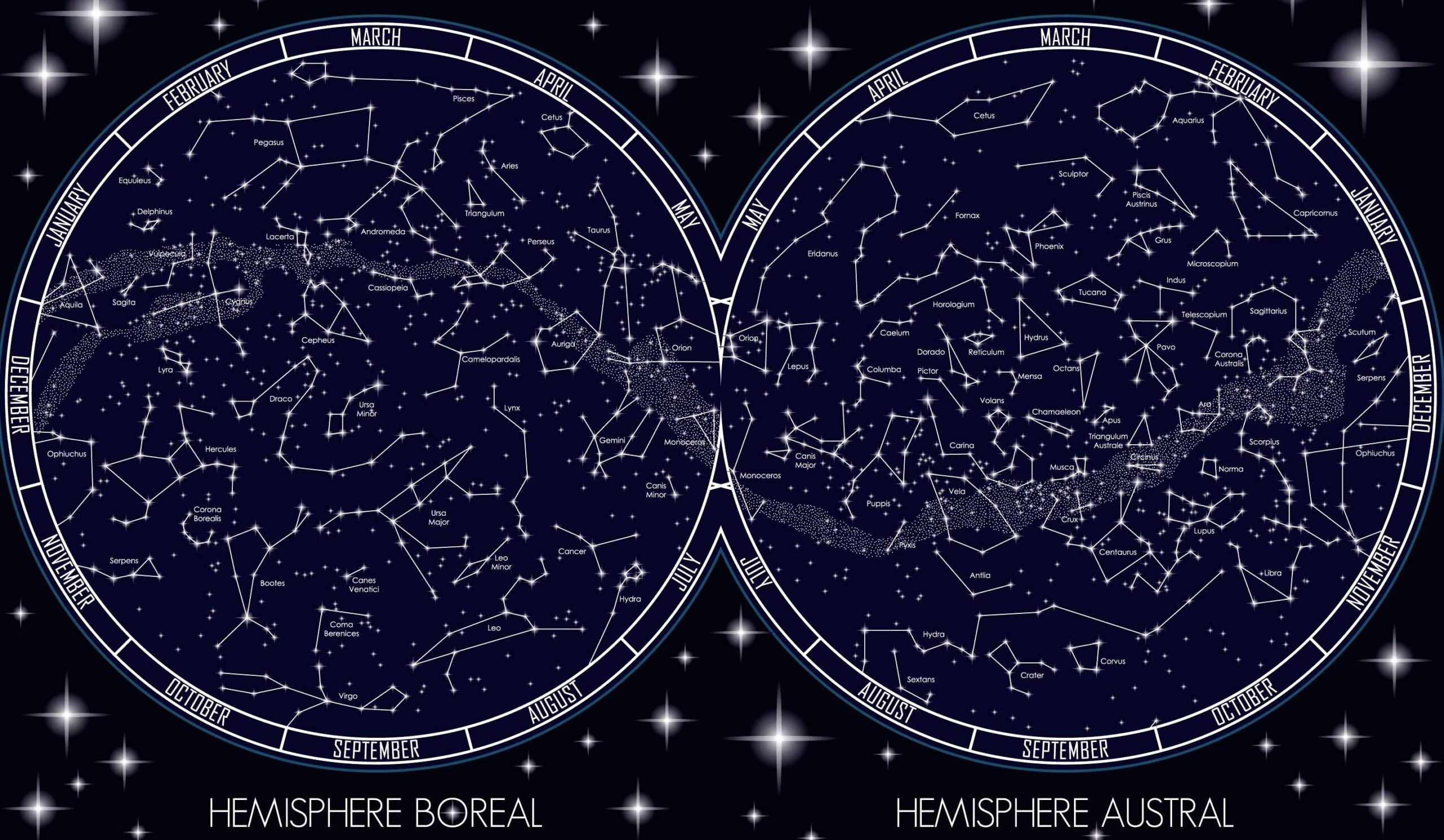
Right next to the Southern Cross lies the massive constellation Centaurus. This sprawling group contains Alpha Centauri, a complex triple star system that currently holds the absolute record as the closest star system to our own Sun, located just slightly more than 4 light-years away. Also dominating the southern skies is the massive constellation Carina, which originally formed the keel of a giant mythological ship known as Argo Navis. Carina houses Canopus, the incredibly bright supergiant star that firmly ranks as the 2nd brightest star in the entire night sky, completely outshone only by Sirius.
Deep Sky Objects Hidden Among the Constellations
🌌 While the distinct lines connecting the brightest stars form the familiar shapes we all recognize, the true treasures of the night sky lie hidden deep within the borders of these constellations. These incredibly fascinating targets are known collectively as deep sky objects. They include vast stellar nurseries, ancient globular clusters containing 1000s of densely packed stars, planetary nebulae representing the explosive death throes of dying suns, and entirely separate galaxies located millions of light-years away from our own Milky Way.
Orion the Hunter is undoubtedly the most magnificent winter constellation worldwide. Positioned perfectly on the celestial equator, it remains highly visible from almost every single inhabited region on Earth. The constellation prominently features the universally famous Orion Belt, a perfectly straight line of 3 brilliant stars. Right below this belt shines the Great Orion Nebula. To the naked eye, it looks like a slightly fuzzy star, but it is actually a massive glowing cloud of interstellar gas and dust where entirely new solar systems are currently being violently born.
| Deep Sky Object | Parent Constellation | Object Classification |
|---|---|---|
| Orion Nebula | Orion | Diffuse Emission Nebula |
| Andromeda Galaxy | Andromeda | Spiral Galaxy |
| Ring Nebula | Lyra | Planetary Nebula |
| Omega Centauri | Centaurus | Globular Star Cluster |
| Hercules Cluster | Hercules | Globular Star Cluster |
The Life Cycles of the Stars Above
Every single star you observe within a constellation is currently experiencing a specific phase in its incredibly long life cycle. Stars are fundamentally born inside massive clouds of extremely cold molecular hydrogen gas. Gravity slowly pulls this gas together until the core becomes hot enough to ignite nuclear fusion. For most of their very long lives, stars remain in a stable phase completely balancing the crushing inward force of gravity with the explosive outward pressure generated by nuclear fusion at their core.
Eventually, the primary hydrogen fuel supply runs out. A medium-sized star like our Sun will spectacularly expand into a massive red giant, perfectly swallowing any inner planets, before eventually shedding its outer layers to form a beautiful planetary nebula. The incredibly dense remaining core is known as a white dwarf. However, stars that are at least 8 times more massive than our Sun face a much more violent destiny. When they exhaust their nuclear fuel, the core suddenly collapses in a fraction of a second, resulting in an unimaginably powerful supernova explosion. The incredibly bright remnant of this violent event becomes either a super-dense neutron star or a mysterious black hole.
We can clearly see examples of these various life stages simply by looking at the constellation Orion. The bright star Betelgeuse is a massive red supergiant nearing the final explosive end of its life cycle. It is so incredibly large that if it were placed exactly at the center of our solar system, its boiling surface would extend far past the massive orbit of Jupiter. Meanwhile, the brilliantly blue star Rigel, located at the opposite foot of the hunter, represents an incredibly hot and young supergiant burning through its fuel at a terrifyingly fast rate.
Tools and Techniques for the Modern Observer
While exploring the sky with the naked eye is a profoundly wonderful experience, utilizing basic optical tools can absolutely revolutionize your personal view of the cosmos. A simple pair of 10×50 binoculars provides an incredibly wide field of view, making them absolutely perfect for scanning the Milky Way, observing large open star clusters like the Pleiades, or watching the moons of Jupiter change positions every single night. Binoculars gather significantly more light than the human eye, suddenly revealing 1000s of faint background stars completely invisible to the unaided eye.
🔭 To maximize your stargazing experience, it is absolutely essential to seek out the darkest possible skies. Modern light pollution from expanding cities severely washes out the faint glow of the Milky Way and hides the vast majority of dim stars. Always allow your eyes at least 30 minutes to completely adapt to the dark environment. During this crucial time, strictly avoid looking at your incredibly bright smartphone screen or any white flashlights. If you must use a light to read a star chart, always use a dedicated red flashlight, as red light completely bypasses your night vision receptors.
Learning the constellations requires patience and absolutely consistent observation. The sky looks slightly different every single hour as the Earth steadily rotates. Start by confidently identifying a massive, unmistakable pattern like the Big Dipper or Orion, and then slowly use those known stars to “star-hop” your way to smaller, fainter constellations nearby. Over a few months of dedicated observing, the previously confusing scatter of glowing dots will quickly become a highly familiar, warmly welcoming map of old friends returning to the sky exactly on schedule.
Recommended Reading List
- The Stars: A New Way to See Them by H. A. Rey
- NightWatch: A Practical Guide to Viewing the Universe by Terence Dickinson
- Turn Left at Orion: Hundreds of Night Sky Objects to See by Guy Consolmagno
- The Backyard Astronomers Guide by Terence Dickinson and Alan Dyer
- Constellations: The Story of Space Told Through the 88 Known Star Patterns by Govert Schilling

Julian D. Thorne — Celestial Mechanics Developer
Researcher and 3D engine developer focused on interactive stellar systems. Julian bridges the gap between theoretical physics and real-time browser-based cosmos exploration.


